Web Analytics RiceHigh's Pentax Blog: Search results for My NEX
Showing posts sorted by relevance for query My NEX. Sort by date Show all posts

Friday, October 08, 2010

Sony A33 Brief Hands-on Impressions (w/ ISO Comparison: 100-12800)

Last week I played with my friend's new Sony A33 when he purchased it. (I recommended the camera to him as he is a novice and I do believe that the A33 is the DSLR that has the best price-to-performance+features ratio currently in the market!) Below are some of my initial observations and impressions for my brief hands-on:-

1. The body is really small for a DSLR and is also lightweight (as a result).

2. The AF is fast with Live View, which is actually the only viewing mode it has anyway, and just because it is actually Phase Matching AF instead of Contrast Detection AF (CDAF).

3. Unlike the NEX, it seems that the Live View is not by the imager/sensor, but by the separate sensor in the viewfinder, which relates the same Live View image back to the LCD monitor even if it is used. I can feel that there is a subtle difference in shutter lag so I suspect the LV principle is different. (Or owing to the processing speed, no quite sure here anyway.)

4. The EVF has a large image magnification, I did feel that the displayed image was evener larger than my Full Frame DSLR's OVF! So, I have just revisited the specs page of the A55 to verify this. The A33/55 has a magnification of 1.1X as stated. So, presuming that it is the magnification at 50mm (as it is not mentioned anyway) and the figure should be divided by the crop factor of 1.5, the magnification of the EVF of the A33 is still 0.73X, which is yet larger than that of most of the Canon and Nikon FF DSLRs!

5. The resolution of the EVF is okay, or I would say yet a little bit coarse indeed.

6. The EVF and LCD LV preview has limited DR (Dynamic Range), though. Although the display is bright, the highlights are blown out easily and little details can be seen.

7. The continuous shooting mode is usable, against what DPR commented. The "blackout" of LV image occurs at the time of exposure, but no in-between. As such, framing is still possible, as the blackout is not complete, although the finder image that can be seens is not continuous.

8. Same as the NEX, the 7 frames per second mode is really nice and it works flawlessly. I used not to need any continuous shooting mode in the past with my previous DSLRs (and back to the age of using Pentax film AFSLRs, I even never used it!), but now my shooting habit has been changed since I acquired my NEX!

9. There is no mirror vibration (since the mirror is just fixed), the difference is very noticeable! The only sound I could hear after pressing the shutter release is the mechanical sound of the shutter action. And well, it is exactly the sound that I always hear with my NEX, which is very "crispy", so I am almost certain that the A33 and NEX just uses the same shutter!

10. The kit lens Sony SAL 18-55 is cheaply built, it is the worst plastic toy kit lens with the cheapest outer shell and design I have ever seen and tried (which even worse than the Pentax DAL 18-55 which I already dislike). I am not impressed with the QC of it neither at Sony's Thailand factory. Just say the starting and end position of the zoom at 18 and 55mm (against where it is marked) are usually mis-aligned significantly. The zooming action is not considered to be smoother enough, too. My NEX SEL seems better (although there is yet the mis-alignment issue - when I purchased my NEX, I choose the best lens amongst three!).

11. Now, it comes to the ISO performance and image quality of the lens and camera. The following shots were made indoor under white fluorescent light. All with the kit lens at f/8 and at 55mm at factory default settings, EXIF preserved:-

ISO 100
200
400
800


1600
3200
6400
12800


My brief observations and comments is that noise are well controlled up to ISO 3200, which I consider to be yet usable. The interesting thing is that noise level is actually increased very linearly per ISO step and increment for ISO speeds from 100 to 3200. As for ISO 6400 and 12800, noise level suddenly jumps up and image colours are changed. It seems that the upper usable ISO limit of this camera is just 3200.

The IQ of the kit lens is not that bad when stopped down one stop to f/8, the camera retains good colours and details, as you can see from my samples.

The A33 reproduces acceptable skin tone at that indoor environment with white artificial light, which seems to be better than my NEX under that condition. If it is just better, then I would scratch my head hard as the NEX is a true P&S design for its Live View principle (and thus the AWB determination) whilst the A33/55 is not, but still the A33/55 is yet better?? In fact, the AWB of the K-x is still the best, which I think I must mention. Furthermore, the K-x user has the choice in the Custom Function that to choose if a "whiter" or a "yellower" AWB under tungsten would be desired, which is again a nice and unique option outhere!


Related:-

My NEX Sample Photos Gallery (36 Original Images Available)

My Ten Reasons to Buy the NEX-3 Over the NEX-5! :-)

NEX-3 Vs K-x Full ISO Shootout (Controlled Test)

Sony NEX-5 VS Pentax K-x ISO/IQ Shootout (Dual Scenes)

Sony NEX-5 and NEX-3 Hands-on Impressions / Quick Review

Saturday, July 31, 2010

If Size Really Matters, What's the Meaning of Micro-4/3 Now?


My NEX is actually smaller than my Girl Friend.. Some people claim that the NEX standard kit lens is much larger. But actually, as you can see from the above, it is just similar in size (and weight as well, actually). And then some Oly guys say that the Oly 14-42mm E-PL kit lens is much smaller. Yes, but it is just retracted when it is needed to be small and the lens must be unretracted before it can be used for shooting!

I think I shall not use my Girl Friend anymore, unless I have no other camera in hands. The noise performance of my GF at ISO 400 is not much better than that of my NEX at ISO 1600, not even to mention that the NEX has slightly higher effective resolution. If I just need the 2X crop, I do believe that better results can always be obtained by cropping. Slightly crop the 1.5X pictures to get the 2X is not difficult. And, if I just adapt the same lens (say, a Pentax one), I get no extra resolution at all for what the lens could give me.

Besides, I don't like the colour response of the GF neither, so does not with my NEX anyway (which I find it to be somehow more acceptable). If I put my Pentax primes on the GF, the colour response of the pics are better, but still the results are not very good. In fact, I like the colour response of my Pentax combos most, and then followed by my 5D with L lenses. The NEX comes next and the last is the Pana.

Furthermore, the noise handling and noise structure of the NEX is the most mature, the K-x is not better but the GF is worst. When the GF pics are pixel peeped and viewed in pixel level, it is not difficult to see those P&S like noise reduction and sharpening, even at the ISO 100! Too bad..

So, after all, that's what I think and here comes my question: What's the meaning/value of the micro-4/3 system now if the current Sony IDLCs (and also the Samsung NX EVILs), both of which are with APS-C sized sensors, are made just as small and the size/weight differences are almost negligible??

With similar or just the same functionality (say, including the video capability), IQ wise the APS-C should do better. The video recording functions of the NEX and the GF are similar, say, for the continuous AF tracking and its speed and smoothness. But the NEX' recorded videos are obviously less noisy than the GF, especially when the videos are taken indoor. The NEX in fact wins all micro-4/3 ILDCs hands down as long as noise performance is concerned, no matter for still pictures and videos, and with a slightly higher resolution and output, too. The NX10 could and should do better, but unfortunately Samsung has been unable to do it better. Why? In fact, the NX10 cannot out-perform much its micro-4/3 competitors and the video function is weak, e.g., there is no usable continuous AF under movie mode. And, the higher ISO noise/details are not better than the Panas and Olys, I would say one stop advantage at most, from my own practical experiences and measurbations on others' samples.


Next, above is the comparison picture I took and posted last time, for my red NEX against my red Casio card-size Exlim S10 P&S (which is my baseline DC which is just better than the cameraphone). You can see the body of the NEX is actually made quite compact. If the "large" APS-C sensor and size is considered, the camera body is indeed very small and it is truly compact!


So, how about to compare the NEX with the traditional APS-C DSLRs. The K-x is one of those smallest DSLRs here. But the difference in size (and weight also) is obvious. In particular, the K-x is much thicker, so does when it is compared against the smaller MZ DSLRs of Pentax back to the old film days.


Well, how about the difference to the Full Frame DSLRs then. From the above photo, I think I need not to say anything more. Well, the lens attached is that smallest and lightest EF lens already, i.e., the cheapo EF 50/1.8II. Canon, why you just can't make smaller lenses of yours?? :-( And, you never made any pancake? :-o


Read Also:-


Sony NEX-5 and NEX-3 Hands-on Impressions / Quick Review

Can Pentax DSLRs be Made Thinner?

Samsung NX10 Second Impressions and ISO Check

NX10 Brief Hands-on Impressions

My K-Mount EVIL is Here!

When Girl Friend Meets Wives! ;-D

Summary Matrix for Equipment Tests and Reviews

Wednesday, November 24, 2010

ISO Craziness - Case of the Latest NEX Firmware and Options

Sony previously a new firmware version 03 for their NEX for improving usability and for direct selection of major camera settings which are yet customisable. For details, read DPR's previous article below:-

http://www.dpreview.com/news/1010/10101104sonyfirmwareimpressions.asp

Going down the article, there are the suggested settings for their preferred choices. The DPR guys chose the (change of) ISO as the most important setting, and they programmed it to the central button, together with two "less important" (but still somehow important) functions that they think. The remaining soft button can be programmed for another (single) function, they chose the "MF Assist".

Although there are always choices, I don't agree with DPR's selections and their (weak) rationales behind. And sometimes, I just always wonder why nowadays people are seeing the ISO speed and the change of the setting so important, or IMHO, just too important. Is it just so important more than the bases of using a camera such as changing the Tv and Av as for PASM exposure modes?! :-o

Such phenomenon, if I have to describe, would be called "ISO Craziness", for which people are just gone crazy and far from sensible about the ISO setting of digital cameras, by too much, too far away and beyond! =_="

Below is my own settings and selection over the DPR's suggested ones. And my rationales for making such options are also briefed:-

Key
My Selected/Suggested Function
Rationale
Soft Key B (Lower Left Button)
Shoot Mode
To reserve the Soft Key C for *three* other functions, as the C can be programmed for *either* for the "Shoot Mode" alone or the other three (called "Custom"). So, to me, it is just a no-brainer! (I have no choice!)

And, how could I live with a camera other than a P&S zoom compact DC without a direct key for PASM selection? :-o (But yes, the DPR guys still did that! ;-))

Soft Key C (Central Button)
Custom:-

1. Autofocus Area

2. Metering Mode

3. White Balance
1. Choosing / Quick changing of the AF Area is important. The NEX is by its primitive nature more or less a high-end interchangeable lens P&S. Sometimes, I would give it to my wife (or even other laymen) to use it as a fool-proof camera with the face-detection function (for both AE and AF) and let the camera do all the things. To use this function, the "Multi-AF" must be selected. In contrast, if I am to use the camera myself, I would use the Central single AF point most of the time.

2. NEX's Multi-Segment metering mode is not as intelligent and reliable as one would think and on paper. I often found that the 16-segment one in my K-x is better! (But ditto for the case of K-x against the K-7!) So, changing the metering mode is yet crucial.

3. White Balance! What I would say the AWB of the NEX sucks! My K-x excels here, yet once again!

The less reliable and accurate Multi-Segment Metering and WB of the NEX just make me scratch my head hard as I just wonder why a LiveView camera could do worse than a DSLR reflex for both!? >:-[

Do note in the above that I do not choose any ISO for all the four programmable function in neither the Soft Key B or C. Why? The Auto ISO actually works well most of the time. Just in case if it doesn't and I need to override it, I could still dig into the menu to change it. I regard the (change of) ISO is less important the the above four settings and functions that I have chosen. And nonetheless, the NEX actually could remember the last setting item I used, so this would be the "Brigthness/Color" main menu item and when I click into it, it has already selected the ISO there (which is also memorised).

For one more remark, I think there is no need to program "MF Assist" in any button, as there is just an option of "DMF" (Dynamic Manual Focus) in the NEX (when an E-mount lens is mounted), which is just similar to Quick Shift Focus in Pentax term, but which can be automatically zoomed in for the Live View image for better, easier and more accurate focusing. Maybe the DPR guys have just forgot about this useful feature and option! Have they read fully the user manual before they had completed their NEX full review?! :-)

On the other hand, if MF lenses are mounted, the "MF Assist" will appear automatically, so this is just a don't bother case afterall!

Last but not least, speaking about the "Custom" functions of three of the central key "C", the camera and new firmware is designed to memorise the last time called function until the battery is extracted. So, this is really a very thoughtful design, which is the good job that I always like and would praise - and more importantly the good hearts of those software engineers in writing their firmware so wholeheartedly and with a careful mind of theirs (which I have to say that this does not often happen for Canon and Nikon cameras, but only in Pentax and Sony ones that I could see, frankly).


Related:-

How a Company Respond Positively to Criticisms

My New APS-C K-mount ILDC! ;-D

Is the Sony E-Mount a Modded K-Mount?(!)

My NEX Sample Photos Gallery

NEX-5/3 First Practical Impressions and Quick Review

My Ten Reasons to Buy the NEX-3 Over the NEX-5! :-o

Monday, August 09, 2010

My NEX Sample Photos Gallery (36 Original Images Available)


Here are 36 samples (exactly one roll of "longer" 135 film :-)), at the following gallery:-

http://smg.photobucket.com/albums/v313/RiceHigh/NEX/My_Samples/?start=all

Click on any of the thumbnails in the above gallery will open a large default view of each picture, in 4,000 pixels in width, with all EXIF data preserved.

If you want to measurbate further and in full depth, you can still download the original pictures under the "download"->"high res image" menu item per picture page, where you can get the original, full-size and un-retouched images. Do note that all images were produced directly out of the camera at full resolution in finest Jpeg.

Whilst a full review of my NEX would follow, you can first judge on the image quality (noise, resolution/image details, etc.), lens quality (sharpness/resolution/contrast/bokeh etc.), colour response and accuracy, skin tone rendition, white balance reliability, moire and level of anti-aliasing, focusing accuracy, metering/exposure accuracy, dynamic range, flash usability and so on..

All in all, I found that my NEX is actually a very good camera, it has high image quality and favourable/accurate colour response (after proper setting of the colour/brightness profile: I use "Landscape" with Contrast and Sharpness both at -1 (Saturation yet kept at Zero)) and in general high accuracy and acceptable system performance that I require. I have never been able to be so relaxed with such minimal burden for travelling but yet with maximum portability and such higher level of image quality and usability at low light that I can get since I went digital (DSLR). Really Nice~

Last but not least, just mind that all photos of mine are copyright and all rights are reserved.


Read Also:-


NEX-5/3 First Practical Impressions and Quick Review

My Ten Reasons to Buy the NEX-3 Over the NEX-5! :-o

Sony NEX-5 VS Pentax K-x ISO/IQ Shootout (Dual Scenes)


My 550D Samples Gallery and Full Review

My K-x Full Review and Samples

My K-m Full Review and Samples


Summary Matrix for Equipment Tests and Reviews

Thursday, July 22, 2010

My Ten Reasons to Buy the NEX-3 Over the NEX-5! :-)

1. The sensor and thus image quality are the same, but the prices have a 21% difference! Video recording wise, for the 21% price difference, I get the same truly large-sized sensor fully functional "DV" camera, except for the power zoom! Whilst the shallow DoF for movie recording is amazing, I now do have a really usable full-time AF during movie recording with total silent operation of continuous focusing and moreover for the exposure control by real-time variable aperture as well, which is also completely silent. In fact, my RED NEX can be pretended to be a real RED camera, and practically it is far more usable than the Canon 5D MkII for most of the family causal movie shootings.

2. All other specs of the 3 and 5 are the same. I enjoy the same brilliant articulated high resolution LCD monitor with anti-reflection coating. I enjoy the 7 frames per second continuous shooting mode. I can use the same one-scan automatic stitching panorama mode. I can have the full time quick and continuous CDAF in movie mode. I have the same responsive and accurate face detection AF mode for taking still pictures.. and so on.

3. NEX-3 has four colours to choose, whilst the NEX-5 has only two. And, the silver colour of the NEX-3 does have a better match to the metal shiny silver kit lens, but the silver NEX-5's does look dull, on the contrary. Well, you know, as spoiled by Pentax in the recent years, I am a colour-hungry person for cameras! (I have bought the Silver *ist DS, my Olive K-m and then my Navy Blue K-x these years.)

4. NEX-3's on/off switch is at a more convenient position than the NEX-5 that can be easily turned by the thumb, i.e. concentric with the shutter button. And I prefer this "Pentax" style design as I have been adopted to it for long (since the MZ-S). ;-)

5. NEX-3 records videos in MP4, which is a format which has far better compatibility. Moreover, the AVCHD format and file structure (with multiple folders+sub-folders and files inside) is really troublesome, I have to say. Once the structure is destroyed, the videos cannot be played back at the camera.

6. NEX-3 has the 720p(/30fps), whilst NEX-5 only has the 1080i(/60fps) but no choice of 720p. If MP4 format is chosen at the NEX-5, it will give you a strange format of "1080p" at 30fps at a forced 16:9 aspect ratio but actually sub-sampled at 4:3. As such, many software players do not recognise and playback the video and its aspect ratio correctly. Last but not least, compressed 720p is easy to playback smoothly on more modern PC machines than the 1080 ones. What is the point of having "higher" resolution if one can't get a smooth *video* and playback?

Btw, do note that both MP4 and AVCHD videos are actually H.264 compressed. So, actually there should be no difference in image/video quality, against what Sony and Panasonic are claiming! Afterall, only the bit rate and compression ratio counts actually!

7. NEX-3 is slightly larger and thus is a little bit more balanced than the NEX-5, as it looks and feels.

8. The lack of an IR remote controller support is not a major issue for such a "P&S" camera, which does not support wired cable release anyway (at least by now), just like the K-x.

9. The shallower grip is not a real issue to me, as we used to have no grip for most P&S DCs, right? :-) On the other hand, the grip of the NEX-3 is broader, which would be more comfortable to hold for some people.

10. The non-metal body is a non-issue to me, as I have been used to have all those plastic DSLR bodies from Pentax, since the *ist D!! :-o (except the K-7~)

Wednesday, July 14, 2010

Sony NEX-5 and NEX-3 Hands-on Impressions / Quick Review


My friend "Takeo" (who is a Canonian who owns both a Full Frame 5D MkII and cropped APS-C Canon DSLR bodies) has bought a NEX-5 recently as his "P&S" and "second" camera. I borrowed his new toy for playing and testing for an afternoon. Thanks, brother! :-D

Below are my hands-on impressions:-

1. Body Design and Build Quality:

Despite the thin body design and what the appearance of a larger lens on a small body, the kit zoom NEX combo is still felt balanced in hands and comfortable/easy to hold. Both the NEX-5 and the kit zoom E-mount 18-55 are covered by metal material(s) for most of the outer parts which give a high build quality feel. The kit zoom is with a metal lens mount, too, although the zooming part of the lens barrel is yet plastic. Anyway, if the Pentax DAL kit zoom is to be compared with the NEX's one, it just feels like a piece of plastic toy afterall. And as you can see later (for what I have found out in the field), the image quality of the Sony E kit zoom also blows the DAL kit zoom out of the water and miles away! (Too bad..)

2. Operation and User-Friendliness:

There are not many buttons and dials on the camera body. As an user who used to operate traditional designed DSLRs, I do need some times to learn and see how the new design works. Thanks to Takeo, who kindly gave me a quick briefing on how to operate his camera, after some trials, I quickly adopted to the new user interface! :-)
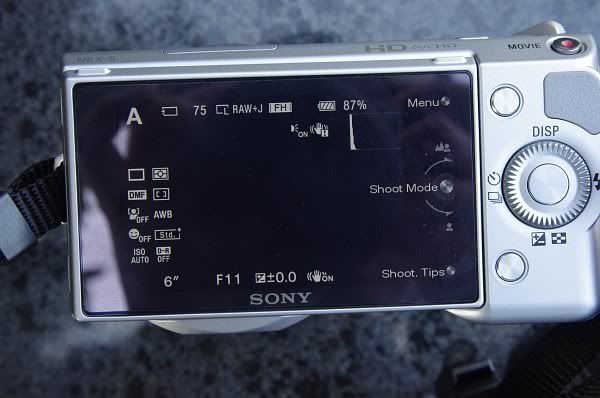


I found that whilst the NEX-5 has few buttons and lacks a mode dial, the operation is not as difficult as I originally imagined. In fact, it is far more easy to use than my GF1 (of which the user interface really sucks and rather difficult to use anyway) and is yet better than that of the Samsung NX10.

I do like the new design concept of the "soft" dial which can be operated in a cyclic manner for setting various different things. It can act as the mode dial, it can change the ISO, it can change the colour mode, it is used to change Av and Tv and so on. After some practice, you will find that the operation is smooth and quite nice. And I do like the simulation/animation, too, which I would describe as "lovely".

To operation anything non-standard (i.e, not those printed function on the four way controller and the default function of the central button) will begin at the "menu" button at the top near the thumb. After that, the screen for the soft dial will change and show different indication/animation. The operations thereafter are just fairly easy enough and not difficult to understand then.

One thing is that I would rather have is that the "Shooting Tips" button, which is located at the bottom right, could be programmed but unfortunately it cannot. The "Shooting Tips" offers a quick help for novices, though, but which I (and many other more advanced users) do not need anyway.

Last but not least, the camera has a dedicated video recording/"movie" button which is located at the top position and easily to be pressed with the pointing finger of the right hand quickly while holding the grip, which is nice.

3. The Monitor

The articulated design of the monitor is indeed a welcome and useful feature, especially for a ILDC that without the provision of any viewfinder (no matter it is optical or electronic). The articulate joint facilitates low and high angle framing and shooting, but the joint and the monitor is not easy to rotate / change angle with only the left hand during video recording and shooting.

The monitor is very bright and fine / detailed. I encountered no big issue to compose and shoot under direct sunlight outdoor on a bright day in the afternoon. However, the lack of anti-reflection coating on the monitor does cause some inconvenience, or might be an annoyance, I would say.

In addition to a bright and fine monitor that is much usable for framing and playback of images, the most lovely thing of the monitor is its colour accuracy, I would say. It reproduces neutral colours and tones as far as I observed, which Canon 550D's monitor lacks as it is just too blueish in the overall colour rendition (although it has anti-reflection coating on it, on the other hand).

4. The Flash

The clip-on flash is provided as a standard accessory with the NEX. It is small and weak. But with the high ISO and low noise capability of the new generation of Sony sensor and processing, I think it is not a real issue if the user sets the camera at Auto ISO and using the camera at ISO 400 and up indoor. I have tested it for only a few shots with the flash, the exposure and results are fairly good.

5. Shutter Sound/Feel and Lag

The shutter action produces a clunky sound but I do like it very much. The shutter release is really instantaneous and the lag is not much noticeable - The best amongst all ILDC/EVIL I have ever used, i.e, better than the GF-1 and far better than the NX10, which really sucks in this aspect.

6. AF Speed (for Still Picture and Video)

The CDAF speed is very good. If it is not faster than the GF-1, it is at least as good. I found that the continuous AF under video recording mode is very good and no obvious hunting could be seen for the AF. In fact, the CDAF of the NEX surprisingly has the least hunting amongst most current ILDC cameras. I do believe Sony has implemented a very good and advanced CDAF algorithm for the NEX, which is quite fast and very smooth and is the best I have seen/used so far.

7. Image Quality Aspects

- Resolution: The resolution is surprisingly high with the 18-55 kit lens, even at the corners! I found that the AF accuracy to be very good as the high resolution of the recorded images verifies that.

- CA: Some CA can be found at the corners, but it is not that much as originally expected for a APS-C "large" sensor with a back focus distance as short as the NEX (at 18mm only).

- Image Noise: With the default "Auto NR" setting, the noise is really low even at ISO 1600, at the expense of some loss of image details.

- DR and Exposure Accuracy/Tendency: Seems to be worst for this aspect.. The highlights are easily blown out and exposures tend to over. Maybe a constant -ve exposure compensation could cure the problem and maybe lower the contrast of the colour profile could help - I haven't tried how to "rescue" anyway, as the using time is still short.

- Colour Response and WB: Sometimes it looks too cool and sometimes too warm. I like the colour response of my K-x and 5D better (after proper fine-tuning, anyway).

8. Battery Level Indication and Life

The indication is very precise in % but I am not too impressed with the battery life, which drops a bit too fast than I wished. Maybe such a precise indication touches more the nerve of the user, i.e, if you see the battery juice percentage drops every minute, then? ;-)

9. Other Special Features

- 7 Frame Per Second Mode: This is really impressive for the speed and it does feel like a machine gun with the sound and high shooting rate, although the total number of burst you can get is not that high - I used a Toshiba Class 10 card for testing.

- Panorama Mode: The camera will shoot continuous in burst (7 frames a second, I think) and make up a composite Panorama image shortly afterwards in one second or two. The high processing power of the NEX is really impressive. But the user needs to experiment with the panning speed, that is, you cannot pan too slow or too fast for the best results.

- Using Old Manual Lenses: With the shortest ever back focus register distance of 18mm, the NEX is really the best ideal "adaptor" to plug in any old film manual lenses ever made on Earth including the Leica M lenses and the Contax G. To use the feature, enable the "Shoot/Release w/o Lens" in the Setup menu. After that, when the E-lens is detached, the "Shoot. Tips" button will become "MF Assist", then you can press the button to zoom in the preview image in "7X" and then "14X" to do the MF by naked eyes. NICE!

10. Super Value for the Money(!)

With just the price of a K-x standard kit, one can get a dual lens NEX-3 kit with an additional 16mm/2.8 prime lens, what else should one ask for? Indeed, a Pentaxian can even have some saving if he/she buys the Sony NEX-3 or even -5 dual lens kit instead of buying a DA15/4 pancake lens alone! Well, even we are not talking about the big price difference, both are APS-C primes, both are pancakes but the Sony is one stop faster, right? :-o

Today, I have also tried the NEX-3 for a while at a shop. There are not many differences from the NEX-5. The major difference is the grip, which the NEX-3's is smaller/shallower and is more difficult to hold as secure as the NEX-5's (maybe it fits ladies' smaller hands better). The body shell covered materials are different, which NEX-5 is metal whilst the NEX-3 is plastic. I don't care much about this anyway as the lenses are still metallic anyway and for a "P&S", I won't ask for metal anyway, right? ;-) (But last time when I bought my Fujifilm "top model" P&S, I did make up my decision based on a metal body as one of my determining factors~). Other than the above, and that I was told that NEX-5 does support a remote controller (and the NEX-3 doesn't), I have found no other difference between the two models, including that the shutter sound and time lag is just the same.

If you do accept a plastic body, a less deep grip (which you need to hold one in hands to try anyway) and the lack of remote control facility as well as the Full HD video capability (720p is actually just good enough for me), the NEX-3 is the REAL Bargain of the Bargains indeed!


Next Coming../Blog Trailer:-

Shootouts Against the K-x: ISO / Image Quality / Lens Quality differences, etc.! As usual, the shootouts will be for the same scenes and were carried out at nearly the same time and place and at close enough settings/profiles! Stay Tuned! I will post them when I have the time~ :-)

(Upate on 7-16: Done! Here it is!)


Read Also:-

Can Pentax DSLRs be Made Thinner?

Summary Matrix for Equipment Tests and Reviews