Quite some time ago, I wrote here for the DA 21 Limited Front Focusing (FF) and Back Focusing (BF) problems as reported by some users, in my fourth article in my this blog (and actually the first time for me to talk about the issue on the net - the contents of the first three articles were actually talked about and discussed previously in three different posts at the Steve's Pentax forum which got me banned shortly afterwards overthere).
Later on, the famous professional fashion photographer, Mr. Benjamin Kanarek, who was a new Pentax user (as you know, he switched from Canon), found that his DA 21 Limited lenses as acquired from Pentax France/Germany were having back focusing and also front focusing problems and he finally got four copies of the DA 21 after that I have not seen that he reports again about mis-focusing of his DA 21 on his K10D anymore. Nonetheless, I'm not sure if his this copy really works for him now or he has just aborted to try as the problem might still persist.
So, reports of those FF and BF problems of the K10D, in particular for those associated with the DA 21 Limited which are even more frequently reported, either with the K10D or the K100D or both, just have been continuing to appear up till now (yet an recent example here, with comparison photos posted). Recently, particular German users have found that the mis-focusing actually associated and being affected by the aperture f-number as set by the user or as selected by the camera, which a German user summarises the case clearly and precisely in the following DPR forum thread:-
http://forums.dpreview.com/forums/read.asp?forum=1036&message=24445741
So, the reported strange phenomenon is that if the aperture selected is smaller than f/5.6 (i.e., f/6.3 and onwards), the AF accuracy will be better, even if the user set a f/8 value first, say, then performs the AF, and then change the f-number back to f/3.2 wide opened, say, and take the shot - the focus achieved is usually better than when the user uses the camera normally, e.g., f/3.2 is selected when doing the AF and then take the shot at f/3.2.
Indeed, the above finding really sounds very strange and odd and I could hardly believe that for the first time I heard about it. However, by following down the above DPR thread, one will not be difficult to see quite some different DA 21 users have confirmed the same phenomenon after they tried and tested their gear, no matter briefly or extensively with care. So, the strange problem, along with the yet clumsy and odd "workaround", have been confirmed.
Actually, I saw before from an issue (#116) of a local magazine that the resolution of the DA 21 lens on a K10D as tested and measured using the Imatest is rather low, with results not more than 1,600 LW/PH (Line Widths per Picture Height) at image centre and around 1,400 only at image corners, at best. To compare the figures, I checked the Issue 115 of the same magazine for the test results of the (just 6MP) Nikon D40 with (just) the Nikkor kit lens 18-55 II AF-S and was rather surprised to learn that at 18mm, it yields results at about 2,100 LW/PH at image centre and about 1,500 to 1,600 LW/PH at the image corners, depending on the f-stop used, which simply means that the resolution of the kit lens on the D40 just blows away the DA 21 Limited prime on the K10D fully and also throughout the whole picture frame as well !(?)
Well, the possible reasons for the low resolution as verified above can be two: 1. The inaccurate AF system of the K10D which gives mis-focusing which in turn decreases the effective resolution significantly; 2. Blurry in-camera jpegs of the K10D (first discovered and reported by Phil Askey) which are primitively having lower resolution than other DSLRs of the competitors or even the K100D (now it is worse than the D40, as verified in the mentioned tests above, in just two consecutive issues of the same bi-weekly magazine).
As a side issue, a poster who responded to the above DPR thread also pointed out that the final focus point achieved by the AF system of his DA 21 varied depending on whether the lens was turned from infinity or from the closest position, which this yet strange but surely undesirable phenomenon was first reported by me nearly two years ago in my this post in 2005. It was really rather disappointed that now the DA 21 on the latest Pentax DSLRs is still the same, with the same old problem, even after two years I had reported the issue.
Do note that in my above old report I had indeed fully tested my $180 MZ-30 (and my more expensive MZ-S too) that my FA 43 Limited did have NO such problem exhibited on these two film bodies whereas my *ist DS and D are having the mentioned problems obviously and do note also that I tested and compared the MZes and the *ist Ds at the same environment, with the same FA 43 Limited lens, for the same target(s) and at the same time. So, this case is really rather sad and absurd.
All in all, I really don't understand why the problem is still here and it seems that Pentax have not listened and still don't listen and the bug is still here! (but Why?) The Bottom line is: Don't forget that the MZ cameras do NOT have similar problems! (including the rather cheap $180 "bottom-of-the-line" MZ-30). So the key point still is: IF Pentax listens.. (and also if They didn't produce inferiorly performing systems in their DSLRs, namely, the AF and AE systems used, which they did do it right and were capable to make better stuff before, in their MZ line of film SLRs..)
See Also:-
AF's Dependency on Lenses and Yellow Light
Focus Calibrations of Pentax DSLRs and Lenses
Sunday, September 23, 2007
Saturday, September 15, 2007
First Formal Test of the DA* 16-50/2.8
A Polish gear testing site has carried out the first DA* lens formal test and the test report is published as follows:-
http://www.optyczne.pl/92.1-Test_obiektywu-Pentax_DA*_16-50_mm_F2.8_AL_ED_IF_SDM_Wst%C4%99p.html
(A free online Polish to English translator can be found here)
Yet, below is a better human-translated summary on the test:-
http://forums.dpreview.com/forums/read.asp?forum=1036&message=24830862
Well, let's go on to see about the key findings of the test:-
1. Resolution:
See the following report page for the 50% MTF test results, measured in the lp/mm:-
http://www.optyczne.pl/92.4-Test_obiektywu-Pentax_DA*_16-50_mm_F2.8_AL_ED_IF_SDM_Rozdzielczo%B6%E6_obrazu.html
As a short note for what the test is measuring and what information the results can tell, it is to measure the maximum resolvable line-pairs per millimetre (lp/mm) for the black and white lines in the resolution chart for the difference between the black and white levels not less than 50% (ideally, black is at 0% and white is at 100%, so the maximum difference can be 100%).
From the first chart, we can see that MTF / resolution figures are good at the image centre. It can be seen that the optimal focal length is at 30mm, which is the middle of the zoom range. The maximum obtainable resolution figure is about 44 lp/mm. At both extreme ends of the zoom range, i.e., at 16mm and 50mm, resolution drops at about the same amount. As for the optimal f-stop, it is at f/5.6 where the best resolution can be obtained for all focal lengths. At f/2.8 wide opened, the resolution deteriorates and can be as low as at about 27 lp/mm at 50mm.
So, one would ask me how to judge those figures. Is 44 lp/mm or 27 lp/mm good or bad? First, you can compare Photodo charts and figures to have an idea. Do note that Photodo tested the Pentax lenses in a different way for the MTF. They used fixed test target with patterns of different lp/mm and then measure the MTF percentage. So, the higher the percentage, the better is the result. On the other hand, remember the latest popular measurement unit of LW/PH (Line Widths per Picture Height). Normally, a 2,000+ LW/PH figure is considered as high resolution for a 10MP DSLR, e.g. for those Imatest figures or those eye judged resolution charts by DPR. To convert the unit, 44 lp/mm simply means 1,408 LW/PH for an APS-C sensor at about 16mm height. 27 lp/mm is equal to 864 LW/PH. Although those figures are not directly comparable. I would say the highest obtainable resolution of 44 lp/mm is fair to good enough but the 27 lp/mm should be bad.
Well, now that we go to the second chart, which summarises the results for the edge performance. As you can see, the performance drops further. The poorest performance occurs at 16mm and followed by 50mm and then 30mm is still the optimal focal. But now that the highest lp/mm figure at edge is just 39 lp/mm (at 30mm at f/5.6) and the worst now drops to 16 lp/mm (!?), at 16mm at f/2.8, which undoubtedly is a very poor result.
Finally, it can be noted from the captures of the resolution charts for the existence of colour moires of which this phenomenon was also found by other reviewers before, for the K10D.
2. Chromatic Aberration:
http://www.optyczne.pl/92.5-Test_obiektywu-Pentax_DA*_16-50_mm_F2.8_AL_ED_IF_SDM_Aberracja_chromatyczna.html
They conclude that the CA is terrible, especially at the widest focal and/or wider opened, it performs worse. You can also see the obvious CAs from the sample pictures posted, in addition to the CA chart.
3. Distortion:
http://www.optyczne.pl/92.6-Test_obiektywu-Pentax_DA*_16-50_mm_F2.8_AL_ED_IF_SDM_Dystorsja.html
The distortion figures obtained are indeed rather terrible at 16mm, at an unbelievable huge amount of -4.1% (barrel) whereas at 30mm there is virtually no distortion (0.1%, pincushion) and at 50mm it is good (0.71%, pincushion). But then at the wide(st) angle, such a huge amount of distortion is ridiculous and IMHO practically it is just unusable! The Pentax DA 16-45 has a distortion of -2.52% at 16mm but yet I already notice its distortion when shooting landscape, I really cannot imagine what will happen for a -4.1% barrel distortion - which is worst than most lenses, including most cheapo kit lenses at 18mm.
4. Blur pattern:
http://www.optyczne.pl/92.7-Test_obiektywu-Pentax_DA*_16-50_mm_F2.8_AL_ED_IF_SDM_Koma_i_astygmatyzm.html
Interestingly, they measured how the image blur at this part of their test. As you can see from the red beam point. At centre (pictures at the left column), the red point reproduction is near perfect and at edges (pictures at the right column), the image formation is sketched in a certain directional way and thus causes blur.
5. Vignetting:
http://www.optyczne.pl/92.8-Test_obiektywu-Pentax_DA*_16-50_mm_F2.8_AL_ED_IF_SDM_Winietowanie.html
Obvious vignettings are found at 16mm as tested, even at one-stop stepped down at f/4. At f/2.8 and 16mm, an average mean of -1.8EV light loss is recorded at the image corners, which is considered to be significant for an APS-C DSLR. Well, I can see slight de-centering defect, too. The de-centering can be a camera body body for a not perfectly centred CCD sensor, though.
6. Flare Control:
http://www.optyczne.pl/92.9-Test_obiektywu-Pentax_DA*_16-50_mm_F2.8_AL_ED_IF_SDM_Odblaski.html
As we all can see from the sample photos, the flare control is poor, at least the testers were disappointed with the results, especially when compared with the other Pentax lenses they have tested before.
7. Autofocus speed and accuracy:
http://www.optyczne.pl/92.10-Test_obiektywu-Pentax_DA*_16-50_mm_F2.8_AL_ED_IF_SDM_Autofokus.html
They found that the speed and accuracy are both good enough. This differs from a few of previous less formal tests I have quoted in my blog before.
So, the conclusion? I think I need not to go further to quote their conclusion. I think you have made up your own conclusion already at this point. This DA* lens simply doesn't perform, with worst performance at wide angle and wider opened. So, what's the point of getting this lens? Aren't two of the major selling points of this lens is that it is a fixed f/2.8 faster zoom with a 16mm wider angle? Even for the flare control, where Pentax usually excels, the lens yet doesn't perform here. A real disappointment here and I feel really very sad again here. Actually, this is rather sad for Pentax to produce a "Pentax" lens like this, not even to mention again it is a "Star" lens as labelled. It seems that Pentax has just put her long established Star reputation at risk, which is indeed the most disappointing thing ever seen in Pentax's history.
See Also:-
Shootout Again! DA* 16-50 Vs SIGMA 18-50/2.8
SDM = More AF Errors?
DA* 16-50 Vs DA 16-45, A Shootout
Friday, September 07, 2007
Shootout Again! DA* 16-50 Vs SIGMA 18-50/2.8
Here is a very recently published shootout test for the above two lenses:-
http://forum.pentaxfans.net/showthread.php?t=54131
(The report in Traditional Chinese, you can use Babelfish to translate)
Nonetheless, since Babelfish is not something one can fully understand :-D, I summarise the author's findings as follows (you may wish to read in conjunction with the full report with all those testing sample pictures posted):-
1. Purple fringing of the DA* is more obvious than the Sigma at the widest focal settings, for apertures from f/2.8 to f/8, i.e., at 16mm Vs 18mm respectively. The author compares the image corners.. ;
2. Exposures (i.e., for the image brightness) and colour/tone responses are more or less the same as tested at 50mm;
3. Resolution of the Sigma throughout the same aperture range (f/2.8 to f/8) wins the Pentax clearly, at the widest focals as compared. My comment is that this comparison may not be totally fair as the magnification of the Sigma at 18mm is slightly larger. As such if the same crops of the same image scene are compared, the larger magnification one will have the slight advantage. However, the difference seems to be so obvious that the Pentax should really have (much) less resolution. Also, the tester also tested at 34mm/35mm to verify his results on another day and yet again he found that the Sigma is still having better resolution;
4. Focusing accuracy test: The Pentax DA* back focused whilst the Sigma focused flawlessly on the same K10D!(?) The author remarks that this confirms the reported (back) focusing problem of the DA* lens, when SDM is used. He further writes that the focusing error could be the true culprit for the decreased and lower resolution as found. I think he is right for that suggested point as focusing accuracy is very important to keep the (high) effective resolution;
5. Distortion levels of both lenses are more or less the same and both are quite obvious. My comments are: I can see from the test images that the test chart/target are not shot "perfectly" on an optical bench for perfect alignment nor the target is perfectly flat. However, this is understoodable for what a non-professional measurebator could do with the limited resources he has. Still, the test shots can be treated as some kind of basic reference, IMHO;
6. The author is astonished at the high performance/cost to price ratio of the Sigma but however rather disappointed with the Pentax DA Star, which is expensive but yet found to be inferior and lose the shootout for almost all aspects under test;
Well, after reading this test and all the results, I feel rather disappointed (again). The DA* Star is again something let Pentaxians very down in general. It has focusing issue as verified, which has been reported over and over again since launched. The true cause can be either a design flaw, no matter hardware and/or software wise or a quality control issue. The DA* optically does not live up to the standard as supposed and expected. Actually, it has more obvious purple fringing, lower resolution, obvious distortion and so on - and the worse is that it cannot even win but just lose to the Sigma which is being sold at a price less than half of the DA Star.
My impression is that the DA Star is just something Pentax created to hurt seriously their long established reputation of their only true strong point, i.e., excellent optics, especially for the Star series, which should be their top-of-the-line, most luxury glass with the best possible optical quality and performance on the Earth, but still being sold at attractive and reasonable price levels - which all these favourable factors are true and valid for the old film FA* and F* or even A* lenses. But now that it looks rather sad and disappointed for those digital DA* "Star" are found to be performing just like some kinds of rebadged Tokinas which are actually being sold much cheaper. Still, the Pentax Digital "Star" are yet marketed with a "Star" price but lack the true quality and real performance which they should have (or at least as expected or supposed to be), as reported by many of the new users for what have been tested and verified repeatedly from many of the recent reports. (Not even to mention the unique optical characters which each of the old *true* Pentax Star lenses had - Sad. Really..)
Afterall, I believe that the consumers are brilliant, overall speaking. Reputations, no matter good or bad, are built over time and nothing can be hidden or cheated. So, if the DA* really don't perform, I'm afraid that Pentax is really endangering their brand name and just spoil their long-established good name of the Star and when the end of the Star legend comes, their old real fans must be upset (mostly).
How to Get Back to an Older Version of the Firmware?
For quite some good reasons, Pentax users, particularly K10D ones, wish to get back to older version of firmware for their DSLRs. A quick search on major Pentax forums will reveal such queries easily.
One of the major "drives" for those users to "downgrade" is that they encountered focusing problem so that they need to get back to the earlier version 1.10, which has the engineering service mode access method disclosed and in that mode there is a parameter that can be input to compensate for the AF error and as such the Front Focusing (FF) or Back Focusing (BF) problems can be cured partially, at least for particular lens and under specific lighting condition, say, tungsten environment.
Now that some people have found that SDM focusing could produce more AF errors, i.e., BF or FF. So, I and some people have thought about why not try an older firmware and see if there is a difference and if the problem can be cured?
Now, the problem is how to downgrade the firmware, which is not allowed by design. As when the user tries to re-program a "new" copy of firmware to the camera, there must be a version checking process which will only allow upgrade, or at least re-programming of the same version, but not an downgrade. Pentax have assumed that users should and will never look back. But of course, this is not the case in real life.
So, here comes a method for downgrading from version 1.11 to 1.10. In fact, the working principle is simply to cheat the existing firmware for the "new" firmware version. Just change the old firmware file's header, using any Hex Editor (click here for a list of free Hex Editors), to replace the string(s) of actual firmware version to the latest version number, say, it can be even 1.30. It is said that one can then program/write over the existing firmware. And then, if one still want to have complete original old firmware to be installed in his camera, the author said that now the original old firmware, without any modification, can now be then downloaded back to the camera by just using the usual procedures for firmware "upgrade". Well, a copy of the original untouched K10D firmware version 1.10 can be found here.
Good luck and happy downgrading (and actually hacking)! ;-) But do remember try everything at your own risk and you should be the one who knows what you are doing, and why you need to do so, the risk involved and the possible consequence(s) thereafter!
Update (Nov. 25): All the K10D firmware versions can be found here, officially:-
http://www.pentax.ca/digital/digital_slr/k10d/firmware_110.php
http://www.pentax.ca/digital/digital_slr/k10d/firmware_111.php
http://www.pentax.ca/digital/digital_slr/k10d/firmware_120.php
http://www.pentax.ca/digital/digital_slr/k10d/firmware_130.php
How long Pentax Canada will keep the older versions is yet a question, though, as it seems that it's Pentax's central policy to remove older version of the firmware for downloading once a newer one is available.
Update (Dec. 16): For those who do not want to do the Hex editing, an already modified copy of the firmware version 1.10, which can be used to write over the latest firmware version 1.30, can be downloaded at the page below:-
http://www.vietzon.com/red/forums/viewtopic.php?f=7&t=33
If you still feel unsafe or uncomfortable or whatsoever with this "hacked" version, just write over it with the original 1.10 that can be obtained in the Pentax Canada link mentioned above and then the downgrade will be perfectly completed.
Wednesday, September 05, 2007
SDM = More AF Errors?
Recently, some different Pentax users, who had got the new DA Star lenses for their K10D, have reported that they found that more AF errors were resulted when the SDM lenses were used on their K10D, i.e., by enabling the SDM function to do AF ultrasonically. Just see the following hot thread:-
http://forums.dpreview.com/forums/read.asp?forum=1036&message=24652706
As we can see, the logic of the thread open person is simple and clear. If his DA Star lens is used on a non-SDM body with traditional body driven AF, the AF accuracy is good enough at f/2.8 wide opened. And then if another older generation non-SDM prime lens is used on his K10D, the AF is still okay for the same aperture and focal as compared. So, out-focusing only occurred when the SDM lens is used on a SDM body and thus he has drawn up the conclusion that the culprit is the new SDM focusing function, which should be in fault or having some bugs (hardware and/or software wise).
Do note that the Pentax Star lens are with hybrid AF facilities so that it can be used on both latest SDM-enabled Pentax DSLR or older body driven Pentax AF bodies, which is really a good thing as full backward compatibility is ensured. However, if the SDM would actually introduce more AF errors, then this will be a big problem and issue. In fact, this issue (if really existent) must be looked into seriously and tackled by Pentax in a very urgent way and manner. In the meantime, a custom function for letting the user to choose between SDM or body AF motor would be a viable interim solution that can be provided by Pentax quickly and easily, as only a new firmware update with minimal software modification is needed. Until some days later an ultimate technical solution arrives, this firmware option could be the true saver for users who have encountered the problem - and for the rest who do not find any problem, they can leave the setting at default and continue to use the SDM.
Anyway, to learn more about the reported cases and to judge if the problem is really existent, I think the lengthy thread cited above already provides quite some useful information for reference with useful sample photos posted as well. Nonetheless, as there are numerous numbers of opposite arguments followed down the thread (as usual and it is quite normal), I think any reader without a stance can think and judge the case in a more objective way, as far as possible. Of course, in the end, everything can still be concluded with the "bad sample" theory that the reporting users are just being the most unlucky ones. Or, again, simply the old but golden defensing rule of "user errors" can be applied. But, if you're about decided to buy the new DA* lens(es), will you take the risk? Will you bet, or not? (. . until some days the case has been made clearer.)
Update (Sept. 7): I have just a thought which've come over my mind. I think instead of waiting Pentax to confirm and hoping for a solution from them, why not be proactive and try to test the gear oneself and even to find out a possible solution that is actually ready available?
In fact, according to the past track record, Pentax have never admitted those more critical reported gear problems openly or they simply just not even responded publicly to those, even if for the problems that had been widely reported and recognised (clearly for their existence). As such, I think my last imagination or suggestion on the "interim solution" maybe just something not very realistic afterall.
So, what's my thought then? Still remember the old K10D firmware versions of Pentax which do not support the SDM? As such, with those older firmwares, it is most likely that the K10D will do AF *traditionally*, i.e., with the body AF motor to drive the Star zooms to do the AF. I haven't tried that myself though but I think it is most *likely* and it should work.
So, how to get back to the older firmware? Just see my next short article on that.
Update (Sept. 9): PentaxForums.com member SloPhoto has confirmed that older K10D firmware version 1.2, i.e., very probably for all firmware versions prior to the version 1.3, "will focus the DA* lenses using a conventional screw drive". So, this would be really a good news for all those users who have found problems associated with the SDM for their new DA* lenses on their K10D. At least now there is a readily available possible solution for them to try.
Sunday, September 02, 2007
De-centering Defects of Pentax Lenses
Klaus Schroiff of the PhotoZone recently has cancelled his tests on both of the two latest DA* zooms, owing to the pronounced "centering defects" found. In fact, he has already found so many and too many similar defects with Pentax lenses during his tests on Pentax lenses carried out up till now. With those centering defects found, Klaus either re-acquired another sample from the PhotoZone community or he simply cancelled the tests, which is indeed a rather disappointing thing, especially when this keeps repeatedly happened, very unfortunately.
A search of the term "centering defect" in the PhotoZone forum datebase using its search function will reveal how many times this problem has been appeared and reported during the course of his testings in recent months. I'm actually not being totally surprised for having alignment issues with Pentax products from my own "unfortunate" experience, especially for the recent Pentax products which were made and are being made outside Japan.
Nevertheless, I am a bit sceptical about if it is really about the poor QC of the Pentax lenses instead of the mis-alignment of Klaus's K10D body instead. Coincidently, I have asked Klaus the similar questions more than twice in different posts in which he reported the problem when he tested different Pentax lenses (which I can see many of the conversations again when I have done the search on the keywords "centering defects". Below were some of his answers to my questions:-
http://www.photozone.de/active/forum/ShowMessage?ID=108899021463946422146394641A
"This is very unlikely. There were no significant centering defects in the Tamron 70-300, Cosina 100 and the Sigma 10-20 tests - these were among the most recent test runs in Pentax land."
http://www.photozone.de/active/forum/ShowMessage?ID=108552321463980702146398065A
"An asymmetrical centering defect isn't all that severe from a testing perspective.
If I reject a lens it is mostly because the _center_ portion shows both sharp (although suboptimal) edges as well as "edge shadows". In the real life this kind of defect shows up as weak contrast but not as asymmetry."
Here is a capture of the *image center* for a chessboard like resolution chart pattern:-
http://www.photozone.de/active/forum/ShowMessage?ID=10829312146400715A
As we can see from the above diagram, asymmetricity or the phenomenon of directional "edge shadows" does really exist. As Klaus has mentioned in so many of his Pentax lens review and posts about his tests that there are centering defects in common (more or less), objective facts tell me that I should admit that there is a problem with even the Pentax optics, despite I have already tried to think objectively about any other possibly cause and asked for times if "it should be the body". (Well, I do not have very good faith or impression on the quality control and perfect alignment of the K10D body but I can't imagine even a bundle of different Pentax lens models could have serious alignment problem - even for the optical center).
Very interestingly, MTF tests like those conducted by Photodo indeed can already show the presence of centering defects, as cleverly pointed out by this PZ poster:-
http://www.photozone.de/active/forum/ShowMessage?ID=1082931214640066121464006602146400658A
Now, the DA* 16-50 and DA* 50-135 samples which have been got from the street have very significant and pronounced centering defects. Despite the tests have been cancelled and Klaus will not publish the test results formally anymore, he is yet kind enough to post briefly the unpublished results in his forum:-
http://www.photozone.de/active/forum/ShowMessage?ID=10889902146394636A
Well, as we can see, actually both DA* perform not so well especially for the poor/low resolution at wider apertures and at the image borders as well as the huge amount of CA present. Whilst the centering defect, which is found to be existent in both DA* lenses, could affect image quality and "spoiled the MTF figures a bit", which has been verified, here, possibly the lenses' optical performances are not that good by themselves. As remarked by the tester, the inferior CA performance is just "Tokina alike".
Last but not least, as those lens samples obtained are new products which have passed the factory QC and those are acquired from the streets, we may think it in the following two additional possible ways:
1. The de-centering amount is just within Pentax's factory specs but should not be considered as a defect by Pentax's own standard - but then Klaus compared the Pentax lenses from Canon, Nikon etc. or even to Sigma and Cosina (on the same K10D) but he found that particular Pentax lenses are worse, including even the latest "luxury" DA Star zooms;
2. Those samples put under test are just lemons and they leaked through the Quality Control system/net from the factory - if so, I'm afraid that the QC system of Pentax is really rather ineffective or even useless as there are so many bad samples out there as picked up in the streets and ultimately been borrowed/bought by Klaus and very unfortunately even been put to the lab test.
All in all, my opinion is simple: for lower priced lenses, such defects are more acceptable as the customers should get what they paid (for). However, for "Star" lenses that marked with a new golden "Star" label on them, with a "Star" price, shouldn't we expect a "Star" quality also, in terms of *real* stringent QC tolerance and inside performance as well.. But, so far from what we can see from all those specific adverse user or even test reports of the new DA Star lenses (which are shown together with quite some evidences), I'm really afraid that our above assumption has not been proved valid and maybe even just wishful thinking of we Pentaxians. Really sad.. :-(
Wednesday, August 29, 2007
Underexposure Tendency of K10D and K100D
Last time when I was trying to find some new DA* sample photos, I came across the following nice and interesting sample photo gallery by a K10D user, who have shot and posted quite some pairs of pictures with different Pentax lenses on his K10D:-
http://www.pbase.com/tcom/k10d
Well, when I inspected those comparison shots between the DA* 16-50 against the DA 16-45 as well as those of the DA* versus the DA 21 Limited, I found an obvious irregularity, that is, underexposure. ( Um, it should be "regularity" for Pentax DSLRs, though :-( )
First look at the church photos taken with the DA* 16-50 and the DA 16-45 lenses, I read the EXIF information and discovered that a huge amount of +ve exposure compensation were applied for the two wide angle shots made with the DA* 16-50 and the DA 16-45 at 16mm, i.e., in a value of +1.7EV both for the same scene with the same framing/composition. What does this mean? It simply means that serious underexposure had occurred for the uncompensated metering reading when the shooter attempted to take the shots. Do note also that he put his K10D camera in the Matrix metering mode when he took the pictures.
People may start to argue that the scene is a bit tricky to the light meter for for the lighter wall of church and the bright sky above it. However, I really don't think it is a very difficult scene to be handled with for typical matrix meter with should be somehow intelligent and in this case the K10D matrix / multi-pattern meter simply failed to handle such a situation. And then some people may argue again that the Pentax meter was just trying to preserve the highlight. But I just wish to point out that no blown/burnt out of the sky even after the +1.7EV compensation in the sample pics posted. So, I just wish to ask *what* is/are the camera was trying to "preserve"? What??
So, let's go on to inspect another pairs of photos. This time we can see the church shots taken with the DA 21 lens along with the DA* 16-50 also. The 21mm shot was made with a +0.3EV compensation whereas the DA* 16-50's one was taken with a +0.7EV, which simpy means that the DA* underexposed more than the DA 21, for the same scene with pictures taken at nearly the same time. We can also draw another rough conclusion that the wider the angle in used, the K10D tends to underexpose more when we compare the shots taken at 16mm with the same DA* lens and the DA 16-45, even the two pairs of shots should be taken at a different time which the weather conditions might be different. Well, the K10D user still used the matrix/pattern metering mode and underexposure did still occur, again.
In fact, the underexposure problem of the Pentax DSLRs are the same old problem which seem has never been and could not be cured by Pentax since their old first *ist D. Just look at the set of quick tests and experiments carried out by another K10D user below:-
http://blog.xuite.net/allison_tabris/tabrisphoto/10528261
(Text in Traditional Chinese, you can use Babelfish to translate.)
From the above page, we can see that even fixed pattern metering, i.e., the Spot meter, of the K10D underexposes much and indeed it is rather inaccurate. For a dark mouse, a +ve EV exposure compensation could still be required - this simply violates the basic rule and working principle of light metering for a reflective light meter and is actually rather abnormal amongst all other light meters on Earth which are calibrated to meter correctly for the mid-grey/tone. In fact, with such rather inaccurate Spot meter of the Pentax DSLRs, even of their current "top" model the K10D, the real purpose of a Spot meter is totally defeated as every user uses this mode is supposed to be aiming for the highest possible accuracy and total control in metering. Of course, if a Pentax DSLR user is to adapt for such abnormality, he should always aim at the dark (areas) when using the Spot meter(ing) as an attempt to get proper exposure, but then this is actually very improper, frankly.
And then I can guess some people will still argue that I do not know about the actual condition of the above test shots as I am not the one who was at the site and took the picture. Well, no problem with this, I will show my photo then. Below is a picture took with my K100D on a scene which I don't think is something really very difficult, although the subject was lit by the sunlight:-
I shot RAW and the picture below is the direct original picture without any digital exposure compensation:-

The corresponding *original* exposure histogram actually looks like this:-
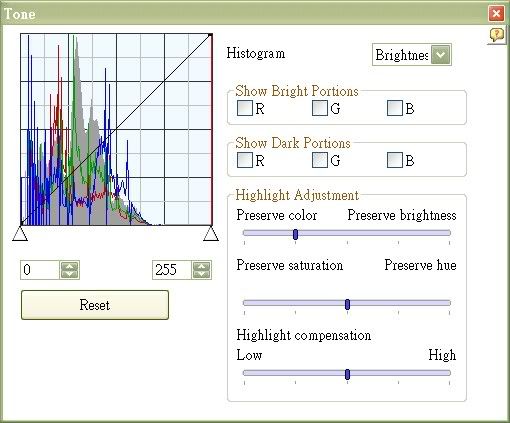
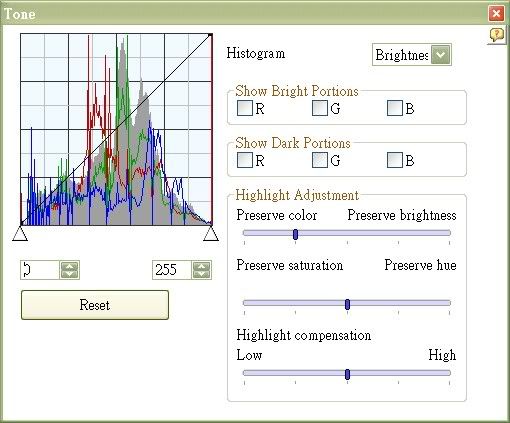
Well, in order to rescue the picture to make it looks better again and as close as it could look like as the real scene, a large amount of +ve exposure compensation is inevitable. Actually, to bring it back to the normal sunshine look, a significant large amount of +1.5EV is required, in the Pentax Photo Laboratory. After the correction, the histogram looks more healthy now then, as below:-
But the fact is the whole "corrected" picture now just looks flatter and the building looks less pop than it should be, than *if* proper exposure was achieved *at* the time of exposure by applying the same +1.5EV exposure compensation (but then this *must* require trials and errors *at* the *field* which just means more time wasted but with less photo opportunities - when the time is being wasted, photo opportunities would go away too). Besides, the shiny feel and the colours of the picture becomes a little bit worse too, after the "correction". Now, we have:-

So, proper exposure is *always* the best thing we want and bad exposure and underexposure is just an evil which is *always* undesirable. Well, again any more "preserve highlight" *theory* (by those Pentax defenders)? Well, what can we look from the original histogram distribution above? In fact there is nothing close to clipping, even that we inspect the individual histogram curve for the individual R, G or B colour channel. The whole histogram simply skewed heavily to the left and left *much* room in the right. In my book (and actually in any book about light metering), this is simply called UNDEREXPOSURE.
So, afterall, what's the true advantage of such underexposure if it is really intended. I'm afraid that the true answer is None but the reverse is true. Digital compensation cannot do all the magics but only that inferior picture quality will be resulted - Here is a more detailed and systematic analysis.
To compare with other better DSLRs in the metering and exposure department, take the Canon 5D as an example, which will seldom let me down in shooting under the sunlight, even with bright or even very white subjects and scenes, which the 5D is clever enough or at least much cleverer than the Pentaxes to handle these quite well and yields very satisfactory results with a much higher hit rate and more acceptable results, even when dealing with more tricky scenes and objects. Here are two quick examples, which were made directly out of the camera as in-camera jpegs, just and merely by aimed and shot (no re-touching of any kind has been made except for down-sizing):-


Truly speaking, such kinds of very annoying underexposure problem, with variation with lenses and focal length, etc., is really one of the big reasons to *force* me not to get any Pentax DSLR body "upgrade" further but I need to go with the Canon for a new body not only just for more pixel count.
Unless Pentax is willing and/or able to make a brand new designed body with improved metering and exposure, I think this would be very hard to be acceptable, at least by my own (minimum, I think) standards and requirements. Or, if they are not just so stubborn to not go back to their old but actually reliable 6-segment metering which used in their MZ line of SLRs and quite some popular high end film P&S as well as a few very early Optio DCs, the problem will never disappear, I bet. For a few more examples on how inferior underexposure could spoil photos and how other "proper" DCs/DSLRs can do better (including my old trust-worthy Optio 330 which just has the old 6-segment pattern metering), see my this old *ist D comparison gallery:-
http://ricehigh.net/Samples/samples.html
http://www.pbase.com/tcom/k10d
Well, when I inspected those comparison shots between the DA* 16-50 against the DA 16-45 as well as those of the DA* versus the DA 21 Limited, I found an obvious irregularity, that is, underexposure. ( Um, it should be "regularity" for Pentax DSLRs, though :-( )
First look at the church photos taken with the DA* 16-50 and the DA 16-45 lenses, I read the EXIF information and discovered that a huge amount of +ve exposure compensation were applied for the two wide angle shots made with the DA* 16-50 and the DA 16-45 at 16mm, i.e., in a value of +1.7EV both for the same scene with the same framing/composition. What does this mean? It simply means that serious underexposure had occurred for the uncompensated metering reading when the shooter attempted to take the shots. Do note also that he put his K10D camera in the Matrix metering mode when he took the pictures.
People may start to argue that the scene is a bit tricky to the light meter for for the lighter wall of church and the bright sky above it. However, I really don't think it is a very difficult scene to be handled with for typical matrix meter with should be somehow intelligent and in this case the K10D matrix / multi-pattern meter simply failed to handle such a situation. And then some people may argue again that the Pentax meter was just trying to preserve the highlight. But I just wish to point out that no blown/burnt out of the sky even after the +1.7EV compensation in the sample pics posted. So, I just wish to ask *what* is/are the camera was trying to "preserve"? What??
So, let's go on to inspect another pairs of photos. This time we can see the church shots taken with the DA 21 lens along with the DA* 16-50 also. The 21mm shot was made with a +0.3EV compensation whereas the DA* 16-50's one was taken with a +0.7EV, which simpy means that the DA* underexposed more than the DA 21, for the same scene with pictures taken at nearly the same time. We can also draw another rough conclusion that the wider the angle in used, the K10D tends to underexpose more when we compare the shots taken at 16mm with the same DA* lens and the DA 16-45, even the two pairs of shots should be taken at a different time which the weather conditions might be different. Well, the K10D user still used the matrix/pattern metering mode and underexposure did still occur, again.
In fact, the underexposure problem of the Pentax DSLRs are the same old problem which seem has never been and could not be cured by Pentax since their old first *ist D. Just look at the set of quick tests and experiments carried out by another K10D user below:-
http://blog.xuite.net/allison_tabris/tabrisphoto/10528261
(Text in Traditional Chinese, you can use Babelfish to translate.)
From the above page, we can see that even fixed pattern metering, i.e., the Spot meter, of the K10D underexposes much and indeed it is rather inaccurate. For a dark mouse, a +ve EV exposure compensation could still be required - this simply violates the basic rule and working principle of light metering for a reflective light meter and is actually rather abnormal amongst all other light meters on Earth which are calibrated to meter correctly for the mid-grey/tone. In fact, with such rather inaccurate Spot meter of the Pentax DSLRs, even of their current "top" model the K10D, the real purpose of a Spot meter is totally defeated as every user uses this mode is supposed to be aiming for the highest possible accuracy and total control in metering. Of course, if a Pentax DSLR user is to adapt for such abnormality, he should always aim at the dark (areas) when using the Spot meter(ing) as an attempt to get proper exposure, but then this is actually very improper, frankly.
And then I can guess some people will still argue that I do not know about the actual condition of the above test shots as I am not the one who was at the site and took the picture. Well, no problem with this, I will show my photo then. Below is a picture took with my K100D on a scene which I don't think is something really very difficult, although the subject was lit by the sunlight:-
I shot RAW and the picture below is the direct original picture without any digital exposure compensation:-
The corresponding *original* exposure histogram actually looks like this:-
Well, in order to rescue the picture to make it looks better again and as close as it could look like as the real scene, a large amount of +ve exposure compensation is inevitable. Actually, to bring it back to the normal sunshine look, a significant large amount of +1.5EV is required, in the Pentax Photo Laboratory. After the correction, the histogram looks more healthy now then, as below:-
But the fact is the whole "corrected" picture now just looks flatter and the building looks less pop than it should be, than *if* proper exposure was achieved *at* the time of exposure by applying the same +1.5EV exposure compensation (but then this *must* require trials and errors *at* the *field* which just means more time wasted but with less photo opportunities - when the time is being wasted, photo opportunities would go away too). Besides, the shiny feel and the colours of the picture becomes a little bit worse too, after the "correction". Now, we have:-
So, proper exposure is *always* the best thing we want and bad exposure and underexposure is just an evil which is *always* undesirable. Well, again any more "preserve highlight" *theory* (by those Pentax defenders)? Well, what can we look from the original histogram distribution above? In fact there is nothing close to clipping, even that we inspect the individual histogram curve for the individual R, G or B colour channel. The whole histogram simply skewed heavily to the left and left *much* room in the right. In my book (and actually in any book about light metering), this is simply called UNDEREXPOSURE.
So, afterall, what's the true advantage of such underexposure if it is really intended. I'm afraid that the true answer is None but the reverse is true. Digital compensation cannot do all the magics but only that inferior picture quality will be resulted - Here is a more detailed and systematic analysis.
To compare with other better DSLRs in the metering and exposure department, take the Canon 5D as an example, which will seldom let me down in shooting under the sunlight, even with bright or even very white subjects and scenes, which the 5D is clever enough or at least much cleverer than the Pentaxes to handle these quite well and yields very satisfactory results with a much higher hit rate and more acceptable results, even when dealing with more tricky scenes and objects. Here are two quick examples, which were made directly out of the camera as in-camera jpegs, just and merely by aimed and shot (no re-touching of any kind has been made except for down-sizing):-
Truly speaking, such kinds of very annoying underexposure problem, with variation with lenses and focal length, etc., is really one of the big reasons to *force* me not to get any Pentax DSLR body "upgrade" further but I need to go with the Canon for a new body not only just for more pixel count.
Unless Pentax is willing and/or able to make a brand new designed body with improved metering and exposure, I think this would be very hard to be acceptable, at least by my own (minimum, I think) standards and requirements. Or, if they are not just so stubborn to not go back to their old but actually reliable 6-segment metering which used in their MZ line of SLRs and quite some popular high end film P&S as well as a few very early Optio DCs, the problem will never disappear, I bet. For a few more examples on how inferior underexposure could spoil photos and how other "proper" DCs/DSLRs can do better (including my old trust-worthy Optio 330 which just has the old 6-segment pattern metering), see my this old *ist D comparison gallery:-
http://ricehigh.net/Samples/samples.html
Saturday, August 18, 2007
DA* 16-50 Vs DA 16-45, A Shootout
Here is one of first more formal tests I have seen, which I think is good enough to tell us some truths about the lenses, for a head-to-head comparison:-
http://blog.photosharp.com.tw/BLOG/Article.aspx?m=%e5%8e%9f%e9%87%8e%e7%b6%a0&id=3407
(Test report in Traditional Chinese, use Babelfish if required)
Well, as we can see from the pairs of sample photos and the full size crops the author posts, he gives us the following conclusions:-
1. Purple fringing of the DA* is just a little bit better than the DA, but both lenses are considered to be worse than acceptable because the fringes are still obvious for both;
2. The DA* 16-50 consistently underexposes more than the DA 16-45 on the K10D, under a wide variety of shooting situations, as stated by the author. In fact, the two posted sample images by him show this clearly too. The author considers the underexposure of the DA*16-50 is highly undesirable. It is further noted that the DA* may have more light loss which is judged by lower EV values metered but yet the pictures came out to be darker, which is again undesirable indeed;
3. The images from the DA 16-45 are warmer, i.e. with more yellow whilst the DA* 16-50 contains no yellow at all. It is further stated that the DA* 16-50 images look more saturated than the DA 16-45 but anyway the author does point out that this maybe related to underexposure as underexposed images normally look more saturated than normally exposed ones. Personally, I must say I still don't like the "new" tone of the DA* lenses, as I have said before. Regarding this kind of colour reproduction which I don't like, I can find the same thing for many of the other sample photos I have seen on the net, including Ned Bunnell's ones, which I bet quite some we *old* Pentaxians will not like it - we love the *old* tones of those older Pentax excellent optics, but it seems that those were the days. In fact, I found that the DA 16-45 is already cooler than I like (a detailed comparison here) but now that the DA*s are even more blueish!(?)
4. Resolution wise, the DA* 16-50 wins and that the only aspect it clearly wins. The difference will become smaller when stopped down to f/8 or beyond, though.
Nonetheless, do note that the above comparisons are not made with the same aperture numbers, the tester compares the relative stopped-down apertures in the same amount of stopping down step(s). As such, there is always one f-stop's difference in the comparisons. One may think this to be fair or unfair, depending on what one thinks about the rationales.
Besides, I have also found another fair and comprehensive overview by another new DA* 16-50 user here. Actually, he also "coincidently" notes about the underexposure problem too with his DA* on the K10D. Besides, he points out that the AF with SDM is indeed not significantly faster than that with traditional body AF.
Another major problem some other new users have reported about is the high amount of distortion at wide angles, which is obviously more than that of the DA 16-45 (2.52% barrel), which IMHO is too much indeed for a wide lens, not even to say for a luxury classed one as the DA Star. In fact, some of the users believe that the distortion is of the same level as the Tokina ATX Pro DX 16-50, of which the amount is measured and can be visualised here (a 3.55% barrel distortion, which is really *too* much!). My experience is that such large and obvious barrel distortion is a true annoyance when shooting landscapes with the horizons or any horizontal lines appeared near the top or bottom picture frame borders, which will make the pictures look somehow ugly and odd.
So, if one asks me if the DA* worth its price, in particular for the DA* 16-50, I would say "No" without second thought. Actually, I won't recommend this lens as long as there is a much alternative cheaper choice of which the DA* 16-50 is not much better than, i.e., the DA 16-45. With nearly four times the price of the DA*16-50 than a DA 16-45, the small difference in performance and features actually makes the DA 16-45 a no-brainer. Do note that the DA 16-45 does even have some other advantages over the DA* 16-50, as for those discussed above and some other things which are obvious, e.g., it is smaller and lighter and uses a common Pentax thread size of 67mm (which the DA*50-135 uses too).
Wednesday, August 08, 2007
Hoya has Completed Acquiring Pentax
Two official announcements have been out at the Pentax Japanese website:-
http://www.pentax.co.jp/english/news/2007/200772.pdf
http://www.pentax.co.jp/english/news/2007/200773.pdf
It is stated in the above first announment that now Hoya has 90.58% of voting rights of the company Pentax, that is, Hoya is the largest and major shareholder who holds even much more than 50% of the stakes of the compnay and Hoya is also called as "our parent company" in the announment by Pentax. With such a large percentage of stakes owned by Hoya, Pentax is virtually so close to a wholly owned subsidiary of Hoya now.
Besides, in the second announment, it is told that two new directors are appointed for Pentax by Hoya, both are senior officials from the Hoya company and of course this has been agreed and approved in the shareholders' meeting without any problem.
So, let's wait and see how the company will become and see if the Pentax camera system will become ever stronger under the big umbrella or just to be aborted (by Hoya) in the end.
Last Related Article: Finally, It is Done.
Friday, July 20, 2007
New DA Star Lenses are Coming Soon, Finally!
Pentax has just made a news release at their Japanese homepage about the final market launch of their repeatedly delayed and hence long-awaited Star DA zooms, which are told will arrive on August 11 for the DA*16-50 and July 27 for the DA*50-135 (but why not the standard zoom to be come first?):-
http://www.pentax.co.jp/japan/news/2007/200758.html
(In Japanese, use Babelfish to translate if needed)
By looking at the included link in the above news release for the previous product announcement of the lenses, it is interesting to see that the monthly production rate for each of the DA Star zooms will only be 1,000 units per month. Since Pentax have not updated this figure in their latest news release but just include the link for the old press release, we may assume that they keep this figure. However, with such an extremely low production rate, there are some obvious implications, as we can see and predict for the possible outcomes:-
1. The lenses will be in great shortage in supply as the 1,000 units will be shared worldwide, including for the demand for the Japanese home market;
2. It is either that Pentax's initial estimation on the demand of the DA Star lenses is rather pessimistic and conservative, or that their factory production limit has been reached, regardless of the demand in the market and the back orders they received. It is just because for new lens models put into production simply means more production capacity will be required.
However, since Pentax last time told us that their last delay of the Star lenses was caused by the increased "huge demand" of the lenses, I wonder why they don't tell us the increased new production rate this time. Maybe they have forgot to do so (but I prefer that they should follow up on what they told us last time). Or, they just want to keep the 1,000 units per model per month low figure in our mind, or, actually they really still keep this figure as their latest plan and target! Who knows?
Lastly, usually new products will sell more or even much more when they are fresh and new. So, if they really keep this figure at their side, I am really afraid that they will miss the boat again (and again, as in the past - otherwise, I couldn't see there have been so many long-time Pentaxians switched and went away or needed to buy into one more brand, usually brand C or N). Indeed, people won't wait for products that they don't know when these will actually come, even after they are willing to place the back orders or also needed to pay deposits for those orders. As they can always choose other numerous alternative products, which are widely available and far more easy to find, and at comparable prices.
Just as a joke for relaxing, I wish the Hotax merger could have completed earlier as the Hotax had and have a much higher production rate than what Pentax alone can achieve now! ;-)
Subscribe to:
Posts (Atom)