Web Analytics RiceHigh's Pentax Blog: Exposure Accuracy
Showing posts with label Exposure Accuracy. Show all posts

Friday, April 14, 2023

More K-3 III Monochrome Samples at the "Pentax Official" Site

https://pentaxofficial.com/18527/

https://pentaxofficial.com/18482/

https://pentaxofficial.com/18512/

All in Japanese, but the pictures speak for themselves. Various Pentax original lenses were used for the tests.

Thursday, October 20, 2022

More Information about the Priced Gradual ND Digital Filter (for K-1 and K-1 II)

Now it is put on sales at the Japanese Ricoh online store (Google English translation of the page Here).

It is learnt that Serial Number of the camera shall be provided for the purchase of the license key for unlocking the function. The key is not portable across different bodies and one key is solely for one unique camera body. Besides, it should be noted that product keys for the K-1 and K-1 II are different. The price of the product key (without tax) is in Japanese Yens 10k.

Upon purchase of the key, Ricoh will send the buyer a QR code which the camera will read the code to unlock the function. It says it takes from several days to one week for Ricoh to generate and send back the code to the buyer. It seems that everything is being processed manually. The worst thing is that if the consumer has entered the wrong serial number of his/her camera, Ricoh will not be responsible for it and the correct code will not be resent?! :-|

As for the operation of the function, read the Chinese article here. The working principle is also briefed in the article.

In short, the camera takes two consecutive photos according to the maximum Exposure Value  (EV) difference. The camera will then process the photos and clone them into one with the selected gradual ND pattern. And, the pattern of dark/bright sections could be set by the user. It is recommended that the user should put the camera on tripod when using this function.

The EV range could be from 0.3EV to 5EV. Some example results are as below:

(1EV Grad ND applied with less exposure at the top)


(With and without Grad ND Filter, a 3EV difference applied)

After all, how about using the camera's built-in HDR function to solve the problem, which is free of charge? ;-)

Tuesday, December 21, 2021

K-r Service Manual

Someone at the PF forum uploaded the manual in two parts and it is available for download here and here.

For your reference and use just in case. And, it can be appreciated that how sophisticated a DSLR could be, for all those adjustments that required or provided.

Thursday, February 25, 2021

Official: More Technical Information about the K-3 III


Claimed new improvements or new features include: 

- New viewfinder optics with a higher magnification factor of which the displayed image is also brighter, with the addition of a new condenser lens and with an overlaid LCD information display, too 

- New metering system with 307k colour pixels which has better metering accuracy and also helps the tracking of moving objects

- New high-speed mirror and shutter driving mechanism 

- New PRIME V processor and high ISO performance which is better than that of the K-1 II in terms of noise/details as well as reproduced colours (but that the ISO performance of the K-1 II is really rather outdated by today's standard, nonetheless). New Fine Sharpness II setting option is also made available for in-camera JPEG sharpening.

- New SAFOX 13 AF module of which the layout is shown in the below diagram
Legend: Red squares = Crossed AF sensors (25 nos.), Red and Blue squares = Selectable AF points (41 nos.), Deep Blue "circled" sensors = -EV4 low light capable and F2.8 lens aperture compatible (9 nos.)
:

Tuesday, July 14, 2020

Direct Comparison of D FA*85/1.4 against Zeiss Otus 85/1.4 (Tested in the Field)

A Pentax user at the Chinese Xitek Pentax forum shares his friend's sample photos for a direct side-by-side comparison made between the Pentax D FA* lens (put on a K-1 body) and the Zeiss Otus 85/1.4 lens (put on a Panasonic S1R). Here we go:

(Left: Pana+Zeiss, Right: Pentax; Click to Enlarge in around 2000 to 3000 pixels in width)


EXIF data are partially preserved in the original samples in the original post. Despite that the Pentax pics tend to be darker (and the tester also made some exposure adjustment by himself for some pics) and that the Pana pics tend to be over-exposed a bit, the resolution of the Pentax lens seems to be better when the lenses are wide-opened but yet the Pentax Star lens does exhibit some obvious purple fringing at large apertures, however.

Btw, I prefer the colour rendition of the Pentax gear over the Zeiss on Pana combo. :-)

For other standalone samples of the D FA* lens (with key EXIF), they can be found in this post in the same forum thread. I just downloaded them all and have re-uploaded them here for fast and easy viewing:

(Click to Enlarge to around 2000 to 3000 pixels for the longer side, without EXIF)

Tuesday, December 10, 2013

My A7/7R and A3000 First Hands-on Tests (with Full ISO Shootouts for the A7 and 7R)


Tested the three cameras at the Sony showroom today (the A7 and 7R are undoubtedly the most wanted-buy bodies of the year for many those old Pentaxians with film glass!), and found the following:

- A7 shutter action is smoother and faster than that of the A7R, which is terrible, i.e., loud sound, stronger vibration and longer shutter lag;

- The build quality of both cameras whilst is acceptable, but not outstanding;

- I am not convinced with the clumsy user interface and troublesome operation menu of the A7 cameras, which is really a nightmare to use! I comment this as an existing NEX user, of which the operation should be simpler, I believe! >:-(

- The slow speed 28-70 FE kit lens is cheaply built, the IQ of it is not that bad, though. Still, this lens just feels a bit large when it is mounted and thus unbalanced;

- The EVF and LCD displays have some yellow tint to my eyes. The refresh rate of those are not that good;

- AF speed is not fast, but could be acceptable to most people;

- Continuous shooting (speed) of both cameras is just a joke, I don't know what is/are the real problem(s) there. I used a Class 6 Transcend 8GB card to test;

- Exposure accuracy and metering intelligence of the cameras are good enough;

- AWB seems to do a better job than those NEX cameras;

- The IQ is the most important thing of these two bodies, two full ISO speed tests from ISO100 up to 25600 for each of the bodies are posted as follows:

http://smg.photobucket.com/user/RiceHigh/library/NEX/A7A7RA3000Tests/A7

http://smg.photobucket.com/user/RiceHigh/library/NEX/A7A7RA3000Tests/A7R

All camera settings were reset to factory defaults. Lens used for both tests was a FE 35/2.8 ZA "Zeiss" prime. Full size original sample for the same (close) test scene can be downloaded per picture page (by clicking the magnifying glass symbol twice).

Nevertheless, I have not brought any of my Pentax lenses to test further for the adoption of those lovely Pentax glass of mine on the A7 and 7R. I have no doubt about the IQ of these cameras after my above first test anyway. However, I have big reservations on quite many of the issues that I have mentioned above!

As for the A3000, whilst it is cheap enough, I think it is also close to a piece of junk in many ways, including the build and the ridiculously tiny/low resolution EVF of it. It is even stupid enough to switch between the EVF and the back LCD manually, just like what was done four years ago with the first generation added-on EVF for Pana GF1 of mine! :-o The LCD looks bad, also..


As for the IQ of the A3000, it is just so so. Noise starts to appear and could be easily seen from ISO400 and up, just see the following few full samples:

http://smg.photobucket.com/user/RiceHigh/library/NEX/A7A7RA3000Tests/A3000

Wednesday, October 09, 2013

Official K-3 Promotional Videos at YouTube


Tuesday, October 08, 2013

K-3 Official Full Samples and an Early Hands-on Video (Unofficial)

http://www.ricoh-imaging.co.jp/japan/products/k-3/ex/
(in Japanese)

http://www.youtube.com/watch?v=uiHYIumICH0
(in Spainish)

Monday, October 07, 2013

New Official K-3 Component Pictures


Guess what is what by yourself! ;-)

Sunday, September 22, 2013

Latest K-3 Technical Details (from my Trustable Source)

So, the last rumoured K-3 thing while is true but not exact. Of course, I believe my source. Here we go! :-D

Ricoh Pentax K-3: 24MP APS-C Sensor, Hardware AA Filter-less, Software AA Filter, PRIME III Image Processor, 86k RGB Segmented Light Metering with -3EV Sensitivity, 27-Point AF with -3EV Sensitivity, 8.5 Maximum FPS (Tentative), 4 Stop SR, 100% 0.95X Optical Viewfinder, Fixed Air-gapless LCD, Built-in Interval Shooting up to 2000 Frames and Internal Video Composite, MPEG4 AVC/H.264 Full HD 30p/60i Video, New Stereo Phone-out Monitor Jack, 3 User Modes, USB 3.0, 800g, US$1299.99 Body Only.

Tuesday, August 27, 2013

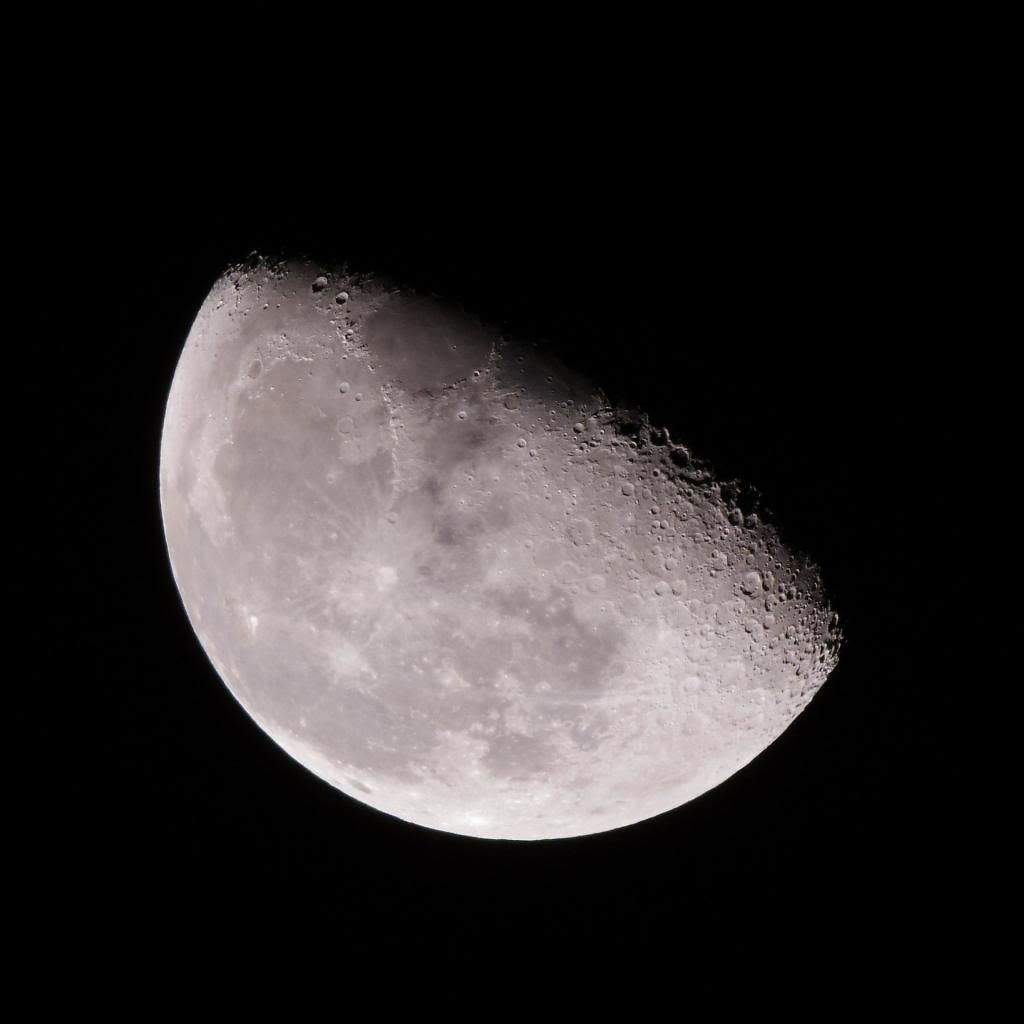
Shooting Moon with the Pentax Q and a F*300/4.5 K-mount Lens

Here is the result (from direct JPEG out of the Q, no major re-touching but just only resizing along with light sharpening):


( Click to Enlarge - All Rights Reserved: RiceHigh (c)2013 )

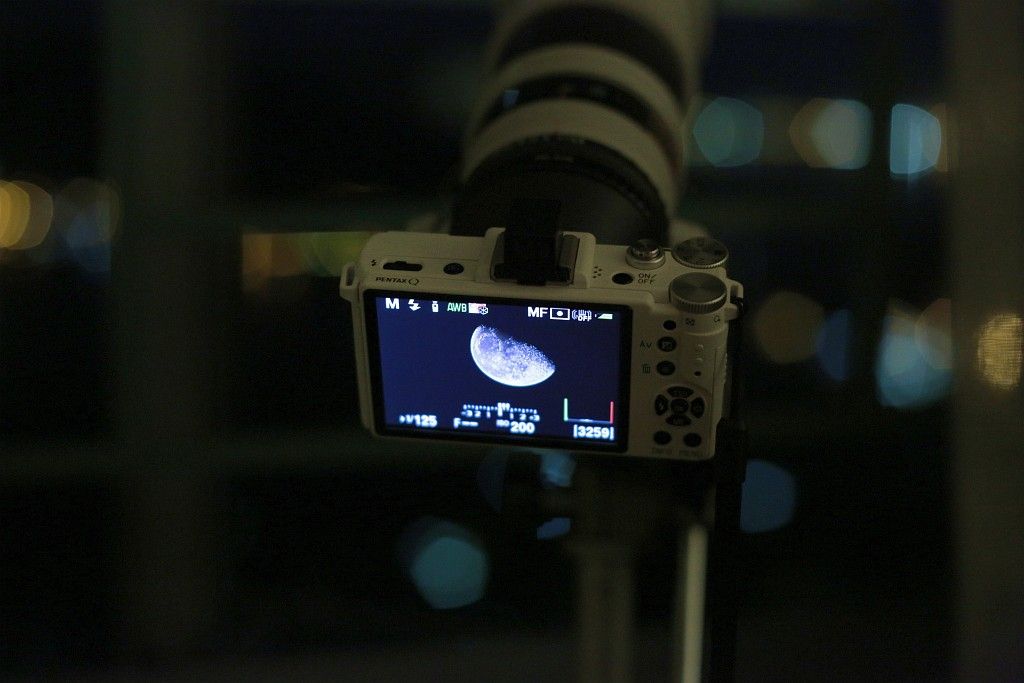
And the combo of my gear that used:


Indeed, there are quite some advantages of using the Q in shooting this type of photos, namely:

1. No mirror slap and even no shutter shock of any during the course of shooting, as electronic shutter is solely used;

2. Large magnification with higher pixel count and not much cropping is needed. The above is with effective focal length of 1680mm in 135, i.e., 300mm x 5.6;

3. Live View mode with focus peaking is especially useful for critical focusing with highest focusing accuracy that is required.

And, some techniques of mine:

1. Use spot metering and M mode, trying to expose to the Right as far as possible but avoid any highlight clipping. (As for the White Balance, AWB is just fine and will do the job);

2. Use IR remote controller to trigger the shutter (no Q camera supports the cable release) and take the shot to avoid any vibration at that very high magnification. Actually, some oscillations could be seen if the shutter release button is pressed directly;

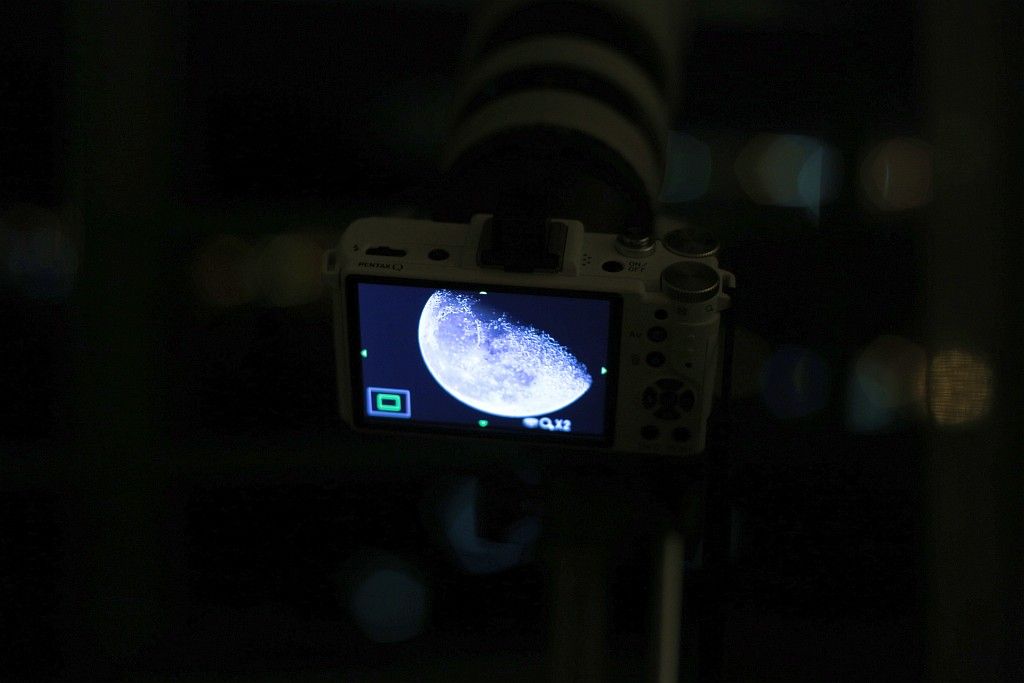
3. Use MF focus peaking in 2X or 4X to achieve even more accurate focusing. Choose the right magnification can help even better centering of the moon. In my case, I chose 2X, as shown below:


4. Do not use very high ISO of the Q as details will lose significantly and dynamic range will be more limited. I chose ISO 250 for the best compromise of a higher shutter speed but not too high an ISO speed;

5. Stop down the lens for sharper result. The above exposure combination is f/8 and 1/125s at ISO 250, i.e, one stop faster than base ISO.

Last but not least, a very high quality K-mount prime lens like my F*300/4.5 is required. Otherwise, all those optical imperfection will appear (as they are greatly magnified with the 5.6X crop factor) before anything is recorded! :-o


Related:

The Unbalanced Q - Part 2.5: Photo Samples

The Unbalanced Q - Part 2 (with a K-mount Lens)

Total Lunar Eclipse (2011-12-10, at Hong Kong)

Tuesday, August 13, 2013

New K-50 Official Full Samples are Now Available

http://www.ricoh-imaging.co.jp/japan/products/k-50/ex/index.html
(in Japanese)


Lenses used include DA*16-50, DA*55, DAL18-55, DA*50-135 and DA50/1.8. Measurbation Time Now!