http://www.olegkikin.com/shutterlife/
Six models of Pentax DSLRs are included. The results can also be compared to other camera models of other makes as well.
Showing posts with label K200D. Show all posts
Showing posts with label K200D. Show all posts
Saturday, December 29, 2012
Thursday, November 08, 2012
Incredible Macro Shots with Pentax K200D and K-x!
Look at these pictures:-
http://www.thomasshahan.com/photos/
And a YouTube video to explain the setup, procedures and techniques to take these wonderful shots:-
URL: www.youtube.com/watch?v=wqRn3at0H60
The lens was reversed with adaptor and with extension tube plus flash.
Via DPR Forum Post Here.
http://www.thomasshahan.com/photos/
And a YouTube video to explain the setup, procedures and techniques to take these wonderful shots:-
URL: www.youtube.com/watch?v=wqRn3at0H60
The lens was reversed with adaptor and with extension tube plus flash.
Via DPR Forum Post Here.
Thursday, January 12, 2012
Pentax SLR Cameras 1952-2011

(Updated: Click Above to Download a Larger Poster!)
Source: Pentax Germany @ Google Plus
Via: Chassimages Pentax Forum
Btw, does it have a larger version? :-(
Read Also:-
A (Pentax) Camera Catalogue Collector
Pentax SLR Cameras 1952-2008
Major Canon Cameras 1930 to 2010
Thursday, December 01, 2011
Sensor Used in the K-r and K-x (Sony IMX021 APS-C CMOS)

First of all, let's look at the original official product press release:-
http://www.sony.co.jp/SonyInfo/News/Press/200708/07-072/index.html
(in Japanese, Excite English Translation Here)
With a 12-channel output architecture, the IMX021 has a maximum frame throughput rate of 10.39 frames per second at full image resolution in 12 bits. So, the K-r has a maximum frame rate of 6 fps for maximum resolution JPEG (which is converted from 12-bit RAW sensor data down to 8 bits per colour channel of the JPEG format) which has not yet fully utilised the full potential of the sensor indeed. Of course, the bottle-neck for this maximum camera shooting rate is not at the sensor anymore.
Other feature of the sensor is a built-in programmable amplifier up to a maximum gain of 24dB. The rated output voltage (sensitivity) of the sensor (at f/5.6 with yellow light source of green colour signal) is in 500mV (or 0.5V, average figure) and the maximum saturated voltage is 1100mV (or 1.1V, minimum figure). If this is compared to the specs of the ancient 10MP CCD sensor ICX493 used in the K10D/K200D/K-m, it could be noted the improvement is not by that much indeed as whilst the IMX021 has slightly better sensitivity (so that there will be slightly less noise owing to less amplification required), the saturation level per pixel is close and similar. As such, it should say that actually the IMX021 is even more vulnerable to suffer from charge overflow which will result in highlight clipping of the pixels and then in the final image. But of course, the better image processing technologies and techniques of the later could always help, so as to compensate for this deficiency and to produce better results ultimately.
Besides, it is interesting to see that the initial set selling price, back to 2007 when it was first announced, of the IMX021 was in 40,000 Japanese Yens, which roughly equalled to be about US$400 by that time. Indeed, it was surely not cheap for the total cost of an entry-level DSLR body. I still remember that when I bought my K-x almost two years ago, it costed me for something just more than US$600. So, the profit margin by the camera manufacturer was really not that much, even though the price of the sensor could have been dropped and that in volume order that it could be cheaper.
For more details about the sensor, here is the product catalogue in pdf:-
http://www.sony.co.jp/Products/SC-HP/cx_pal/vol74/pdf/imx021.pdf
Unfortunately, the catalogue does not contain more information on the video recording part but only mentions once that the sensor supports it. Otherwise, I shall see if it is possible to record 1080p video like what older Canon APS-C CMOS sensor could actually do!
Related:-
Myth? CCD Has Better IQ Than CMOS? (A K-m Vs K-x Shootout and Riddle)
The Secrets of the K10D (Part 1 of 3) - The Heart: CCD Imager
K-r and K-x are Much Different!
Heart of the Pentax Q - Sony IMX078CQK Imager
Inside the Nikon D7000: The K-5 Sensor is There! ;-)
Wednesday, November 30, 2011
Supported Pentax DSLR Functions with Different Pentax Lenses
Read this question at the PF and I was surprised to see the reply by the site owner Adam (i.e., the first reply to the OP), which shows that Adam completely lacks the basic user/operation knowledge in using older manual (aperture) Pentax lenses on any Pentax DSLR! :-o
Maybe Adam has been given too many of the latest Pentax lenses (for "reviewing" or whatsoever) so that he has almost forgotten how older Pentax manual lenses would behave on all the Pentax digital bodies. Nevermind, I think it's my take now! Below are two summaries that I compile to let all my readers here know (or got refreshed for the knowledge if already known) about the basic technical features or limitations of our Pentax lenses back to the 60s of the last century and what they could or could not do for us with our Pentax DSLR bodies! :-)
N.B. I don't think that you can find ALL of the information below in any of the Pentax DSLR/lens user/operation manuals! ;-D
Table 1: Lens Data/Function Availability with different Pentax Lenses
Legend: Y= Yes/Available; "-" = No/Not Available; S = Supported depending on Lens Model (if Feature is Available)
*Remark: Limited/Partial Function - Only Auto Zoom Retract and Powered Zoom are Supported.
Table 2: Pentax DSLR Camera Function Availability with different Pentax Lenses
Legend: Y= Yes/Available; "-" = No/Not Available
Okay, is it and everything much clearer now? :-> And no need to make thanks to me, thank Adam instead! ;-p After all, I just won't make any reply over his premise to help others (and actually help him to make more money!) anymore (although Adam is really "kind" enough for not banning me!), as I decided and told two-and-a-half year ago! :-D
Further/Reference Read:-
K-Mount Metering and Exposure Bases - A Technical Brief
Related:-
Two Important Custom Functions for Proper Metering
Modding a Rikenon-P 50/1.7 Into an "A" Lens! :-o
Ten Things that I Want Ricoh to Do for Pentax
Hypocrites of the PentaxForums and Their Lies
Updating of my Blog Editing Direction
Maybe Adam has been given too many of the latest Pentax lenses (for "reviewing" or whatsoever) so that he has almost forgotten how older Pentax manual lenses would behave on all the Pentax digital bodies. Nevermind, I think it's my take now! Below are two summaries that I compile to let all my readers here know (or got refreshed for the knowledge if already known) about the basic technical features or limitations of our Pentax lenses back to the 60s of the last century and what they could or could not do for us with our Pentax DSLR bodies! :-)
N.B. I don't think that you can find ALL of the information below in any of the Pentax DSLR/lens user/operation manuals! ;-D
Table 1: Lens Data/Function Availability with different Pentax Lenses
| Lens Data and/or Function | Provision Means | M42 | K/M | _A_ | _F_ | _FA_ | FAJ/ DA/ DAL | DFA (1st Gen.) | DFA (2nd Gen.) |
| Wide-opened Metering | Instant Return Aperture Coupler | - | Y | Y | Y | Y | Y | Y | Y |
| Number of Steps Stopped-down (via Aperture Ring) | Mechanical Position Indicator | - | Y | Y | Y | Y | - | Y | - |
| Maximum Aperture | Array of Electrical Contacts | - | - | Y | Y | Y | Y | Y | Y |
| Minimum Aperture | Array of Electrical Contacts | - | - | Y | Y | Y | Y | Y | Y |
| Focal Length | (Advanced/Serial) Electronic Communication | - | - | - | Y | Y | Y | Y | Y |
| Focus Distance | Electronic Communication | - | - | - | Y | Y | Y | Y | Y |
| Lens ID | Electronic Communication | - | - | - | Y | Y | Y | Y | Y |
| MTF Data | Electronic Communication | - | - | - | - | Y | Y | Y | Y |
| Powered/Auto Zoom | Electronic Communication and KAF2 Power Contacts | - | - | - | - | S* | - | - | - |
| In-lens AF (SDM or DC Motor) | Electronic Communication and KAF2 Power Contacts | - | - | - | - | - | S | - | - |
Legend: Y= Yes/Available; "-" = No/Not Available; S = Supported depending on Lens Model (if Feature is Available)
*Remark: Limited/Partial Function - Only Auto Zoom Retract and Powered Zoom are Supported.
Table 2: Pentax DSLR Camera Function Availability with different Pentax Lenses
| Body Function | M42 | K/M | _A_ | _F_ | _FA_ | FAJ/ DA/ DAL | DFA (1st Gen.) | DFA (2nd Gen.) | *Remark |
| Wide-opened Metering | - | -* | Y | Y | Y | Y | Y | Y | Stopped-down metering is available with a push of button. |
| Multi-segment Metering | - | - | Y* | Y | Y | Y | Y | Y | Not as accurate as subject distance information is Not available (and hence is not included in the calculation). |
| Off-the-film TTL Flash Auto (*ist D and DS/DS2 Only) | Y | Y | Y | Y | Y | Y | Y | Y | TTL flash sensor underneath mirror is installed; No Pre-flash is required. |
| Off-the-film TTL Flash Auto (All Others) | - | - | - | - | - | - | - | - | No TTL flash sensor underneath mirror; P-TTL is mandatory for Auto Flash. |
| P-TTL (where P stands for Pre-flash) | - | - | Y* | Y | Y | Y | Y | Y | Not as accurate as subject distance information is Not available. |
| AF | - | - | - | Y | Y | Y | Y | Y | - |
| Lens Correction on Image | - | - | - | - | -/Y* | Y | Y | Y | Only the three FA Limited are Supported. |
Legend: Y= Yes/Available; "-" = No/Not Available
Okay, is it and everything much clearer now? :-> And no need to make thanks to me, thank Adam instead! ;-p After all, I just won't make any reply over his premise to help others (and actually help him to make more money!) anymore (although Adam is really "kind" enough for not banning me!), as I decided and told two-and-a-half year ago! :-D
Further/Reference Read:-
K-Mount Metering and Exposure Bases - A Technical Brief
Related:-
Two Important Custom Functions for Proper Metering
Modding a Rikenon-P 50/1.7 Into an "A" Lens! :-o
Ten Things that I Want Ricoh to Do for Pentax
Hypocrites of the PentaxForums and Their Lies
Updating of my Blog Editing Direction
Wednesday, November 09, 2011
New Lithium Rechargable Battery Type in AA Format - LiFePO4
Thanks to Blog reader Hayami, I've got known to this "new" battery type and product.
This new rechargeable Lithium technology is different from the conventional Lithium-ion or polymer ones, the native voltage is at about 3.45V and with a nominal rated voltage at 3.2V after some use. This voltage is actually very close to the added up voltage of two fresh disposable AA alkaline or lithium batteries. It is called the Lithium Iron Phosphate, or LiFePO4 in chemical term:-
http://en.wikipedia.org/wiki/Lithium_iron_phosphate

(Source: Chinese ZOL Forum)
As we can see from the above Wiki article, LiFePO4 does have many advantages over the other conventional Lithium rechargeable technologies. Yet, it shares the advantages of other lithium rechargeables such as no memory effect and a very low self-discharge rate.
Unlike the conventional Lithium rechargeables, no external voltage regulation is required to match the "1.5V" (x2) voltage requirement, which makes now it is possible to make AA sized battery in which including such a voltage regulation circuitry is almost impractical.
As for the internal resistance of the LiFePO4, it is less than 100 mOhm as specified, which is close to the rated 90 to 150 mOhm of the Energizer disposable AA Lithium L91. But however, since we use four ("1.5V") L91 in our Pentax AA DSLRs whilst only two are needed for the LiFePO4 (with two other dummy battery conductors to be inserted in series and used in conjunction), the total battery internal resistance is halved in comparison, as a result. This is considered still much relatively safer to use the NiZn rechargeable AA as its internal resistance is only at about 5 mOhm per battery unit only, which is considered just too low and too dangerous, as it might cause damage to device depending on the design of its circuitry.
And, here is an article which shows the inside of a charger product that is widely available at Taobao (aka the Chinese e-Bay). It seems that the charger is well made with good materials used and workmanship. The charger is manufactured by a Hong Kong vendor with factory in the mainland China btw.


The LiFePO4 charger is also available in USB format, by a different Chinese manufacturer, though:-

(Source: http://www.qqid.com/jk/shop_view.asp?id=158)
Nevertheless, one of the least drawbacks of the current LiFePO4 AA in the market is about its lower rated capacity in mAh, which is at 600 only. But with its superior voltage regulation throughout its whole discharge curve, it has been widely reported that the battery performance and life is still superior than all those NiMH rechargeables which are rated at 2,000mAH+ something, for most cases. Below is one set of the tested discharge characteristics for two different samples as posted:-

(Credit: http://www.920pk.com/shangpin_7291871215.htm)
After all, my set of 4 LiFePO4 AA batteries (with 4 dummy AA conductors) will arrive very soon. I will test it more thoroughly this week and shall write an user report/review of mine later on. But as you can see in all the above Chinese web-links, most of the user comments are very favourable and positive, with various different kinds of devices used, including DSLRs, DCs, torches and RC toys. Besides using that in my K-x, I am eager to try that in my Tayami QuickDrive (QD) toy racing car and see how faster my car could get with the increased power but yet far less weight that put inside for the batteries! :-D
Related:-
K-x Battery Issue Re-visited (with the Latest Firmware)
Better K-x Rechargable Solution? Is the NiZn Safe?
AA Battery Chargers Fully Compared (4 Models)
Overclocking Your Pentax (AA Battery) DSLR(s)!?
Six Years of AA Battery Pentax DSLRs
When 1100mAh Li-ion RCR-V3s Outperform 2500mAh+ NiMH AAs ..
This new rechargeable Lithium technology is different from the conventional Lithium-ion or polymer ones, the native voltage is at about 3.45V and with a nominal rated voltage at 3.2V after some use. This voltage is actually very close to the added up voltage of two fresh disposable AA alkaline or lithium batteries. It is called the Lithium Iron Phosphate, or LiFePO4 in chemical term:-
http://en.wikipedia.org/wiki/Lithium_iron_phosphate
(Source: Chinese ZOL Forum)
As we can see from the above Wiki article, LiFePO4 does have many advantages over the other conventional Lithium rechargeable technologies. Yet, it shares the advantages of other lithium rechargeables such as no memory effect and a very low self-discharge rate.
Unlike the conventional Lithium rechargeables, no external voltage regulation is required to match the "1.5V" (x2) voltage requirement, which makes now it is possible to make AA sized battery in which including such a voltage regulation circuitry is almost impractical.
As for the internal resistance of the LiFePO4, it is less than 100 mOhm as specified, which is close to the rated 90 to 150 mOhm of the Energizer disposable AA Lithium L91. But however, since we use four ("1.5V") L91 in our Pentax AA DSLRs whilst only two are needed for the LiFePO4 (with two other dummy battery conductors to be inserted in series and used in conjunction), the total battery internal resistance is halved in comparison, as a result. This is considered still much relatively safer to use the NiZn rechargeable AA as its internal resistance is only at about 5 mOhm per battery unit only, which is considered just too low and too dangerous, as it might cause damage to device depending on the design of its circuitry.
And, here is an article which shows the inside of a charger product that is widely available at Taobao (aka the Chinese e-Bay). It seems that the charger is well made with good materials used and workmanship. The charger is manufactured by a Hong Kong vendor with factory in the mainland China btw.
The LiFePO4 charger is also available in USB format, by a different Chinese manufacturer, though:-
(Source: http://www.qqid.com/jk/shop_view.asp?id=158)
Nevertheless, one of the least drawbacks of the current LiFePO4 AA in the market is about its lower rated capacity in mAh, which is at 600 only. But with its superior voltage regulation throughout its whole discharge curve, it has been widely reported that the battery performance and life is still superior than all those NiMH rechargeables which are rated at 2,000mAH+ something, for most cases. Below is one set of the tested discharge characteristics for two different samples as posted:-
(Credit: http://www.920pk.com/shangpin_7291871215.htm)
After all, my set of 4 LiFePO4 AA batteries (with 4 dummy AA conductors) will arrive very soon. I will test it more thoroughly this week and shall write an user report/review of mine later on. But as you can see in all the above Chinese web-links, most of the user comments are very favourable and positive, with various different kinds of devices used, including DSLRs, DCs, torches and RC toys. Besides using that in my K-x, I am eager to try that in my Tayami QuickDrive (QD) toy racing car and see how faster my car could get with the increased power but yet far less weight that put inside for the batteries! :-D
Related:-
K-x Battery Issue Re-visited (with the Latest Firmware)
Better K-x Rechargable Solution? Is the NiZn Safe?
AA Battery Chargers Fully Compared (4 Models)
Overclocking Your Pentax (AA Battery) DSLR(s)!?
Six Years of AA Battery Pentax DSLRs
When 1100mAh Li-ion RCR-V3s Outperform 2500mAh+ NiMH AAs ..
Cable Control Your (Pentax) DSLRs Using iPhone
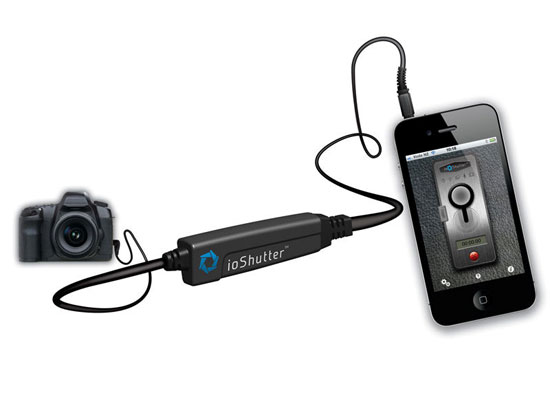
(Credit: DC Fever)
Using the ioShutter.
Now, if your Pentax DSLR has a cable release socket, then you can use your iPhone to fire the shutter remotely but wired, and with even more software control capabilities including interval shooting, programmable bulb and sound/movement trigger etc. A nice and welcome Pentax alternative of course. And with many people are having iPhones nowadays, it could come in handy, provided that the user also brings along with the proprietary interfacing release cable that is to be purchased from the ioShutter altogether with the App.
Related:-
Remote Control Your Camera Using Android Device
The Pentax (Electronic) Cable Switches
Friday, September 23, 2011
New Reviews for Antique Pentax DSLRs
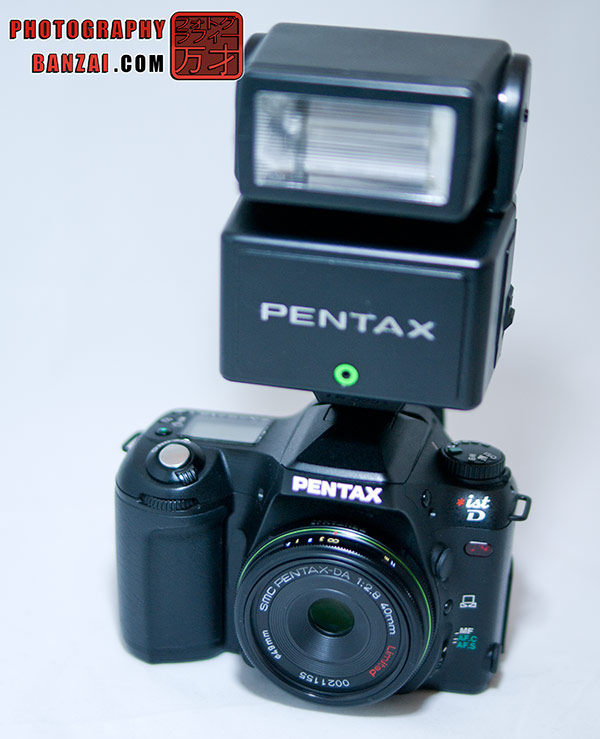

First, there is an *ist D review in 2011!
http://photographybanzai.com/2011/08/31/retro-digital-review-pentax-istd-camera-body/
Via 1001 Noisy Cameras
Next, here is a recent review of the K200D with a DA 18-55 WR (which is not the kit lens btw, but seems to be quite a perfect match):-
http://photographic-central.blogspot.com/2011/09/pentax-k200d-review-weatherproof-dslr.html
Via PF discussion thread here.
Monday, August 01, 2011
Microsoft Camera Codec Pack for Windows 7 and Vista
Is now available for download and supports the RAW files (PEF only) of various Pentax DSLRs from *ist D to K-x (and for many cameras of other brands as well):-
http://www.microsoft.com/download/en/details.aspx?id=26829
Go get it for the update if you are using Win7 or Vista (SP2 only) and you just want to have a quick preview of your RAW pictures at the Windows Explorer. Enjoy!
Btw, the latest Pentax K-5 and K-r are not officially supported, though. And neither the 645D is mentioned.
On the other hand, Pentax has their own RAW codec that supports K-5, K-r and 645D, but than all the 64-bit Windwows are not supported:-
http://www.pentax.jp/english/support/digital/rawcodec_win.html
http://www.microsoft.com/download/en/details.aspx?id=26829
Go get it for the update if you are using Win7 or Vista (SP2 only) and you just want to have a quick preview of your RAW pictures at the Windows Explorer. Enjoy!
Btw, the latest Pentax K-5 and K-r are not officially supported, though. And neither the 645D is mentioned.
On the other hand, Pentax has their own RAW codec that supports K-5, K-r and 645D, but than all the 64-bit Windwows are not supported:-
http://www.pentax.jp/english/support/digital/rawcodec_win.html
Thursday, July 21, 2011
Pentax K Series Ranks Below Average in a Recent DSLR User Satisfaction Survey by J.D. Power

"A study conducted by market research firm J.D. Power and Associates has found that “Nikon Pro Series” DSLRs rank highest in customer satisfaction. The company surveyed 4,500 verified online DSLR buyers to find out their satisfaction across five factors: image quality, durability, features, ease of use, and responsiveness."
From: http://www.petapixel.com/2011/07/19/nikon-ranks-highest-in-online-customer-satisfaction-among-dslr-buyers/
Via: http://forums.dpreview.com/forums/readflat.asp?forum=1036&thread=38944858
Actually, Pentax K ranks No. 5 amongst 7 with a "just-failed" mark of 883 below the passing mark of 887. Nevertheless, the K is still ahead of the Canon Rebel as well as the Sony A, which is ranked last.
Sunday, June 05, 2011
Excellent AA Battery Review by Type
Written by the Photo Rumors:-
http://photorumors.com/2011/06/04/what-are-the-best-aa-batteries-for-photography/
I think this detailed review is really a good read.
Related:-
AA Battery Chargers Fully Compared (4 Models)
How to Resolve the K-x Battery Problem?
Better K-x Rechargable Solution? Is the NiZn Safe?
http://photorumors.com/2011/06/04/what-are-the-best-aa-batteries-for-photography/
I think this detailed review is really a good read.
Related:-
AA Battery Chargers Fully Compared (4 Models)
How to Resolve the K-x Battery Problem?
Better K-x Rechargable Solution? Is the NiZn Safe?
Tuesday, March 01, 2011
New Version of the PK Tether is Out

http://www.pktether.com/new-version-0-4-5
What's New:-
Release version 0.4.5 PK_Tether – changes:
- added drive mode changing
- added white balance changing
- added flash mode and compensation changing
- added extended ISO detecting
- added zoom functionality
- added support for k-m/k2000 and maybe Samsung GX10
- reworked user interface
- fixed bugs
If you really need such a tethering software, which Pentax had dropped the support of the "Remote Assistant" software since the *ist Dx days, this one is for you. At least it will work with the K-x and the K-m, possibly with the K10D/GX-10 also.
Update (3-3): In the main page of the PK Tether, it is now told that it supports Pentax K-x, K-7, K-5, K-r, K20D, K10D and K200D.
Previous Related:-
Tethering Software for the K-x (3rd Party Freeware)
Tethering the Current Pentax DSLRs?
Monday, January 03, 2011
Some Bits and Pieces (1-3)
1. Sony to double image sensor output, via buy back chip plant from Toshiba:-
http://www.reuters.com/article/idUSTOE6BQ04420101227
http://www.reuters.com/article/idUSSGE6BL0B220101222
2. A new K-r review with image crops for measurbation:-
http://www.cyberphoto.se/?info.php?article=K-rsvart
(in Swedish, Google English Translation Here)
Related: http://ricehigh.blogspot.com/2010/11/yet-k-5-brief-review-with-full-original.html
3. A trick for faster image zooming review for for K-5/K-7/K10D/K20D/K200D (and a few other Pentax DSLRs - but some do not work with this trick, e.g., the K-x):-
http://www.dchome.net/viewthread.php?tid=971802&extra=page%3D1
(in Chinese, Google English Translation Here)
In short, it states about when zooming is activated in image playback review mode, in addition to turning the e-dial for zooming in and out, the EV compensation (+/-) button and the Green button can be pressed and continuous zooming-in or out action is possible, which could provide a quicker access and minimise the wear and tear of the e-dial.
As a side-tip of mine, no matter what Pentax DSLR model(s) you use, if you just want to zoom in larger instantaneously without turning the e-dial for cycles. There is an option of "Quick Zoom" under the "Playback Display Method" menu. Just enter a zoom ratio you prefer once you turn the e-dial for zooming during image review. That's it! :-)
http://www.reuters.com/article/idUSTOE6BQ04420101227
http://www.reuters.com/article/idUSSGE6BL0B220101222
2. A new K-r review with image crops for measurbation:-
http://www.cyberphoto.se/?info.php?article=K-rsvart
(in Swedish, Google English Translation Here)
Related: http://ricehigh.blogspot.com/2010/11/yet-k-5-brief-review-with-full-original.html
3. A trick for faster image zooming review for for K-5/K-7/K10D/K20D/K200D (and a few other Pentax DSLRs - but some do not work with this trick, e.g., the K-x):-
http://www.dchome.net/viewthread.php?tid=971802&extra=page%3D1
(in Chinese, Google English Translation Here)
In short, it states about when zooming is activated in image playback review mode, in addition to turning the e-dial for zooming in and out, the EV compensation (+/-) button and the Green button can be pressed and continuous zooming-in or out action is possible, which could provide a quicker access and minimise the wear and tear of the e-dial.
As a side-tip of mine, no matter what Pentax DSLR model(s) you use, if you just want to zoom in larger instantaneously without turning the e-dial for cycles. There is an option of "Quick Zoom" under the "Playback Display Method" menu. Just enter a zoom ratio you prefer once you turn the e-dial for zooming during image review. That's it! :-)
Wednesday, November 17, 2010
K-r Focus Varies with Different WB Settings! +_="
See this experiment by this Pentaxian whom has newly purchased a K-r:-
http://www.dchome.net/viewthread.php?tid=953899&extra=page%3D1
(Traditional Chinese, Google Translated English Page Here)
In this reply post, the OP writes the test conditions of his and and the shocking finding/conclusion of his experiment:-
http://www.dchome.net/viewthread.php?tid=953899&page=1#pid11231193
Translated, "On tripod, 2 sec self-timer, with each WB setting 5 shots were taken (3 from infinity to a mid-distance object and 2 from near distance to the same object for the lens), the focus for each WB group are close enough whilst the focuses between different WB groups are very different! So, it is concluded that a (different) WB setting actually changes the focus. If it is not a real problem, I have nothing more to say!"
He also stated that he has been a user of K100D, K200D, K-m and K-x also and has never ever encountered the same problem! He further said that he would go to the local Pentax Customer Service Centre for help when he has the time. But what can I say to him is just: Good Luck, Guy! May God bless You!!
I dare to bet they will "play" him to death till the end of the world without any practical solution nor any real and responsible action that could help the suffered users, as that have been happening and being reported from time to time by our Pentax users, almost daily! >:-[
http://www.dchome.net/viewthread.php?tid=953899&extra=page%3D1
(Traditional Chinese, Google Translated English Page Here)
In this reply post, the OP writes the test conditions of his and and the shocking finding/conclusion of his experiment:-
http://www.dchome.net/viewthread.php?tid=953899&page=1#pid11231193
Translated, "On tripod, 2 sec self-timer, with each WB setting 5 shots were taken (3 from infinity to a mid-distance object and 2 from near distance to the same object for the lens), the focus for each WB group are close enough whilst the focuses between different WB groups are very different! So, it is concluded that a (different) WB setting actually changes the focus. If it is not a real problem, I have nothing more to say!"
He also stated that he has been a user of K100D, K200D, K-m and K-x also and has never ever encountered the same problem! He further said that he would go to the local Pentax Customer Service Centre for help when he has the time. But what can I say to him is just: Good Luck, Guy! May God bless You!!
I dare to bet they will "play" him to death till the end of the world without any practical solution nor any real and responsible action that could help the suffered users, as that have been happening and being reported from time to time by our Pentax users, almost daily! >:-[
Wednesday, November 03, 2010
K-r DxOMark and Yet Another ISO Test (Full Sized but Not Original)
The DxOMark of the K-r has been out. It gets an overall score of 72.
Below are some of those endless comparisons, using the "compare" tool at the DxOMark page:-
K-x Vs K-r Vs K-7 (Well, the K-x has slightly better high ISO noise and very marginally better DR..)
A33 Vs K-r Vs A55
K-m Vs K-r Vs K200D
D5000 Vs K-r Vs D3100
550D Vs K-r Vs 60D
and so on.. that you can compare endlessly till the end of the world! ;-) There is no K-5 comparison though as the DxOMark for K-5 hasn't yet been out. :-(
Besides, here is an ISO comparison on the same scene with pics posted in full sized, but compressed and without EXIF:-
http://www.pentaxforums.com/forums/pentax-dslr-discussion/120750-k-r-iso-test.html
So, happy measurbations after all!
Related:-
K-r Vs K-x ISO Measurbations (Head to Head)
My K-r First Hands-ons (Tested Twice)
Below are some of those endless comparisons, using the "compare" tool at the DxOMark page:-
K-x Vs K-r Vs K-7 (Well, the K-x has slightly better high ISO noise and very marginally better DR..)
A33 Vs K-r Vs A55
K-m Vs K-r Vs K200D
D5000 Vs K-r Vs D3100
550D Vs K-r Vs 60D
and so on.. that you can compare endlessly till the end of the world! ;-) There is no K-5 comparison though as the DxOMark for K-5 hasn't yet been out. :-(
Besides, here is an ISO comparison on the same scene with pics posted in full sized, but compressed and without EXIF:-
http://www.pentaxforums.com/forums/pentax-dslr-discussion/120750-k-r-iso-test.html
So, happy measurbations after all!
Related:-
K-r Vs K-x ISO Measurbations (Head to Head)
My K-r First Hands-ons (Tested Twice)
Saturday, September 25, 2010
The Pentax (Electronic) Cable Switches
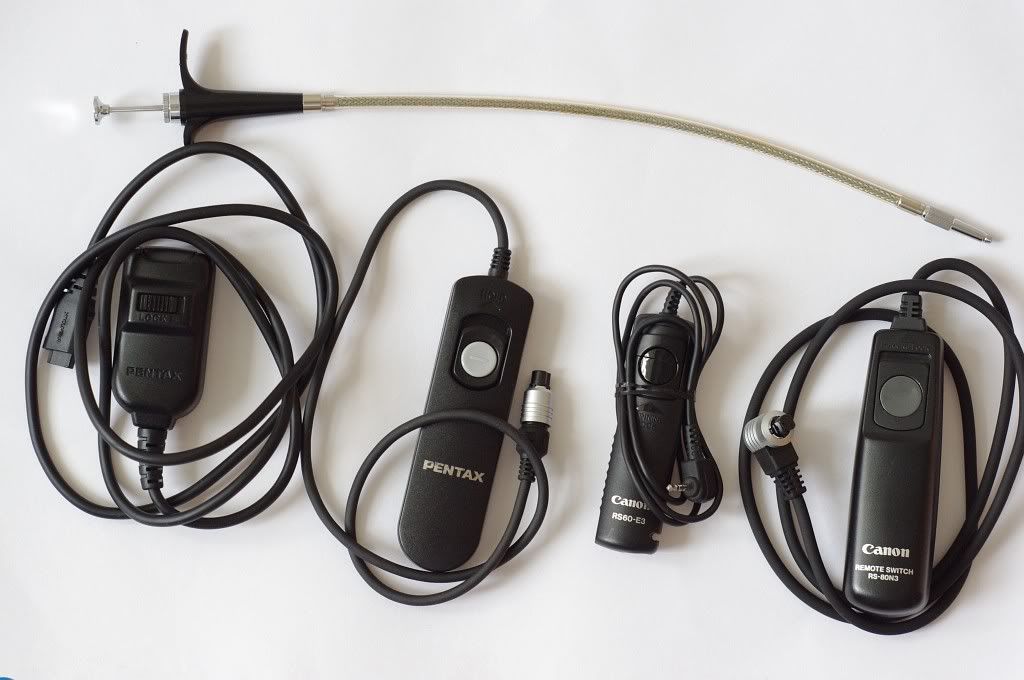
Above: All Cable Releases of Mine; From Left to Right: Pentax Cable Switch F, Pentax CS-105, Canon RS-60E3, Canon RS-80N3; Top: Traditional Universal Mechanical Flexible Cable Release.
| Cable Switch | For Camera(s) | Period |
| Cable Switch F | SF Series, (P)Z Series, MZ Series (Except MZ-S) | 1987 - 2002 |
| CS-105 | MZ-S | 2001 |
| CS-205 (Canon RS-60E3 Clone) | *ist, *ist D Series, K(number)D Series, K-number Series | 2003 - Now |
| No Support | K-alphabet Series, i.e., K-m, K-x & K-r | 2009 - Now |
The CS-105 is actually the most professionally designed and built cable switch that Pentax has ever made. But unfortunately, it supports/supported only the MZ-S. It has the same design as the Canon upper Remote Switch RS models for their upper class AFSLRs/DSLRs only. The design has an automatic mechanical lock so that the cable switch cannot be detached accidentally. To detach, one must hold and press the silver portion of the connector which will release the lock as you can see from the above photo, for both the CS-105 and RS-80N3. It has one disadvantage IMO, though. That is, the insertion of the connector is directional, which is really no good for inserting the cable in the dark, but which is usually the situation in which the user usually requires to use the cable switch/release!
I didn't buy the CS-205, though, when I acquired my *ist D. I was indeed somehow "angry" with Pentax for changing the cable switch after only one model. As the CS-205 is just a Canon low-end "RS" clone but which was sold at doubled price and was more difficult to find than the Canon (as usual, for all Pentax items!), I opted to buy the Canon. Anyway, even the Canon is of no use to me anyway for more than one year now, as my current and last Pentax DSLRs, namely, the K-x and K-m, just does not support any cable switch/release for each of them (and so does the upcoming K-r)!
Update (9-28): Some people doubt about the usefulness of a wired cable switch and release. I would like to elaborate a bit more about its true value for some applications and the differences underlaid..
1. A cable release actually consists of two switches, one for the half-pressing and the other for shutter release. An IR release controls only one switching, i.e., the release of shutter. Some IR remote controllers of Pentax like those that I built-in with my Zoom 90 WR and purchased together with my Optio 330 have the zoom control, but then so what?
2. The control of the half-press is crucial if you want also to control AE and in most cases, the AF, just like what we are using the cameras daily. Just imagine that when you use a DSLR without half-press function, then.. I think I needless to say more! For some shooting applications like shooting concerts on monopod/tripod or to track racing cars and panning where direct pressing of shutter button is not desirable so as to avoid shakes right before the exposure, a cable release is particular useful - but still we need to do and control the AE and AF, right?
3. An IR controller needs to point directly to the IR receiver and sensor at the body (which is located in the front for Pentax DSLR bodies) as long as it is pressed for the "Bulb" control. With the K-x, the user can choose in the Custom Function that for a "two-press" operation, i.e., to press one to open the shutter and press another time to close it. No matter how, this is not as convenient, reliable, direct and responsive as what a simple wired cable release can do for the user. One of the good examples of application is shooting fireworks, where timing is really critical if you are really using the shutter to control the (multiple) exposures instead of using a black card in front of the camera with a long bulb mode. An old example of mine:-

(Canon EOS 5D: f/16, 5s, ISO 100, 24-105L @24mm, RAW post-processed with DPP, Cable Release Used; Photo taken in Feb. 2008 @ Victoria Harbour, Hong Kong - Click to Enlarge in New Tab/Window)
P.S. I might upload some more fireworks plus some concert or racing car photos later on, as most of my old shared photos were already deleted at my old Yahoo Geocities account which I cancelled but they are not re-uploaded.
Friday, July 02, 2010
Overclocking Your Pentax (AA Battery) DSLR(s)!?
See this experiment done by a K200D guy for the physical and performance differences found and measured when using different battery types:-
http://www.dchome.net/viewthread.php?tid=883911
(in Traditional Chinese, Google translated English page here)
So, his comparisons and results are tabulated:-
So, it is clear that the NiZn wins all, it is lighter and yet more powerful. But this may also be too powerful for the Pentax AA DSLRs to tolerate, as the voltage might be too high and more importantly, the internal resistance of the NiZn is just too low, this may put some electronics and components inside our cameras at risk, in particular the built-in flash, I bet - Read my this previous article for more details:-
Better K-x Rechargable Solution? Is the NiZn Safe?
Anyway, if you hate much the NiMH battery performance and reliability in your Pentax AA battery DSLR(s) (I DO), and if you might want to overclock your DSLR(s) for better performance, you may give the NiZn a trial. But remember, do this at your own risk and you might get your camera burnt and damaged in the end!
P.S. Recently when I did some prolonged movie recording (which was just for a few minutes continuously for each clip and then clip after clip, air-conditioned indoor) with my K-x with fully-charged NiMHs in it, it quitted and left the "LiveView" mode a few times prematurely without any warning. The battery indicator changed from green to yellow (half-depleted) and then to red (fully depleted) and back to green after enough rest! This is really annoying as I found that when I did the same with the Canon 550D, even under a hot sun and high temperature outdoor, and for even longer recording time, no problem ever happened! That AA battery rechargeable "solution" used by Pentax in any Pentax AA DSLR does really SUCK, I have to say! >:-( It's just now an unique Pentax problem anyway, for the current lines and models of DSLRs that are in the market.
Read Also:-
AA Battery Chargers Fully Compared (4 Models)
http://www.dchome.net/viewthread.php?tid=883911
(in Traditional Chinese, Google translated English page here)
So, his comparisons and results are tabulated:-
| Battery Type: | NiMH (Sanyo 2500 mAh) | AA Lithium (Energizer) | NiZn (PowerGenix) |
| Total Weight (4 x AAs): | 115g | 98g (85%) | 58g (50%) |
| AF Motor Speed (from 00 to nearest w/ DA 16-45) | 0.316s | 0.254 (80%) | 0.211s (67%) |
| Voltage (Per Cell): | 1.38V (-8% Lower than the Designed 1.50V Nominal Voltage) | 1.72V (+15% Higher) | 1.78V (+19% Higher) |
So, it is clear that the NiZn wins all, it is lighter and yet more powerful. But this may also be too powerful for the Pentax AA DSLRs to tolerate, as the voltage might be too high and more importantly, the internal resistance of the NiZn is just too low, this may put some electronics and components inside our cameras at risk, in particular the built-in flash, I bet - Read my this previous article for more details:-
Better K-x Rechargable Solution? Is the NiZn Safe?
Anyway, if you hate much the NiMH battery performance and reliability in your Pentax AA battery DSLR(s) (I DO), and if you might want to overclock your DSLR(s) for better performance, you may give the NiZn a trial. But remember, do this at your own risk and you might get your camera burnt and damaged in the end!
P.S. Recently when I did some prolonged movie recording (which was just for a few minutes continuously for each clip and then clip after clip, air-conditioned indoor) with my K-x with fully-charged NiMHs in it, it quitted and left the "LiveView" mode a few times prematurely without any warning. The battery indicator changed from green to yellow (half-depleted) and then to red (fully depleted) and back to green after enough rest! This is really annoying as I found that when I did the same with the Canon 550D, even under a hot sun and high temperature outdoor, and for even longer recording time, no problem ever happened! That AA battery rechargeable "solution" used by Pentax in any Pentax AA DSLR does really SUCK, I have to say! >:-( It's just now an unique Pentax problem anyway, for the current lines and models of DSLRs that are in the market.
Read Also:-
AA Battery Chargers Fully Compared (4 Models)
Wednesday, June 23, 2010
DxOMark Lenses on Bodies Measurbation Paradise! :-o
Here you can go and enter another paradise of measurbators! (but actually might be a new hell for true photographers! ;-D) A step-by-step guide below!
1. Go to:-
http://www.dxomark.com/index.php/en/Lens-with-Camera/All-tested-lenses
First of all, you can select the "Filtered View" if you like. I think this can be useful when the test database continues to grow;
2. Choose the Lens Model and then the Camera Body, then you can see the "Overview" of a summary (on scores);
3. Go to the Individual Tab to view different page/test results of "Resolution", "Transmission", "Distortion", "Vignetting" or the "CA";
4. There are Sub-Tabs to see/access to all the test data at different Focals (for zooms) and different Apertures. Just choose it, appropriate charts and graphs will be shown. There are also "Field Map" representations, which are simply a plot of the image frame with different colours to represent the results and different performance aspects measured.
With doing the above four steps, dig into different sub-tabs and choose different focal/aperture combinations and then compare different lens/body and so on, you will be a true qualified measurbator! Congrats! But before you are to do this endlessly, do remember time will always be not enough and is killed very quickly as such!
Two quick observations, btw:-
1. High resolution bodies do have a clear edge for obtaining higher scores, especially for the aggregrated mark of "Lens Peak Score".
2. Full Frame cameras perform better, even for the same pixel count and equivalent effective 135 focal length and FoV.
Besides, some more quick reading notes and remarks:-
1. "TStop" is just the actual f-stop measured for the lens (wide opened) at specific focal length, the EV stop differences against the specified ones at different focal lengths are represented at second plot chart below.
2. The MTF charts should be read as they always should, it is just a plot of the Modulated Transfer Function (the difference between the levels of Black and White) against the (different) Spatial Frequencies. Normally, MTF 50% is the default threshold for measuring Resolution, but of course a different MTF value can always be chosen, no matter it is higher or lower. Of course, should the set MTF threshold is set to be higher, the Resolution results drop and vice versa.
3. The measured "Resolution" of lp/mm (line pairs per millimeter) is NOT normalised for the sensor size and format but just a physical measure on the actual resolution regardless of the sensor size. On the other hand, another commonly used (but newer) resolution measurement unit LW/PH (Line Widths per Picture Height) is normalised. So, this should be something that you should be aware of. Just say with exactly the same resolution figure for both an APS-C combo and a Full Frame combo, indeed the FF just outperforms the APS-C as the resolution of the APS-C is needed to be "magnified" just for the same printout and viewing size of the "same" picture.
Read Also:-
Useful Lens Review Links
A New Measurebators' Paradise!
1. Go to:-
http://www.dxomark.com/index.php/en/Lens-with-Camera/All-tested-lenses
First of all, you can select the "Filtered View" if you like. I think this can be useful when the test database continues to grow;
2. Choose the Lens Model and then the Camera Body, then you can see the "Overview" of a summary (on scores);
3. Go to the Individual Tab to view different page/test results of "Resolution", "Transmission", "Distortion", "Vignetting" or the "CA";
4. There are Sub-Tabs to see/access to all the test data at different Focals (for zooms) and different Apertures. Just choose it, appropriate charts and graphs will be shown. There are also "Field Map" representations, which are simply a plot of the image frame with different colours to represent the results and different performance aspects measured.
With doing the above four steps, dig into different sub-tabs and choose different focal/aperture combinations and then compare different lens/body and so on, you will be a true qualified measurbator! Congrats! But before you are to do this endlessly, do remember time will always be not enough and is killed very quickly as such!
Two quick observations, btw:-
1. High resolution bodies do have a clear edge for obtaining higher scores, especially for the aggregrated mark of "Lens Peak Score".
2. Full Frame cameras perform better, even for the same pixel count and equivalent effective 135 focal length and FoV.
Besides, some more quick reading notes and remarks:-
1. "TStop" is just the actual f-stop measured for the lens (wide opened) at specific focal length, the EV stop differences against the specified ones at different focal lengths are represented at second plot chart below.
2. The MTF charts should be read as they always should, it is just a plot of the Modulated Transfer Function (the difference between the levels of Black and White) against the (different) Spatial Frequencies. Normally, MTF 50% is the default threshold for measuring Resolution, but of course a different MTF value can always be chosen, no matter it is higher or lower. Of course, should the set MTF threshold is set to be higher, the Resolution results drop and vice versa.
3. The measured "Resolution" of lp/mm (line pairs per millimeter) is NOT normalised for the sensor size and format but just a physical measure on the actual resolution regardless of the sensor size. On the other hand, another commonly used (but newer) resolution measurement unit LW/PH (Line Widths per Picture Height) is normalised. So, this should be something that you should be aware of. Just say with exactly the same resolution figure for both an APS-C combo and a Full Frame combo, indeed the FF just outperforms the APS-C as the resolution of the APS-C is needed to be "magnified" just for the same printout and viewing size of the "same" picture.
Read Also:-
Useful Lens Review Links
A New Measurebators' Paradise!
Monday, May 31, 2010
For Those Who Think the DA 17-70 is the Fastest SDM Lens in AF..
First, see this:-
http://www.youtube.com/watch?v=Ewcgq9tmPfw
Then, this comparison (on the AF motoring speed alone):-
http://www.youtube.com/watch?v=n1ap2OjrfVQ
http://www.youtube.com/watch?v=2Jdcpsf1Qas
Well, this time, I blog, YOU decide! (I just don't make any comments!)
Read Also:-
AF Speed Difference of K-m Vs K20D
http://www.youtube.com/watch?v=Ewcgq9tmPfw
Then, this comparison (on the AF motoring speed alone):-
http://www.youtube.com/watch?v=n1ap2OjrfVQ
http://www.youtube.com/watch?v=2Jdcpsf1Qas
Well, this time, I blog, YOU decide! (I just don't make any comments!)
Read Also:-
AF Speed Difference of K-m Vs K20D
Thursday, April 22, 2010
Firmware Updates for the K-m, K20D, K200D and K10D
Just announced at the Pentax Japanese Homepage:-
http://www.pentax.jp/japan/imaging/index.php
Direct firmware update and download pages:-
http://www.pentax.jp/japan/support/download/digital/km_s.html
http://www.pentax.jp/japan/support/download/digital/k20d_s.html
http://www.pentax.jp/japan/support/download/digital/k200d_s.html
http://www.pentax.jp/japan/support/download/digital/k10d_s.html
(All pages in the above URLs are in Japanese)
There is only one change for all the above firmware updates, though. That is, to "improve the stability of SDHC cards for photo recording". It is not really an exciting update with no new functionality after all but it is still good to see Pentax does support their old product to ensure better compatibility with new SD cards even for a really old product like the K10D which was discontinued years ago.
http://www.pentax.jp/japan/imaging/index.php
Direct firmware update and download pages:-
http://www.pentax.jp/japan/support/download/digital/km_s.html
http://www.pentax.jp/japan/support/download/digital/k20d_s.html
http://www.pentax.jp/japan/support/download/digital/k200d_s.html
http://www.pentax.jp/japan/support/download/digital/k10d_s.html
(All pages in the above URLs are in Japanese)
There is only one change for all the above firmware updates, though. That is, to "improve the stability of SDHC cards for photo recording". It is not really an exciting update with no new functionality after all but it is still good to see Pentax does support their old product to ensure better compatibility with new SD cards even for a really old product like the K10D which was discontinued years ago.
Subscribe to:
Posts (Atom)