Web Analytics RiceHigh's Pentax Blog: Search results for sdm issues
Showing posts sorted by relevance for query sdm issues. Sort by date Show all posts

Sunday, January 17, 2010

The SDM Petition Online

Update (2-11): The Petition has been exploding! Currently there are 656 signatures already. I have not signed yet, though, so as to keep me "neutral" in the case! ;-)

--
Just read a post at the DPR Pentax SLR Forum about the subject issue, quoted:-

"Someone at Pentaxforums has created a petition regarding the unacceptable SDM from Pentax.

I think this is a good idea.
There must happen something.

Here is the link if you want to read it and sign it:
http://www.petitiononline.com/593039/petition.html"

And, the latest signature and comment page is here:-

http://www.petitiononline.com/mod_perl/signed.cgi?593039&1

I do encourage any Pentaxian to sign and write something if you feel the same. In fact, what I think Pentax/Hoya should, in the following order of sequence and priority:-

1. Review the SDM design and/or the manufacturing process so as to improve its reliability (make it not so vulnerable) and performance (running/working at a higher speed);

2. Initiate Product Recall for all the affected users and provide Free upgrade/replacement services, after the latent defect(s) has(have) been located and hardware revision/update has been achieved;

3. Update the Firmware of Pentax DSLRs to allow an Option to select whether the users want to use SDM or screwdrive for AF if their lenses support both, i.e., namely, only the DA*16-50 and the DA*50-135.

For more SDM issues as reported and documented in my this Blog, you can use the Search funciton, e.g.:-

http://ricehigh.blogspot.com/search?q=sdm+issues

Thursday, July 08, 2010

DPR SDM Failure Summary List

A DPR Pentax forum user has been updating a list for most of the SDM failure cases that have been reported at the DPR and discovered/counted by him so far:-

http://forums.dpreview.com/forums/readflat.asp?forum=1036&thread=35746036

Here are the latest statistics, as at the time I make this post:-

"Lens - # of reported issues
16-50mm - 40
50-135mm - 34
17-70mm - 6
60-250mm - 0
55mm - 0
200mm - 2
300mm - 6
Number of lenses with issues - 88"

via https://spreadsheets.google.com/ccc?key=0AoOE9_TdlzaNdHl0U0ljXzUyR1FvX2pkRU1YZGNFbWc&hl=en#gid=0
(Good Job, Russell! Well Done! :-))

Hence, once again the SDM issue and unreliability is confirmed. But then particular fanboys would still argue and defend endlessly that the number of reported cases is small and thus "negligible" and there is far more number of SDM lenses sold so far. But I think they just lack minimal logic by saying so and in fact they have no valid argument and point of any at all.

It is because we cannot assume all Pentax SDM owners/users read the DPR forum. Secondly, we cannot assume all the DPR readers reported their failure cases. Thirdly, we cannot assume that those who have not reported did not face any problem (and vice versa anyway). But then one thing is *for sure*, for those who reported, the case is more or less the same and the reported cases are NOT "negligible", that is, there have been A LOT OF failure reports of different SDM lenses already.

If the above summary and cases for what has been reported in details at the DPR are not adequate, just go read back the last SDM Petition elsewhere online, then one can find many more of the failure report(s) (although with less details given per case):-

http://ricehigh.blogspot.com/2010/01/sdm-petition-online.html

Well, will Pentax Imaging or Pentax respond? I am afraid NOT! And I bet NOT! And I am almost for sure! It seems that they will just let the problem "go" quietly till the end of the days!! >:-| (Ned, it's your take now, will you show up? Why not discussing with the Pentax/Hoya HQs to see what can/should Pentax do?? Still busy with arranging lucky draws with the PentaxForums? ;->)

Tuesday, November 02, 2010

Pentax Completely Abandons Screw-drive Body-AF for All Upcoming New Lenses (If Any!) >:-[

This is disclosed from an interview with the senior officials of the Pentax Imaging, at the recently held New York PhotoPlus Expo:-

http://enticingthelight.com/2010/11/01/speaking-to-pentax-at-photoplus-expo-in-new-york/

Quoted:-
  • DC is a new type of in-lens focusing motor that’s intended for consumer lenses. DA* lenses will incorporate the higher grade SDM focusing.
  • Going forward, all DA lenses will have DC focusing only, losing the screwdrive option. The exception will be the DA Limited lenses, which will stick with screwdrive focusing.
  • The new DC 18-135mm f/3.5-5.6 is DA focus only and will be available within a few weeks (the display unit I tried out is a preproduction model). It is “weather resistant” and has a metal mount. Price will be $530 in the US.
  • Still no official statement from Pentax about the SDM failures. I was told Pentax USA was aware of the issues people were reporting, but that it was Pentax Japan who had to acknowledge a problem (if there is one). Pentax USA doesn’t know if the alleged issue is being addressed, but I was told the engineers are continually working on improving their designs so it could be new SDM lenses would be more resilient. As of now, Pentax Japan have not informed them of an SDM II being developed.
  • No word on any possible new lenses.
Well.. Oh, NO! >:-{

When some people are always blaming me for being "negative" from time to time. But in reality, aren't all these news are just too discouraging enough? Mind that almost every person writes his/her own words in the Internet now, and I am surely not the only Pentaxian who are being "negative". Do note that the above are all told by the senior officials of the Pentax Imaging of USA. I believe that the author does not mis-quote what the officials said.

At the end of this post, I just can't help myself and just wish to ask: With the drop of backward system compatibility with all the new lenses (which are yet unknown for their actual existence!), why people should go Pentax now? Just because their SDM is known to be particularly superior in performance and more reliable?? Besides, it should be noted that the performance and reliability of the DC motor is yet not proven, but time will tell.

Finally, do note that if they now could abandon the support of those a bit older DSLR bodies that were made only back to 2006 (K100D and before), a few years later they can yet once again abandon the support of the *current* screw-driven DA/FA Limited lenses on their new bodies, which possibly by that time will only support lenses that have an in-lens AF motor in them. So, this would be something that we should really think about..

Indeed, Pentax *was* the company whom once had insisted the most on system forward and backward compatibilities. But now, everything shows that Hoya just breaks this good tradition too easily, but without good enough reasons, which is rather disgusting after all!


Read Also:-

1,000 Signatures of the Pentax SDM Petition Online!

Really NO MORE HOPE WITH PENTAX (Dozen Reasons for WHY NOT PENTAX NOW)

Pentax Starts to Drop Support for Body Driven AF

Thursday, February 26, 2009

SDM Reliability Issue

I have seen yet again another Pentax user reported failure of the Supersonic Drive Motor (SDM) of his SDM lens:

http://forum.pentaxfans.net/showthread.php?t=73981

(Text in Traditional Chinese, use Babelfish or Google Translate to translate if needed)

He said that he bought his lens in August last year and has used his lens only for 3 times!

In fact, the SDMs of the DA* 16-50 and the DA* 50-135 seem to be prone to fail. A quick search on major Pentax gear forums will reveal many reports on these, for example:-

http://search.dpreview.com/?forumid=1036&scope=Forums&sort=date&q=sdm+issue

For average Pentax users, the reason(s) for why these two lenses are having more failure reports are actually unknown. It maybe just that they are the first generation of the SDM lenses and the design was not yet mature. On the other hand, it could be that these two lens models have been sold more in number (since they are the oldest and thus the marketing period is longer). But one thing seems to be almost certain, that is, there exists some quality or design issues for the SDM used in these lenses so that the durability and reliabiity of this type of AF motor as used by Pentax are in question.

Saturday, October 08, 2011

Ten Things that I Want Ricoh to Do for Pentax

1. Build a FF K-mount DSLR System (at least for a Body First):

One of the most valuable asset of Pentax is their complete 135 lens designs in K-mount. In fact, It is very easy to update all those old film FA lenses with very little modifications and thus minimal efforts and costs. The modifications involved could be only the incorporation of newer technologies like ultrasonic AF motor and updated lens coatings.

I know that some Pentaxians would argue that it is just a suicide for Pentax to make a FF DSLR body. But I just wish to ask, what "suicide" would it be? Would the Pentax Q be a suicide either btw? Besides, if the 645D body plus two new lenses haven't killed Pentax so far, why a 135 FF DSLR will??

If they never try, how will they succeed? I think the key point to succeed is the uniqueness in product and market positioning. I think Pentax should make a truely compact FF DSLR body, which is their good old tradition for what they were good at. If they make one and it is in K-mount, I shall buy one, provided that it is not dearer than $2500 (US) dollars, I suppose.

2. Build a K-mount Mirrorless:

The Q is indeed helpless for the IQ. It is clear that the Q is targeted to novices and ladies who knew little about digital cameras but wish to buy a new beautiful/elegant-looking (maybe well-built also) ILDC just for the sake of lenses are being interchangeable but nothing else.

It does no harm to simply make a K-mount ILDC straight away. My guess is with all those pancake DA lenses that are already there, this new *system* is going to be strong. People will then say that the body will be too thick than desired, but then I think it will still be much smaller than the current K-mount DSLRs, with the removal of the mirror housing and pent-prism/mirror, won't it?

At the end of the day, Sony NEX is very slim for the body, but all the new lenses are made to be very long. So, what is the point of a thin body if so? After all, my opinion is that Pentax should try to make a K-mount mirrorless, and to put every effort to minimize it, but not making a new mount. Yes, Pentax could then make a K-mount adaptor to it even if they are really going to build from ground yet another new mount of theirs, but this will be so indirect and incur too much development cost to themselves and ultimately to the consumers as well. If we just want a K-mount, just do it straight away, in one-off!

Another short-term alternative is to make a K-mount A1x module for the GXR, but then this would not be the true Pentax gene, as we all knew.

3. Re-build the Full K-mount Specifications for High End Models:

Since the film *ist and the *ist D back to 2001, Pentax has crippled the K-mount "permanently" (up till now and for too long) and the harm to themselves and the K-mount community is unmeasurable. Now, under the new leadership of Ricoh, if they want that their old Rikenon lenses can be used for wide-opened/real-time metering and exposure control on upcoming Pentax bodies. They have to re-incoporate the full K-mount specifications, at least in new higher-end Pentax bodies, just like what Nikon has done for their D300 and upper models.

For low end models, I do not object to cut corners so as to save costs, as most of the new users might not use those old lenses anyway.

Btw, I do see the mentality behind for camera makers to cripple things and support in new bodies as they just want the old users to buy new lenses. Yes, this is true to some extent. But for Pentax and Ricoh, if they want to be more competitive, they have to do something more. Also, I think sometimes brand loyalty is magical, some users (I guess including me), the most old lenses they could use, the more new lenses they will buy! Just believe it or not! ;-D

4. Update the Pentax SLR AF system:

A f/2.8 AF system is just a must. Those "f/2.8" or even wider AF sensors measure focus from the peripherals of the glass instead of in the centre and thus could have to eliminate a lot of those focusing error when using faster primes. I knew that Pentax has been trying to programme different compensation factors into new bodies so as to guess better for where the actual focus *would* be at. But at the end of the day, no guess work is good work and do remember every lens on this planet was actually produced differently, even for the same model. In fact, the manufacturing process and materials etc. are ever changing and alignment for each lens could be somehow different. So, real and actual/exact measurement is the only way to go, as long as accuracy is the prime concern!

Sometimes, I really just don't understand the stubbornness and "insistence" of Pentax of not incorporating any f/2.8 AF sensor into their SAFOX AF system which was first designed exactly ten years ago! Well, Canon, Nikon and Sony had that many years ago and Canon even included the f/2.8 sensor into their entry level DSLR since their 450D. Why not Pentax alone should not and still do not have it (and thus created so many problems)?

When many Pentax users always wonder why when they suffered from those endless BF/FF issues especially when they used older Pentax lenses, many of them just don't know it is just the in-born limitation of the Pentax AF system. I bet not until Pentax is willing to incorporate at least one f/2.8 sensor for the central AF point, this problem will NEVER be cured!

5. Debug/Remove the SDM Sadam; Build a Ring-Type Ultrasonic AF Motor

The fact is SDM has too low the service life time and too low the reliability and yet too low the serviceability either. Ricoh should try hard to see how the design could be improved. If not, just disregard it and find a new design. At last, true ring-type USM should be made, this is still the best current technology on Earth that has the highest performance and to be far more reliable!

6. Build an In-Lens IS System

Whilst I do not object to body SR system, which has its value, the value of in-lens IS should not be ignored. The fact is that in-lens IS is more efficient for long focals and that it is better to use in-lens IS to avoid heating problem for pro-longed video recording and that in-lens IS can also help for making slimmer camera bodies, too.

Some people would then suppose that in-lens IS could have conflict with in-body SR. But I think what will the conflict be if they are made by the same maker? Is it so difficult to write a simple sub-routine in the firmware to teach the camera to turn off one of them when an IS lens is put onto a SR body? :-)

7. Build an Updated Flash System; Re-incorporate the True TTL Measurement for Real-Time Flash Exposure!

The P-TTL system is infamous for P equals to Pathetic for long now. Indeed, it has been proven that the K-5 is yet far more inaccurate with external P-TTL flash guns than the K-r. I think Ricoh should look more seriously on why the P-TTL system of Pentax is so pathetic in accuracy and reliability.

As I have been asking for so many years now since the *ist DL, why Pentax should really disregard the plain old TTL real-time off-the-"film" flash measuring sensor after the *ist DS2. I still recall the indeed very high accurate of my *ist D with my old Pentax TTL auto flash will just win any of the P-TTL flash combo in terms of exposure accuracy and predictability. Yes, the old Pentax centre-weighted TTL-Auto is not having any "intelligence", but it is just a super reliable workhorse.

To think a bit more, with the new CMOS sensor technology, I suspect that even the CMOS sensor could be used for that real-time exposure measurement or maybe the sensor built-in electronic shutter could also be used to control flash exposure, too? But anyway, how much additional cost for such plain old technology for such an additional photo diode and some very simple associated circuitry? If reliable output and backward compatibility could be reassured, it worths! How about to put it in the flagship, at least? If people just want that *feature*, they will buy it! (Pentaxians are always worrying about no one will buy costly Pentax flagship and bodies - but there are always some major issues to force me not to buy the pseudo "flagships" in these years, frankly! If they are just not good enough, why should more people buy? >:-()

8. Improve Qualities

Less design issues, less manufacturing issues, less QC problems. Yes, more manufacturing costs will incur, but the brand reputation will be re-gained and more customers will be attracted (both old and new)! Not even to mention this also saves all those after-sales "support" and repair costs which should not be necessary if qualities were made better!

9. Better Services and Supports

Better pre-sales and after-sales services and supports are always the key-success to companies. What I could say is that the current services and supports by Pentax, are failed, or more directly, they usually suck! Yet again a recent user report, there is no spare part available for his defective DA*300 (once again the SaDaM in action!): http://forums.dpreview.com/forums/readflat.asp?forum=1036&thread=39519041

10. Better Publicity and Public Relations

I could see that Pentax are trying to do these in short-cut ways nowadays. But the true PR is that they should not try to select/filter things to publicise in an extreme way and select people whom they think will tell mostly the goods for them, which is rather short-sighted afterall. In this IT era, people will know well about all the problems sooner or later and people will judge. The most proactive and positive ways is to let people to know as much as possible and don't try to hide anything. The more the maker tries to hide, the more issues and negative impacts it will create.

P.S. I hope Ricoh decision makers and top management guys could see my this post and more importantly I hope they could take my suggestions and analyses into account (only if they read and understand mine). I think as a really long-time Pentaxian who has supported them for over two decades and have never stopped purchased new Pentax items no matter what and how, they should really treasure my comments and I don't believe that all my inputs and contributions to the Pentax community should be something that they should completely ignore. (This site is a living example, despite that many Pentax fanboys just hated me to death, for my "negative" opinions and continuous "brand bashing"! >:-()


Further Reads:-

The State of Pentax (by Q1 2011)

Ten Reasons for Thinking Twice before Decided on a K-5..

Major Causes of Poor AF Reliability of Pentax DSLRs

My Idea of a K1000D

Reference Technical Articles:-

P-TTL Vs TTL: Is Newer Better?

K-Mount Metering and Exposure Bases - A Technical Brief

Monday, March 07, 2011

The State of Pentax (by Q1 2011)

The photo industry super analyst Thom Hogan (a Nikonian in principle) has recently written a sum-up of the current states of Nikon's product lineups and families of DSLR and camera gear.. See:-

http://bythom.com/state2010.htm

I think it would be interesting to my readers if I write a similar article about Pentax. So, here we go! :-D


PENTAX HAS:


- A second highest resolution APS-C DSLR body with (relatively) "compact" size, i.e., the K-5 (Canon current APS-C DSLRs all have 18 MPs);

- A weather-sealed mid-grade APS-C body with optional weather-sealed lenses (DA* and WR models);

- Stylish entry DSLR bodies (K-r and the old K-x) with various choices of different colour combinations and special cartoon editions of those. There are always more fun with Pentax regarding this! (And they taught me for not liking black cameras anymore! ;->)

- Compact (but rather slow in speed) elegant DA pancake lenses (i.e., DA 15/21/40/70);

- Choice of other bulkier (but yet not really very fast) DA primes, e.g., DA 35 Macro, DA 35/2.4, DFA 100 and etc.;

- Good to better ergonomics for the body and operational interface/menu design, usually;

- SMC coating - superb flare control, excellent colour rendition;

- SP coating for front/rear glass elements - easy to clean and yet sturdy;

- Still the nearly cheapest entry level DSLR body by now (the price of K-r has been reduced significantly already);

- A higher grade 645D Cropped Medium Format (MF) DSLR body - unique in the market for an "entry level" "low-cost" MF DSLR body and system (but there are only two new lenses launched so far for the digital Pentax 645D "system" anyway);

- Some uniquely designed compact P&S DC with appealing appearance and attractive/useful specs, e.g., the latest Optio WG-1/GPS, which people think that it looks like a Casio G-shock watch.


DOESN'T HAVE:

- An upper grade and true professional APS-C camera;

- A 135 Full Frame K-mount body;

- Faster prime lenses with larger aperture values (they used to achieve this for the FA lineup in the old film days!);

- A complete lens lineup that supports full frame nor there is anything beyond 300mm on the super-tele side, neither;

- There is no Tele Convertor/Adaptor that just supports AF nor SDM, in addition;

- Any plan(s) on the future development of the Pentax systems - at least it is not as transparent as it should be, or, there is no useful for those;

- An updated P-TTL system that can perform better;

- Updated flash units with faster recycling time and more updated features and etc. - The two 360 and 540 models are just too aged and now many Pentax people who want better performance and/or value have already gone Metz;

- A true video compression codec and technology for effective video and motion compression for any of their DSLRs ever made.

- A mirrorless system (at least one body + two lens!).


(SUPER) NEGATIVES:

- SDM of those premium DA* to mid-range DA lenses could die at any time and people scare!

- The latest SAFOX IX/+ never focus properly except at outdoor and on bright days!

- The persistent K-5 sensor stain issue!

- Lack of proper QC for both bodies (made in Philippines) and lenses (made in Vietnam).

- Inferior after-sales support: Slow response to issues / Reluctance to admit problems / Inability to eliminate most technical issues for that those become persistent and infamous.

- Pentaxians on Internet still call the "P" of P-TTL stands for Pathetic, owing to its poor exposure accuracy and reliability! >:-(


Last Analytical Paper:-

Pentax' Performance Evaluation Against Forbes' Seven Secrets of (Successful) Companies

Sunday, September 06, 2009

My K-m Review, Tips and Tricks


1. General Review on Key Performances

Metering

The metering accuracy of my Olive K-m is in general acceptable although there is still some tendency of underexposure. The 16-segment multi-pattern metering (called the Matrix thereafter) is in fact quite heavily centre-weighted and its intelligence is really mediocre, or indeed just lack of. Nonetheless, I found that the new 77-segment pattern metering of the K-7 is even worse as it is just too sensitive to highlights and being too conservative, e.g., even though the highlights are at extreme corners and constitute only a small area of the frame, those unimportant parts are heavily weighted whereas the main areas of interest are underexposed.

To get best consistency and accuracy for metering with my K-m, I use the Matrix with +0.3 EV compensation as my default setting, which will give more centred histograms for mid-tones (I have verified this with my standard exposure accuracy check with My Exposure Accuracy Test Chart). In fact, the metering results will not be much different for most of the time even if the Centre-Weighted Average Metering is used (but it seems that the Matrix is just a little bit more flexible). Furthermore, and it is quite important, for more accurate metering, I enabled "the AE Locked when AF Locked" Custom Setting so that I do not need to press the AE Lock manually each time when I recompose the frame off-centre (will discuss more below for the technical reasons behind and why this is needed).

In fact, underexposure is the biggest enemy for digital photography as it promotes noise. My imposed +0.3EV compensation not only helps to resume more correctly exposed pictures in brightness, it also improves noise performance of the pictures, overall speaking, especially for the shadow areas. Do not worry too much about overexposure and highlight clipping, which is not an easy thing to happen even with that small amount of +ve exposure compensation for *Pentax DSLRs*, as there is always margin (for their underexposure tendency)! Indeed, -ve exposure compensation with Pentax DSLRs is rarely needed. Having said that, I still would say that the K-m is the only Pentax DSLR model made so far in the Pentax land with the least underexposure tendency, which I found to be better than the K20D and the K-7 and my K100D, DS and original *ist D which I had been using for long.

Btw, if you prefer to use 1/2EV stepping, the camera will change to +0.5EV when the option is changed. With +0.5EV, the pictures will be exposed more to the "Right" than centred, against +0.3EV, which is +1/6EV more for the exposure. As such, more care should be taken for not to burn the highlights for the subjects/areas of interest if a +0.5EV exposure compensation is applied. Nevertheless, if you want overall a bit lighter and brighter pictures and/or the scenes involve more high key tones, it still maybe a good idea to impose the +0.5EV exposure compensation as the default value (but as I've just said, great care should be taken - watch out the histogram and the highlight clipping warning!)

Focusing

The AF is in general accurate with a variety of Pentax AF lenses of mine, except at low to very low light where the reliability of the AF system drops (will discuss more below). Speed is acceptable but actually still not very fast (the fastest AF is achieved with the kit lens as the AF running throw is short for typical focusing distance, e.g., from infinity to 1m). My 1999 once bottom-of-the-line MZ-30 film AFSLR of Pentax is surely still faster and more decisive. At low light, my K-m still hunts but far less than any Pentax DSLRs of K20D and before (see this previous experiment by other here). My K-m's focusing speed, with AA Lithium batteries, still by no means can catch up with my Canon 5D with just the cheapest EF 50/1.8 II which is equipped with Canon's lowest end Micro Motor for AF. With true Ring-type USM on 5D, it just blows the K-m (and any Pentax DSLR actually, and of course K-7 is of no exception) out of the water just too easily, especially when the light level of the environment and/or contrast level of the objects drop.

Well, some people will start to argue that the K-m is an entry-level camera body. But my experience is that the K-7 is actually not much faster in AF and the AF behaviour, responsiveness and performance are actually quite similar between the two. The K-7 is somehow faster but it by no means can match the Canons (and of course the mid-class to high-end Nikons as well). So, will using using the SDM help? I bet as many of the Pentaxians have now known, SDM will only slow down AF speed and timing and its performance is just lower! Just do a simple search at my Blog here for all the evidence if not convinced yet.

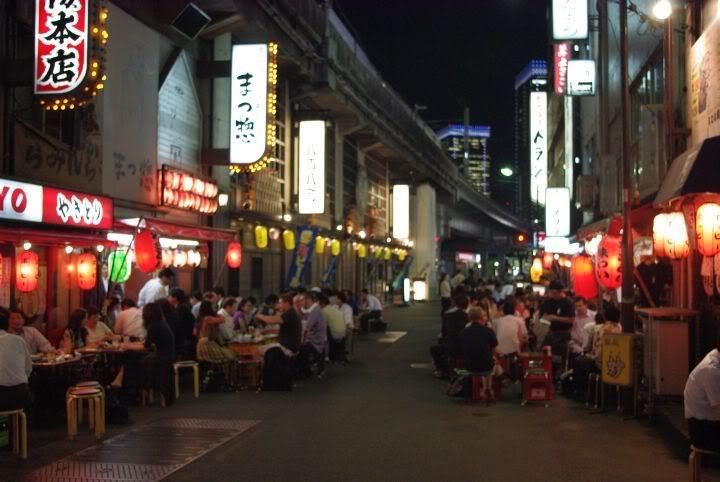
Last but not least, I think I should point out that the AF under low light is still not reliable as it should be, especially if wide AF area is chosen, i.e., all the 5 AF points are enabled. For night scenes, occasionally but from time to time, I got totally out-of-focus images when the AF was achieved with AF points other than the central one (see the example below), which actually is exactly what I found with my *ist D, DS and also the K100D (with illustration). The K-m is still of no exception. In view of this, I believe there must be some issues deeply associated with the SAFOX VIII system which causes the problem, but it seems that the technical issues never got resolved - a real disappointment.


Finally, if you just encounter focusing errors (Front Focusing or Back Focusing) under normal circumstances with faster lenses/wider apertures on your K-m, you may wish to try the Debug Mode to enter a correction factor (detailed instructions here).

Image Quality

The IQ of the in-camera JPEGs is very high with appropriate settings (you can have a look at some of my quick previous samples with 100% crops here). Whilst the JPEGs are of good colours and high resolution, pixelisation is quite visible and I think it is just a trade off to get “sharper” images and it also shows the weakness of the demosaic algorithms used by the K-m's image engine. As for RAW, if the RAW files (PEFs) are to be processed and converted using the original Pentax Photo Laboratory 3.6 (which is bundled), very “Soft JPEGs” are resulted (See this for more details and shootout samples).

White Balance

The Auto WB of the K-m has been much improved than previous Pentax DSLRs. From my own experiences that it is better than the K20D. At least under most natural light conditions, the colour balance results are good. For artificial lightings, the results are more or less close to what my eyes see, with some little errors and colour casts. Usually, it would not correct the whites to “whitest”, but the results are acceptable and I could see that the camera tries to preserve the ambient atmostsphere. In particular, the AWB actually works well with white fluorescent lightings than with tungstens, with which the produced pictures will still look yellowish/orangish (whilst with preset tungsten Manual WB, it produces magenta cast).

One more thing that I don't like the preset Tungsten Manual White Balance is that its chosen colour temperature is just too low and as such the pictures look just too cold, than the previous Pentax DSLRs.

For Manual WB, there is no option to input the Kelvin value of the colour temperature directly at the K-m, the fine adjustment of the G-M/A-B doesn't help much and IMO is not much useful and it is not so straight forward to use (although this can be enabled in one of the Custom Settings). A manually input K value will be the easily way to control colour temperature manually for many circumstances.

P-TTL Accuracy

What I can say is that the P-TTL accuracy of the K-m (with the built-in flash) has been improved, although sometimes it still underexposes, but the occurrence and the amount far less than it was before with other previous Pentax DSLRs.


2. Tips and Tricks – My Own Best Settings

General Operation

The back LCD will be turned on all the time by factory default whenever any button is pressed or the shutter release button is half-pressed. When doing the AF, the screen display will be turned off momentarily. To save battery power, the LCD can be turned off all the time in a Custom Setting, but the user will be required to turn it on by pressing the INFO button each time before viewing the neccessary information for carrying out any operation. The LCD turned on time is the same as the metering operation time as defined by yet another Custom Setting.

When the LCD operation status is displayed, press the OK button will get quick access to the most common settings and functions, see the screen captures below:
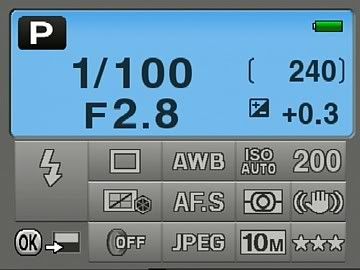
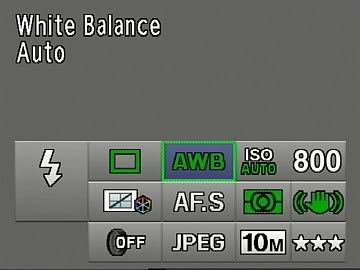

As for the first four setting items at the top, they can also be directly accessed using the Four-way Buttons at the camera back anyway. One thing should be noted is that there is no quick access method to change the AF area, which must be selected via the Menu (Recording Setting Page 2, Sub-item 3 - the Screen Capture can be found a few paragraphs below).

Custom Image and Parameters

After various testings by shooting different subjects and scenes under different conditions, I select the following best settings of my own for general shootings in most cases:-

Image Tone: Natural (I prefer more natural and true-to-life colour rendition and reproduction)

Custom Image Parameters:

Saturation -1: As it is just too saturated at 0 even for the "Natural" Image Tone.

Hue 0: There is no reason to change this and the default is neutral.

Contrast +1: The default Zero setting does not have enough contrast, at least this holds true for most of my Pentax lenses, digital or film ones. The lower contrast is actually related to the use of Shadow Compensation which is activated by default.

Sharpness set to the *Fine* Sharpness -1: The sharpening level at 0 is just a little bit too much. And, normal Sharpness instead of "Fine" is just too coarse to be usable.
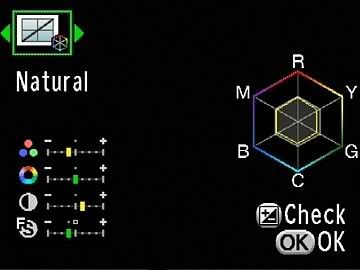


In fact, without Fine Sharpness, the default "Sharpness" (actually it is just "sharpening") produces artifacts that are just too visible and resolution is decreased somehow, too. Fine sharpness is not perfect, though, as it increases noise at high spatial frequency areas and make pixelisation more visible when the pictures are viewed more closely. As another not-so-important remark, the “Fine Sharpness” and “Sharpness” shares the same stored value. So, if you are to toggle between the two (using the e-Dial) and do wish to use different settings for each of them, some more care should be taken.

Colour Space

As usual, sRGB is my choice for better compatibility and directly usable images for printing, with a wide choice of different output devices and better software support. My recommendation is that unless you really need to do editing with special photo editing software and printing applications/devices, the (just a little bit) extra colours that the AdobeRGB could record won't worth the troubles and inconvenience that might get involved.

AF Mode, AE Metering and AF Point

Just see this screen capture and you can known what I select:
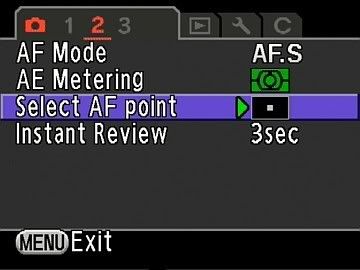


AF-A (A for Auto) is not a much workable mode practically as AF re-composition is often not possibly. I use the classic AF-S by default and choose the default Matrix Metering (but classic CWA Metering is close anyway for the obtained results) I use the Central AF point most of the time (unless in AF-C with running objects off-centred or I give the camera to some “laymen” to shoot). Furthermore, as I always do AF and re-compose and I the Matrix Metering is just *heavily* Centre-Weighted, I also enabled the Custom Setting of “Lock AE when AF Locked so that the whole operation is seamless and easy and all the things are achieved by one-touch (which is not possible with Canon DSLRs as there is not such a flexible option in the Canon land).

Shadow Compensation

Turning it on (by default, one of the Custom Settings) will help to lift up and bring out more shadow details. The Dynamic Range is improved. However, it will decrease the contrast for images under some conditions and more importantly more shadow noise are brought out too and noise level increased – Well, there is just no free lunch on Earth!

Noise Reduction

In order to suppress the noise that are brought out both by the “Fine Sharpness” Sharpening *and* Shadow Compensation, I turn on the Noise Reduction and choose the Weakest setting. The effect of elimination of noise can be seen even at ISO 200 and the effectiveness is good – noise is smoothed out and loss of image details is very minimal. I do not recommend to choose higher settings though as I found that they could be somehow more strong and some image details would be lost.

Unlike the K-7, there is no option for the user to choose the starting ISO speed for the NR. The K-m actually applies the NR for all ISOes whenever noise comes up. But on the other hand, I would say the K-7 is a camera which needs NR for *all* ISO speeds more than the K-m as K-7's images are obviously more noisy primitively (actually the Samsung 14.6MP CMOS sensors, no matter the old or the new versions, used in the K20D or the K-7 respectively).

200% DR

I do not recommend to use this as ISO 100, which is the best IQ setting with the minimal noise, will not be available when it is enabled.

Memory

All ticked function settings will be memorised. Unchecked boxes and functions will be reset to factory defaults each time when the camera is turned off and on again.

The “Help” Button

If you change the Custom Image a lot, configure this button to set Custom Image. I choose to programme it to call out the Digital Filter on Playback, which is very convenient, instead of going into the MENU and activate the function.

As a reminder, to make the Digital Filter to be applicable using the Help Button, the latest K-m Firmware Version 1.10 should be Upgraded.

Digital Filters

It is just a fun to use, the obtained results and effects are quite good IMO. Read the official user/operation manual for more details.

The “AF” Button

As a no-brainer, I configured this as the AE Lock button. I just cannot live with a SLR without any AEL Button on it. Other “AF Button” functions to me are useless and meaningless, also.

Now with the AEL Button, I can still unlock the exposure after AF is achieved when required (as I set in that Custom Setting option) or just to lock the exposure as desired before I am doing the AF.

Folder Name

To choose DATE to group photos by shooting dates or to put them all in a single Folder called PENTX. I choose the later as I don't want to group my photos in a too separated way and I think all the photos have the time stamps for the image files and EXIF as well, already.

LCD Brightness

-1 is the most accurate setting for the image brightness, as compared to my SpyderPro calibrated monitors and my professional grade EIZO, which is very accurate in colours and tones (hardware calibrated at the factory).

Pixel Mapping

Never try this function yourself as nothing can be undone. And, I don't think it is appropriate to open up such a function to the users. My opinion is that whenever new dead pixel appears, the user should take the camera for checking and servicing!

Dust Alert

Remember to point the camera for an even scene or object filling the whole frame when doing the check/test. The camera will check for the more obvious dust for you. For those less obvious and minor ones, the camera is actually more tolerated and would ignore them. For best and most accurate result, point to an even blue sky without any details (but just blue colour) on a bright sunny day.

Dust Removal

As usual, this function is just useless. Just forget about it, it won't do the job, nor it is good to the mechanical alignment of the sensor if you do this too much as its “hitting” on the boundaries is just too vigorous.

Sensor Cleaning

To my surprise, I found that the K-m sensor is not as “slippery” as the old sensor used in my K100D. The original Sensor Swap by the Photographic Solution can remove the dust but I found that it leaves some traces which I had never found with my old Pentax DSLR bodies with the old 6M sensors. Well, there is the new E2 cleaning solution instead of the old Eclipse anyway, which is specifically designed for the Sony 10MP CCD sensors used by various DSLRs of different brands. Fortunately, despite that I can see the traces on my sensor under a strong spot light, these cannot be seen so far in any real-life pictures taken with my K-m and I might buy also the official Pentax cleaning kit set O-ICK1 later on when dust appears again and after I have used up all my Sensor Swappers.

My Other Custom Settings

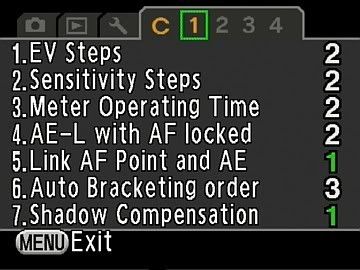
The 3 menu pages of all my Custom Settings are captured as below. And some remarks of mine on the selection are as follows:
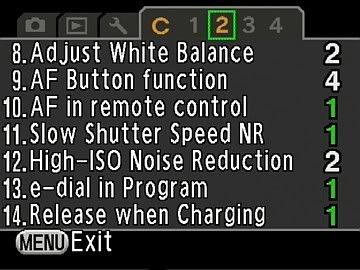
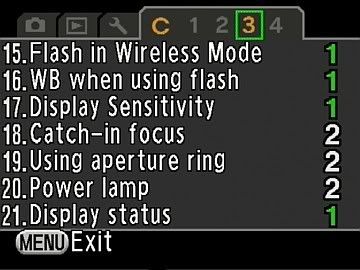
Custom Setting No.:
Remark:
1. EV Steps
1/3EV is more precise for the control and exposure compensation.
3. Meter Operating TimeI choose 3 second, as short as possible to save battery power. The shutter release button will be half-pressed and held anyway. To view the Status INFO Display, just press and hold down the INFO button for any duration as required.
4. AE-L with AF lockedEnabled.(See my previous technical article about this for more details.)
5. Link AF Point and AEDisabled. (See my previous technical article about this for more details.)
7. Shadow CompensationAs discussed above, this should be enabled with the enabling of the Weakest Noise Reduction.
9. AF Button functionAs a no-brainer, I choose the button as the AE-Lock!
12. High-ISO Noise ReductionEnabled at the lowest setting for best results, it will apply to all ISO speeds. Whilst its effect can be seen, the image details are well preserved
20. Power LampI don't need a super-bright power lamp LED indicator, so I just turn down its output level a bit


Setting Summary

Last but not least, here are some quick checkpoints for my optimised settings:-

1. Exposure Compensation of +0.3EV is always applied to avoid underexposed pictures and to suppress noise;

2. Single AF is used, Central AF Point is selected;

3. Use Multi-Segment Metering with AE Locked when AF Locked;

4. Use Natural Custom Image Mode, Saturation -1, Contrast +1, *Fine* Sharpness -1, for most faithful colour and grey reproduction with good Image Quality;

5. Turn on Shadow Compensation for more shadow details and better Dynamic Range (Factory Default anyway);

6. Turn on High ISO Noise Reduction, Weakest Setting (Not Factory Default);

7. Configure the AF Button to be used as the AE Lock;

8. Use Lithium Batteries as far as possible for better camera performance and more reliable camera operation. Just in case you can find an Regulated CR-V3 like mine and you dare to do some hardware hacking (with the basic technical knowledge and skills), try this for my own unique rechargeable solution. Btw, I still found that Eneloops on my K-m is not stable and reliable for most of the time.


3. Sample Photos (Update 1-23: Full Size Original Images Removed)

Notes:-

(i) Click any of the thumbnail images below to Enlarge.

(ii) All pictures were produced in-camera in the Finest JPEG setting. They are only downsized to 1920 pixels for the longer side and unedited. All EXIF preserved (even for the thumbnails).

(iii) All pictures were taken handheld with the Kit Lens DAL 18-55 with the same universal optimal settings of mine as described in this article.

(iv) Except for the first three night scene shots, the exposure compensation values are either +0.5EV or +0.3EV.

(v) Copyright 2009 RiceHigh! Please feel free to download and view. But any other unauthorised use is not allowed, unless prior permission from me is given. And, you're free to link to my pictures (preferably to my this article) as long as I am acknowledged for the ownership of my pictures.

Friday, October 22, 2010

Ten Reasons for Thinking Twice before Decided on a K-5..

Well, after so many K-5 promotions that I have been put forward at my this site since right before it was announced, it's time for me to "sing blues" on the K-5! ;-D Actually, it always does no harm for some more critical thinkings before we are to be decided on anything, which surely will help to minimize the chance of wrong decision and remorse! :-))

Okay, here we go!

1. The 1/180th Maximum Flash X-sync Speed:

We all knew that this maximum sync speed is inadequate, which is even slower than the bottom of line EOS digital model, i.e., the EOS 1000D, which just has a higher X-sync speed of 1/200th second.

Practically, if we used to do daylight fill-in flash in the old film days, we would know that the 1/250th is very valuable so that a larger aperture can be chosen for a longer reach of the flash and that also if shallower DoF is desired. Of course, people would then start to argue that Pentax P-TTL system with dedicated flash is high-speed sync capable. But the question is: Should we be limited to use the few dedicated flash units of Pentax only? E.g., why we cannot use other good flashes like those latest Metzes with a higher stand flash speed sync that is supported? And, I also wish to remind those people about the limitations and shortcomings with all those high-speed sync flashes (brand regardless), e.g., the drastically decreased effective G.N. and flash output power (but with much increased power consumption on the other hand!).

Besides, there is one major important con for a camera that is equipped with a slow x-sync speed that is not so noticeable. In fact, the X-sync speed is not only an indication on the maximum shutter speed that it could be used with standard flash units, it is primitively just an indication on how fast the shutter blades and curtains are moving (and "line scanning" speed of the shutter for the Tvs above the X-sync value). As such, a lower figure just indicate that the shutter module by itself has lower performance. And with slower actual moving speed of the shutter curtains, it means that more undesirable artifacts than ideal are existent and could be seen.

Well, I always just wonder since the MZ-S and also with ALL Pentax DSLRs. How is it so *difficult* to break the 1/180s barrier?

2. The Inadequacy of the Pentax P-TTL Flash System:

First of all, there are currently 4 dedicated P-TTL flash units that we can choose. Besides the new macro flash AF-160FC and the just slightly better than the RTF AF-200FG that is practically not much meaningful, we have only the choices of the really old AF-360FGZ, which is actually the old flash that come with my old MZ-S back to 2001 and the also the now aging AF-540FGZ, which the flash re-cycling time is really slow for its old circuitry and design.

Whilst I won't comment further about the exposure accuracy and consistency of the Pentax P-TTL system (which you can still find many relevant information by browsing through my pages), I would draw your attention to yet one big deficiency of the Pentax P-TTL flash system and design which is not so well-known, that is, it has no Flash Exposure Lock of any. So, just imagine that if you have a camera that is without any AE Lock for Auto Exposure with Ambient Light and now that it is just the case for Flash Metering and Exposure..

3. The Outdated SAFOX AF and Layout Inadequacy:

While Pentax has now renamed the old SAFOX VIII(+) in the K-x and K-7 to SAFOX IX(+) with their latest K-r and K-5 respectively, which I believe there exists some yet unknown improvements by software maybe, the layout of the AF sensors and sizes remain totally unchanged. As such, obviously, the old problems exist.

With such a layout, how can one pinpoint more accurately if more precise AF is desired? The line sensor is just too wide afterall and guessworks are resulted.

Furthermore, the 11-point layout of such an AF system in a just more "advanced" DSLR AF system is just a joke. It is good enough for all those entry-level DSLRs by today's standard. But if such an old 9-year stuff is used in a "flagship", it is just too dated and inadequate.

4. The SDM Evil and that Unresponded/Untackled SDM Issue:

Well, this is really the most headache problem with the current Pentax system. Many people do avoid all those SDM lenses. But then I just wish to ask, how many more current Pentax lenses else that we can buy if SDM is really to be avoided? :-0

5. Limited Lens Lineup and Availability and Without any Clear Roadmap and Future:

Last time Pentax Canada "once" *officially* discontinued 10 DA and DFA lenses (which was shortly deleted for that piece of information anyway) and Pentax Japan has also discontinued some more other lenses including the older FA ones already. In real, we have not much choices at different countries and places in the world for buying some other just older Pentax lenses as well, e.g., the DA 14/2.8 - The DA15/4 seems to be the replacement, although this is not officially told. In fact, many of the Pentax lenses are rather difficult to find brand new and the availability is just very limited.

The even worse thing is that the future of Pentax for their DSLR development is totally unclear and the image circle of their lenses is in a big mess. Some DA lenses are covering 135 full frame but some does not. Amongst those that can cover full frame, some original lens hoods are compatible and some are not. Yes, people would then argue that all DA lenses of Pentax is "designed for APS-C only" and this is also the official information, as we all know. But then nobody knows why with the "same" DA lens *lineup*, this kind of ambiguity and confusion could exist! :-(

Whilst many old Pentaxians believed and have urged that Pentax should officially let we Pentaxians know that which DA lens would be Full Frame compatible and which could not, but unfortunately we never knew that and not even about what Pentax have been thinking and planning and if they would go Full Frame eventually or not.

Indeed, I think this is just a big obstacle for many Pentaxians to invest further on newer Pentax glass. How one can feel safer for their purchases without more hesitations when the future is just so unclear?

6. No Video Compression *Option* for Video Recording:

The K-5 has no video compression option of any. Just say it has no H.264, MPEG-4 (which just the old Pentax Optio MX which I purchased back to 2004 had!), not even to say the Sony-Panasonic proprietary AVCHD format (which uses H.264 compression algorithms anyway). The "ground breaking" thing is that the Pentax K-5 is the only Full HD video recording camera ever made on Earth that has no facility of any for any in-camera video compression *option*!

So, with such tremendous bandwidth requirement of that Full HD video stream which actually the SD cards are just unable to handle with the lack of an effective video compression, I am almost sure that the Pentax engineers had to resort to make more JPEG compression per frame which is the only way to decrease the bandwidth requirement. But then, the image quality suffers.

7. Same Sony Sensor, the Highest Price:

Compared to the Nikon D7000, which has better specifications in almost every aspect but with the same Sony 16M HD CMOS sensor, the K-5 is just overpriced. If it is further compared to the extreme, i.e. the Sony A55, which is yet again with the same sensor, the K-5 has just so little and minimal price-to-performance ratio and just has poor value after all.

8. The IQ of K-5 is Not Better at the Base ISO, but Could be Worse:

I have no doubt about the high ISO IQ of the images from the K-5, but how about the IQ at base ISO? Could it be better than the old CCD Pentax cameras like the K200D and K-m etc.? I am afraid Not! :-( In fact, I still like some of the favourable colour and tone response characteristics of my K-m better than both my K-x and NEX. So, if you just don't need highest APS-C pixel count and those higher ISO speeds, why "upgrade"?

9. There is Always the "Low End"!

When we still have the choice of the K-r with some omissions of features like the weather-sealing or the support of using a cable switch and socket, why pay the double to get a K-5? Well, not even to mention the high ISO performance of the K-r could be *even better*! (But it has less pixel count as we all knew.) IMHO, other feature differences between the K-r and K-5 is almost negligible, e.g., for the 6 fps Vs 7 fps continuous frame rate and etc.

In retrospect, the K-r can be even stronger! Just say the K-r can shoot 14 RAW shots in a chain against what K-5 can do for 7, only. One ridiculous thing is for this "high performance" DSLR that has a continuous frame rate of 7 fps, which just means that the user can only shoot for ONE second if he shoots RAW! :-o How come the buffer of the K-5 is just so shallow? >:-| Since they put a new higher-resolution sensor into the old K-7 body, they needed to increase the frame buffer size too, did they? (But they didn't!)

10. The QC of Current Pentax Bodies and Lenses MIP and MIV are Sub-par but Yet Unfortunately the After-sales Support and Services of Pentax are Just So-So:

I think I won't elaborate more, we have just too many complaints and stories for those quality issues and unsatisfactory or even ridiculous service "support" cases daily everywhere reported in the Web. As for a few amongst all those uncountable number of cases that have been reported here, search this Blog. To see the others, search the Web.

Indeed, my yet recent experience with the MIV FA31 had been totally disappointed and I was not impressed with the QC standard on AF accuracy of the K-x as well - I only managed to get my current K-x unit without any major and obvious BF/FF issue with my fast Pentax primes with 1 body out of 3 different units! So, it's your take to count the "lucky" rate! :-o And, if you are to buy a new Pentax DSLR, what do you think what is your chance of getting a "good sample"?

Update (10-27): To admire about the QC level and standard of the current Pentax factory, just view these late reports from new K-5 and K-r users:-

Some Reported K-5 Faults (Defects and/or Bugs)

K-r Defect Reports


Related:-

P-TTL Vs TTL: Is Newer Better? (How Auto Flashes Work?)

Compatibility of DA Lenses on Full Frame

FA 31 Limited: Assembled in Vietnam Vs Made in Japan - Case Studies

Poll Results and Summary on the Choice of Recent Current Pentax DSLRs

My Ten Reasons to Buy the NEX-3 Over the NEX-5!

Tuesday, October 26, 2010

Some Reported K-5 Faults (Defects and/or Bugs)

Here are some of those reports, by different new K-5 users:-

1. Overexposure with 3 Different External Flashguns Except at ISO 100:

http://www.pentaxforums.com/forums/pentax-dslr-discussion/119630-my-2-days-old-k5-faulty.html

2. Out-Focusing and Inconsistency AF Issues with DA*55 and DA*50-135 SDM Lenses:

http://www.pentaxforums.com/forums/pentax-dslr-discussion/119597-new-k-5-i-need-help-focus-issues.html

3. Un-Cooperative Auto ISO and Overexposure with Flash:

http://www.pentaxforums.com/forums/pentax-dslr-discussion/119808-k-5-flash.html

4. Stuck Shutter Release Button Overnight!

http://www.dchome.net/viewthread.php?tid=944050&extra=page%3D1
(Traditional Chinese, machine-translated English Here.)

5. Auto Rotation Not Working for Photos! (But it works for displaying status info in-camera!)

http://www.dchome.net/viewthread.php?tid=944866&extra=page%3D1
(Traditional Chinese, machine-translated English Here.)

http://www.dchome.net/viewthread.php?tid=944866&page=1#pid11114265
(Yet Another new K-5 user reported that his unit suffered from the same problem.)

6. ISO 70 Bug(?):

http://www.dchome.net/redirect.php?goto=findpost&pid=11115061&ptid=944866
(No further information is provided, though.)

7. Obvious Physically Short-sighted (by observing the lens' distance scale):-

http://www.dchome.net/viewthread.php?tid=945579&extra=page%3D1
(Traditional Chinese, machine-translated English Here.)

Well, this is just a great news for macro photographers, or it should be treated as a Bonus! ;-D

Friday, December 03, 2010

Nice Summary and Suggestions on the Scratched K-5 "Sensor" Reported Cases

See this detailed summary and report, also with some opinions of the OP author expressed:-

http://forum.xitek.com/showthread.php?threadid=812805

(in Chinese, Google-translated English page here.)

Indeed, a very nice summary is compiled. Images are posted of which all are taken with brand new K-5 units with the defective "scratched" sensors (actually the AA filters of) for what some different Pentaxian victims have reported. In the posted photos, the defect is clearly shown and the scratches or stains (or whatsoever it is called, but it is NOT dust!) become very visible when just smaller apertures at or beyond f/11 are used.

Last but not least, I am fully agreed with the OP that it is a case showing the true value and power of the Internet. Without it, those manufacturing and QC issues would never be got known for the public (and so quickly) and the consumers would not get their replacement units so "easily" than ever before.

The poster has also kindly made some very good suggestions to Pentax for checking for the production line for whether there is anything wrong in the manufacturing process, which resulted in damage/contamination to the sensors/AA filters and their optical surface(s), no matter it is related to the machines and/or by the labours.

But anyway, I am almost sure that Hoya would just not listen, they will continue to do things on their own and avoid to admit any problem nor to proactively find out the root causes upon reported issues and not even to mention about to take preventive measures so that the same problems should not happen (and happen) again! >:-(


Read Also:-

Scratched "Sensor" Cases of the K-5 Units - Quality Issue of the AA Filters Manufactured by Pentax?

Scratched Sensors of Brand New K-5 Units

1,000 Signatures of the Pentax SDM Petition Online!

Pentax Service Sucks Everywhere in the World!

Wednesday, December 08, 2010

Endless Stains on the K-5 Sensors! (and the Possible Root Cause?)

These days, the "Stains" reports of the K-5 now appear endlessly, see what this frustrated K-5 user in the Middle East complains, who is really pissed off:-

http://forums.dpreview.com/forums/read.asp?forum=1036&message=37111740

I do really feel for him, very very much indeed. Someone in the thread who've replied emphasizes that as long as Pentax honours a replacement under the warranty, it is "just a non-issue". The victim replies in the thread that it is not easy for him to get another replacement, as the stock is rather limited at his country, and also that the dealer may not honour the replacement at the end. But then other stupid Pentax fanboys immediately jumped on him for saying that it's all his fault for not checking the return policy before he bought, that IMHO is rather plain stupid and the real utmost stupid saying afterall! >:-(

So, do you think and do you know, even Pentax or her agents/dealers over the world do all honour the warranty and offer for the free replacement eventually, could the problem be resolved? It is not even mentioned about all the troubles and time or even money loss, including that for fighting for a replacement and the subsequent shipping and arrangement etc. as well as the time wasted for those troubles as well as the time lost for not having a new DSLR body for use and taking photos - which is what all the new K-5 users and Pentax supporters bought this new model at the first time at a premium price original intended for!!

Okay, to answer back the question. Here is the showcase of the first K-5 user whom I first seen for reporting the issue, back to early November. After prolonged "fighting" and struggling with the local Pentax sole Agent and his shop, he finally got his another brand new replacement unit for after almost a month. Previously, he reported that his new unit was fine (as it seemed to be) when he first got his replacement unit, but now he has just reported today that his new unit has started to have the *same* problem appeared! :-o As previously, he also posts a photo taken with yet his another replaced K-5 for showing the issue.

So, at the end of the day, this issue seems to be a real issue which affects many K-5 units as reported widely, even if not all. Do note that some users may not notice the problem unless they shoot with small apertures and check more carefully. All in all, I think Pentax/Hoya should issue a product re-call, which they have never done that before anyway, but Canon and Nikon did for other major issues of their products happened and confirmed before, in the big contrast.

As for the very possible cause of the issue, this Canon published service notice tells it all! (My special thanks to OGL for providing the information of this! :-))

http://canoncanada.custhelp.com/app/answers/detail/a_id/12944/~/service-notice%3A-eos-1d-mark-iii%2Feos-1ds-mark-iii%3A-oil-spots-on-lpf-surface

Okay, Pentax, or, you should be called Hoya, it's your take now! Still waiting? Want to hide around? Do not want to respond and just know to fix the issue secretly at your side as far as you can? Really? Yet once again??

If this most unfortunate behaviour of Hoya does happen again for this case, Hoya, I dare to tell you, you are the one who hurts yourself most for doing your business better! Originally, you could have been able to sell more of your products but since there is and will be no reaction, the sales hurt deeply - but by your ownself! >:-[ As time goes by, the reputation of your *brand* is trashed and Pentax dies. If it really happens, Hoya, you're the real culprit! History will record that! >>:-\

Update (12-9):-

1. The stain reports have never ended, an Australian user posted his photo that clearly showing the problem:-

http://forums.dpreview.com/forums/read.asp?forum=1036&message=37130900

Yet, here is another posted real world photo posted by a Hong Kong user:-

http://www.dchome.net/viewthread.php?tid=949406&page=37#pid11334257

By looking at all those affected photos, it seems that there is a chain of circular spots in a line across the sensor. And, most of them are near the centre. So, the cause of these may not be the oil splitting as in the case of Canon 1D3, but possibly other manufacturing issues.

2. The first K-5 user who found and reported the problem has posted the serial numbers of his original K-5 and newly replaced unit, which is yet still defective. The s/n begins with 3827 for the old one and the new one is 3877.

3. Yet another victim who has lately reported about his case writes that he has checked four different K-5 units so far, two s/n begin with 38XX and another two begin with 39XX. But he got no luck! So, as we can see, the problem persists and the latest batch of the production K-5 units are still affected! :-[

4. Now, the HK K-5 users and Pentaxians have created a name of this issue: "The K-5 UFO Incident and Phenomenon". They have started a Petition to Hoya at the DCHome.net Pentax forum. Let's see if Hoya will respond, but my bet is Possibly Not, as we learnt from the SDM failure case, the 1,000+ Pentaxians in a Petition are just got completely ignored!


Last Report About the Issue:-

"Stains" on K-5 Sensors, the Story Continues..

Sunday, September 19, 2010

The Pentax Quality and Warranty Crises II - Hinman is Leaving Pentax! :-o :-(

As previous reported and talked about (here and here), Hinman's and my K-xes both suffer from some kinds of serious to minor quality issues respectively. Hin was just more unlucky with a dead camera just after a few months of use. And, the detached SR red logo plate and faded silver rim look rather terrible to me, indeed.

Hinman, being the top Alexa ranked Pentax Blogger for a long time actually, has now decided to leave Pentax! He has yet sold off several of his beloved DA Limited lenses already, all just because of the poor warranty services and after-sales support (if any!) by Pentax (Imaging, the USA) - but NOT because of he doesn't like his Limiteds. In contrast, I can feel that he loves his limited lenses much!

He has left two messages today at my Blog (here and here) about his frustration and disappointment, quoted:-

"My dead Pentax K-x white is in CRIS since 9/2/2010 and nothing has been done on the camera for 18 days after arrival as there is NO parts available from CRIS and NONE is stocked in Pentax USA. It has been back ordered from Japan with NO ETA.

I AM LEAVING PENTAX partially at the moment. And I will leave PENTAX digital for good. That IS IT for me. RH, please spread the words for Hin that he has decided to leave PENTAX.

By the way, that chrome strip is normal wear and I won't sweat little thing on Pentax for that inconvenience but a dead camera is a dead camera in my case. I expect NOTHING from Pentax."

"I have sold my DA limited lens on 21/40/70 and 50. Next will come with DA* 50-135mm f/2.8 and then my F* 300. When you see the F* 300 in marketplace of PF, you will know that I completely OUT of Pentax digital

I will keep my FA limited in 43/77 for my Pentax film work along with Pentax 645N. But my Pentax digital LIFE is no more. Even if they come out with magic in K5, I don't give a damn!"

When compared to Hin's case, I feel far more fortunate that my K-x is still well and fully working. The aesthetic "damage" of that crispy shiny Navy Blue paint is minor in comparison but even though, I don't think Pentax could and should escape from the warranty/defects liability neither even for such "minor" things.

The Pentax local service centre dared to ask me to pay for Pentax' own quality and design issues, which is the most RIDICULOUS thing on Earth. The worst is, very similar to Hin's case, they told me that they had to back-order that piece of plastic cover for the RTF and the Time for Delivery was actually unknown! It just seems that all Pentax' service centres don't keep spare parts. And the stock level of everything is just zero! Oh, everything has to order from the Pentax HQs for each repair?? From a minor piece of plastic parts to the memory card module?! Well, I still remember that the service centre commented that, "Yours is in Blue colour, then.. (we have to special order)"!?

I am sure my broken painting is a quality plus design issue, as I have already had two different Navy Blue K-x units which have suffered from the same! As for the Red/White/Black ones, my observation and guess is that the materials used are different and the problem may not arise.

No matter how, I feel for Hin and actually I feel really sad for Pentax/Hoya to have such a loyal long-time customer plus an important contributor to the brand in internet gone and lost him, whom should be a very valuable asset to the brand and company, really.

For me, I am now looking at the K-5, which gives me no big surprise but more disappointments actually. I might buy one eventually, maybe a Silver version when it would come out later. By that time, my K-x would be sold.

I still remember that last time my special Silver version of my *ist DS got killed at Pentax Japan during a "re-calibration" for AF adjustment - the whole AF module was misaligned, optics inside eyepiece broken, mirror position was shifted. In that case, no one was responsible to give me a replacement unit of the same edition nor a newer model since they just couldn't make it.

Do a company be responsible to all the damages and customer's loss owing to their own faults and incompetence? They just chose to ignore me after all these happenings! >:-( The local agent was "kind" enough to give me an old black colour *demo* unit with obvious used signs, though - but my beloved Silver DS died! (And that they still required me to return the death body to them anyway! :-( That was just an completely unfair "one to one" replacement!)

As the older Pentaxians would know, I wrote a complaint letter to the CEO of Pentax Corporation (when it was not swallowed by Hoya yet) and sent by registered mail with full name of attention, yet my letter was disregarded like rubbish.

All these cases are just ridiculous and unforgivable. "Normal" people like Hin would choose just to leave and move on. But as for me, with a rather stupid blinded brand loyalty in heart, just chose to stay and continue to buy new stuff (and continue struggling when unfortunate things continue to happen!)! Stupid ME!! >:-|

Update (9-20): Hinman has replied to my this post, it would be useful to quote his latest report and comments here:-

"I will eventually leave Pentax. At this moment, I will slowly disappear from Pentax but I will come often to say Hi. Until I see the trend that Pentax do listen to its customers on SDM, pTTL (p for pathetic), CRISis service with Pentax USA properly stocking up parts for its failures, I won't be back.

When I called Pentax service, I ask whos is responsible in stocking up for broken Pentax gear under warranty, Pentax rep says it is CRIS responsibility. Then I ask why Pentax USA don't stock up K-x broken parts, the answer goes in circle and I can only imagine how stupid I have been in believing this company."


Last Stories:-

K-x' Durability/Production Quality is Just a Joke!

The Quality and Warranty Crises (Re: K-x and Pentax)

Sunday, August 02, 2009

Latest Pentax Lens Review - Issues and Adverse Comments

I like this latest post at my Pentax Discussion Group, in which the poster speaks out exactly what I have been thinking in the beginning of his post:-

http://tech.groups.yahoo.com/group/ricehigh_pentax/message/630

"So far, regardless of what anybody says, I have been able to personally confirm many of the results that dpreview got in their tests. Just wanted to say this in case anybody has problems with their results!

So here is another blow to our beloved K-Bayonet mount. It seems we are dying for good these days, with prices going up for less quality all the time.

http://www.dpreview.com/lensreviews/pentax_55_1p4_p15/page5.asp

Quotes from the conclusion page:

Unfortunately though, we have serious concerns over two issues with this lens which have to temper our enthusiasm; namely optical alignment and autofocus (which are quite likely related). Over the course of what has become a rather protracted regime of testing, we've looked at three samples of this lens; each has shown a clear tilt to the focus plane, most pronounced in the first sample, and least problematic in the last (which we finally decided to use for the published tests). This does more than simply mess up our studio tests - it clearly results in real-world image quality and focusing problems too. In fact we've never before seen a lens so capricious when it comes to focusing - we're used to F1.4 primes being challenging for cameras' AF systems, but the 55mm was most difficult of all. We couldn't get any of the tested samples to focus sufficiently accurately for reliable shooting wide open without resorting to focus adjustment, and the amount required on our K20D body (which focused the FA 50mm F1.4 just fine) was huge, a full +10. The lens worked better on the K-7 we received during the course of this review, but still needed adjustment for best results, although curiously in the opposite direction (-3); but on the K2000 we were left high and dry, unable to achieve accurate focus at all. Based on this experience, it becomes difficult for us to recommend the lens to owners of cameras other than the K20D and K-7, on which AF adjustment isn't available, unless you can test it to your satisfaction first.

The other big problem we simply can't overlook is the distinctly high price. At the time of writing we're looking at $650, which does seem rather steep when compared to the alternatives; $500 for the excellent Sigma 50mm F1.4 EX DG HSM, or a mere $250 for the outgoing Pentax smc FA 50mm F1.4 (by way of comparison, Nikon's new AF-S Nikkor 50mm F1.4G retails for about $470, and Canon's EF 85mm F1.8 USM full frame portrait lens, $380). Now it's fair to say the 55mm F1.4 is much improved over the old FA 50mm F1.4, but the Sigma is a different proposition entirely. It sports both excellent optics and ultrasonic-type focusing, placing it very much in the same league as the 55mm. However it's not weatherproofed, and noticeably short for a 50mm lens (we'd place it closer to 47mm, giving a 70mm equivalent on APS-C), making the 55mm a nicer length for portraits.

So providing a final recommendation to this review becomes very difficult. When this lens works properly, it's one of the best portrait lenses that Pentax users can currently buy. But getting it to work properly has been the source of much frustration, and we consider that, especially given the price, it really should work better out of the box. If you can afford the asking price and get the lens functioning properly, you will certainly be delighted; but for most users we can't help but feel that the Sigma, or even the older 50mm F1.4, will be a better (and safer) option."

In fact, I think this time the DPR reviewers have nailed the problems quite dead accurately and they have described the current difficult situation faced by we current Pentax users very well.

Btw, sometimes I just wonder even if the QC of those latest current Pentax products are poor, Pentax/Hoya have been very unwise whenever they sent a test sample of any gear to DPR, it seems that they had never checked the samples themselves, technically, i.e., to finally check if there were any problems with the gear that were to be tested. It also seems that those Pentax officials at the Japan HQs just let Pentax UK to deal with DPR alone but in fact those DPR tests affect the sales of Pentax products worldwide much (as their readership base in reading their reviews is still very huge). All in all, it's not only about the poor and inferior quality control at the Pentax lens factory at Vietnam, it's also about their poor PR and publicity works and they have just been too causal when sending samples for testing - How come they could not be a bit more alerted and took more awareness when they sent DPR their Pentax test samples?

Nevertheless, to make some balance of DPR's experience, findings and results. I do believe that the DA*55/1.4 should still be a good lens optically (putting aside the really problematic QC issue and the ridiculous current high price tag of it), see the tests and results below. Still, the lens at least looks fine to me (and optically it is good to excellent, on APS-C DSLR bodies):-

http://www.informatik.uni-bremen.de/foto-ag/DA55/DA55.html (on K-7 and K20D)
via http://ricehigh.blogspot.com/2009/02/da-5514-vs-fa-5014-measurebating.html

http://www.slrgear.com/reviews/showproduct.php/product/1235/cat/45 (on K10D)

And, as for the slow focusing of the SDM, this is of no doubt and actually nothing arguable - ALL the testers/reviewers are saying the same so far!