Normally, I rarely read reviews at Steves Digicams, owing to the non-professional and non-scientific / laymen nature of their reviews in which comments are often made too brief and subjective. However, a DPR forum user today has just pointed out that he found "awful lot of hot pixels" in the latest K20D review at the site. And as pointed out by the first few replies in the thread, I've visited the sample page of the review:-
http://www.steves-digicams.com/2008_reviews/pentax_k20d_samples.html
If you look at those "studio" pictures, it is not difficult to see there are various obvious green hot pixels across the frame which could appear or disappear from picture to picture. The most worrisome thing is that those hot pixels could even appear just at ISO 100 and with in-camera jpegs. Just see these two samples:-
http://www.steves-digicams.com/2008_reviews/pentax_k20d/samples/IMGP0311.JPG
http://www.steves-digicams.com/2008_reviews/pentax_k20d/samples/IMGP0312.JPG
Furthermore, I think the hot pixels are not generated as a function of (longer) exposure time (which should be normal then) as the second picture was taken with flash at 1/45th second. If we are to going to examine the photos in the gallery one by one, it can be seen that even a higher shutter speed could still give (even more) hot pixels.
Despite Steve does not mention about the hot pixels issue in his review (for either he was unaware of the issue or he opted not to mention it), his sample pictures say it all for the issue.
All in all, this is the third review sites who tested the K20D have found or shown the hot pixels, regardless if they reported that or not, or if they have published their reviews or not. Up till now, the Polish site got 3 K20D production units and found all of them had this issue whereas Dpreview had got two production units and found both of them were the same (so that they opted to delay the K20D review instead of telling their readers formally in a published review about their solid findings). Now, Steve's direct out of the camera sample photos show the same. I think now that the issue has now been proven to be 100% real. Let's wait and see what Pentax/Samsung will do to address this problem.
Since that hot pixels issued first surfaced, I have seen that some people said that the hot pixels will not affect image quality. But I am totally disagreed with this. The main reason to use a higher pixel count DSLR is to get more room for cropping. With such hot pixels issue, how can those K20D users to "freely" crop their pictures? Do they need to shoot RAW all the time and use software to remove all those hot pixels afterwards?
• News about Products and Latest Company Direction
• Summaries of Reported Problems and Potential Issues
• Technical Articles on Photographic Gear and Technologies
Sunday, May 25, 2008


Wednesday, May 14, 2008
My Idea of a K1000D
Having seen the ultra success of the ASUS Eee PC (or called the EPC), this let me think about smart marketing decision is always the key way to success for a company.
Even for a weaker company like Pentax, which is actually always lagging behind in the competition, should and could think more about how to determine and create a new marketing segment by making new innovative product which is not present in the current market. The key element to success here is simply product idea but not technology advantages.
So, let's look at the EPC again, it does have smart marketing idea, slogan and promotion by ASUS. It it told that it is Easy to Learn, Easy to Work and Easy to Play (which the 3 Es represent and what its name is formed) but actually it is also very easy to carry with the clear fact that it is very portable and most importantly it is sold very cheap.
The ultra portability and the lowest price tag plus its high practicality for suiting for quite a number of basic daily applications including multi-media ones such as common compressed format movie playback and photo viewing, etc. Despite that the technical specifications of the EPC is not particularly strong, its bundle of advantages have almost overcome all its shortcomings and the lack of high performance by today's standards for sub-notes. It has more innovative unique feature, too, i.e., its static flash memory "hard-drive" which has the advantage of fast read/write speed and lowest possible power consumption to save battery juice and extend operation time.
Well, let's look at the past "recent" successful products of Pentax then. First, we can look at the K10D. The K10D is taking the approach of the more is better in which Pentax gave us many features in a package and on paper we could get a lot in a moderately priced body. However, I don't buy the idea of this as I never think that the K10D is a camera that has the real performance inside, when it is compared the nearly priced products in the competition of the same period. IMHO I must say it is just a re-packaged *ist D which has nearly the same old performance and technologies inside, e.g., the AF and metering parts. In 2003, such low performance and inaccuracy could still be tolerated to a certain extent, but in 2007 I think Pentax should really do much more if they really wished to market the K10D as a mid-level product as it was promoted and priced.
However, I don't think the K10D is a true success for Pentax actually, despite it suddenly gained attentions and some more sales. It is just because quite a lot of the attracted buyers / new users did not find it to be satisfactory as reported quite widely for its sub-par field performance and reliability, nor, there is anything in the Pentax land for those unsatisfied buyers to upgrade. So, Pentax simply could not retain those new customers and the new user base afterall, as those people switched and went away. The worst effect is that it left a really bad impression to them (and other non-users as well, for what it was told by those users) after they switched.
So, let's look back to the earlier previous Pentax successful model then. I think it is the MZ-5 in 1995, which was a true success IMO. The MZ-5 actually had saved Pentax from being dismissed from the SLR market in the mid-90s after the prolonged market loss since the SF series to the Z-series of Pentax SLRs from late 80s to mid-90s. I think the MZ-5 shares very much the successful elements of the EPC. It is very simple to use, not expensive to buy and has all the most basic functions and features but not yet too outdated. It is very clear that the MZ-5 has none of the leading edge technologies which the market leaders had, nor it could compete with any of the Canon and Nikon mid-range counterparts in its era as long as highest system performance aspects were concerned. But why so many people still choose about the MZ-5, including those new comers? .. which eventually suddenly saved the sales of Pentax SLRs and lenses. Just think about it.. It should be noted that the MZ legend lived for many years, until the *ist D came.
If we are to look at another very old truly successful story of Pentax SLR body, it should then be the K-1000 film SLR, I must say. It is of crude specs but it did sell well and for years - nearly two decades! Again, it is just because it is simple and basic *and* sold at a low price. For decades, the K-1000 has been a very good camera for beginners who had limited budgets on *both* body and lenses. The K-1000 can use any of the damn cheap but widely available old original Pentax and 3rd party K-mount lenses in huge number. Owing to its great simplicity, the K-1000 is also ideal for those who like to learn the basics of photography and exposure / metering control (just because it has nothing automatic and the users needed to do all by themselves). Finally, the K-1000 does have a rigid construction and is mechanically very reliable despite its low cost. It does even work and can take pictures without any battery installed.
After all the talks above, I think NOW it's time for Pentax to think about and introduce a K1000D in order to help themselves in getting back some market shares and to get a new beginner customer/user base which can help the company to survive/grow, too. In fact, I bet the K200D and the K20D in fact won't help Pentax much, as both offers are not attractive enough as they are easily replaced by Canon's and Nikon's similar or better offers near the same price that most of the new buyers will choose. Even assuming that the new Pentax products are the same in performance and price, why people would choose a small name instead of the big names (of the big boys)? As for the old K100D and K10D users, I really can't think out a reason why the existing users have any good reason and strong initiatives to "upgrade" to a K200D or K20D respectively.
I think Pentax has been running and heading a wrong way for years since the digital era for their DSLRs. I can bet they could never compete with Canon and Nikon etc. for keeping up the latest technologies in R&D nor they have comparable R&D budget nor they have the same production capabilities as other big boys. So, what they needed to do is to re-introduce a basic, simple and cheap DSLR which is highly preferable to be a small, compact and lightweight one which can be easily carried everywhere (like the EPC). Again, this camera must be very cheap (than ever) and this would attract many beginners who like to try and learn DSLR photography. To make it cheap, it must be very simple in features and specs. And, only to have simple features and specs, the cost of the new DSLR can be lower significantly - just a chicken and egg problem afterall. Of course, to trim down the unnecessary features is the proper way to cut cost, but not to scarify reliability and accuracy.
Nevertheless, even it is made basic, small and cheap, it must have some unique feature(s). I think Pentax had discarded a very valuable thing of theirs since the *ist D, it is the old K lens user and owner base, since they decided to cripple the new body K-mount forever (it is true up till now, at least). By summarising all the above criteria, I think a K1000D has an outlined specs below should sell very well and can attract many new comers:-
1. Weight less than 500g, preferably close to 400g. Size should be smallest or at least it should not be larger than a D60 and a 450D;
2. Keep the full K-mount specifications and compatibility and let the user to use the aperture ring of the K lenses to meter and expose too. I believe that it will be more accurate than the current Pentax digital lens design for the exposure control - the mechanical f-stop positions are individually calibrated, mechanically, for each aperture ring when each K-mount lens was designed whereas the body driven digital lenses' automatic aperture mechanical coupling is just totally outdated and it could just introduce more exposure inaccuracy and errors.
With the re-introduction of the full K-mount, it is possible for Pentax to make a retro-designed DSLR that will surely look cool and unique in the market, like the MZ-5, but just an updated digital version, say. However, since DA lenses are now not having an aperture ring, Pentax can provide a mean for Av selection in electronic form just in case if a DA lens is mounted. On all other cases, the aperture ring should be enabled whenever it is existent on the lens mounted, including the latest DFA digital macro lenses;
3. Keep only Spot and Centre-weighted average metering to save cost and make the camera simpler. The current 16-segment multi-pattern metering is not needed for those who really want to learn the basics nor it is really much useful owing to its low IQ, poor reliability and low consistency;
4. Keep only the AI predictive Single AF mode which is the only AF mode of the MZ-5 (no Pentax DSLR has been told to have any predictive AF capability now - I just puzzle why). I think only one single crossed AF sensor in the middle is more than enough for such a camera. The crossed sensor is preferably to make with higher pixel density, calibrated more precisely but in a smaller area in the finder for pinpointing focusing so that the highest possible AF accuracy and reliability can be attained. I also suggest that Pentax could make a f/5.6 sensor for the horizontal line and a f/2.8 sensor for the vertical line so as to further enhance the AF accuracy. Furthermore, by concentrating in building only the central sensor, the AF system should be re-built to have better overall responsiveness and good sensitivity in low light;
5. To re-build a focusing screen with more visible matte texture, so as to facilitate better Manual Focusing. Also, the plain very old Minolta/Pentax/Nikon focus indication system should be added to indicate front or back focus - well, just a pair of triangles indication in the finder (to indicate the focusing ring turning directions) is required -> nearly no additional cost to re-introduce but a very useful and unique feature nowadays as all camera makers followed what Canon did with their EOS to delete such useful focus indication;
6. It should support both the old Pentax TTL Auto and newer P-TTL flash guns for the unique compatibility again, so as to attract more old users (or even new ones who just want to get used gear cheap and easily). The K1000D can remove the built-in flash in order to further minimise its size and save weight (and manufacturing cost as well - but not to cut the TTL sensor to save the cost but scarify much compatibility - it is not that expensive to include such a TTL flash sensor afterall);
7. Of course the megapixel should be at least 10MP by today minimum standard. The K10D Sony CCD sensor, which is damn cheap right now, can be used;
8. Only P, A, S and M modes are needed;
9. No other bells and whistles are needed then and of course no Live View. I think even different picture modes/styles are not needed, as these could be included in the RAW convertor instead. I think the "Natural" mode is what most users need if the best colour accuracy is desired;
10. Aggressively priced under (US)$400 for such a greatly simplified design.
Having said that such a K1000D may help Pentax, Pentax should still try to make a true flagship later on which it has the real performance for major camera performance aspects. This would let Pentax to upkeep their outdated technologies in line with the latest in the competition. This flagship is preferably to be a 135 Full Frame DSLR, too, which is just the current trend for flagship DSLRs (at least Canon, Nikon and Sony have been or are now doing the same). The flagship serves as a symbol for marketing as well as practically an ultimate upgrade destination for the current Pentax DSLR users - but then this flagship can be made at a later stage after the success of such a K1000D (if it can be, but I do believe it can) and gaining of a considerably number of new users whom probably are mostly students, beginners as well as those very old Pentax users who just want to have ultimate simplicity and portability (and full compatibility as well). By then, Pentax would have more money and bucks to put back for doing better R&D jobs. All in all, I don't think Pentax is really wise to drop the compatibility and support for many of their older excellent lenses and flashes, which those compatibilities are just the true valuable asset of Pentax and compatibility is actually the true product feature differentiator for Pentax, especially for the full and true K-mount support! (40 millions of EOS lenses have now been produced since 1987, as Canon announced. How many Pentax AF lenses have been made up till now (since 1987 also)? If not all the K-mount lenses are counted, how could Pentax compete?)
Even for a weaker company like Pentax, which is actually always lagging behind in the competition, should and could think more about how to determine and create a new marketing segment by making new innovative product which is not present in the current market. The key element to success here is simply product idea but not technology advantages.
So, let's look at the EPC again, it does have smart marketing idea, slogan and promotion by ASUS. It it told that it is Easy to Learn, Easy to Work and Easy to Play (which the 3 Es represent and what its name is formed) but actually it is also very easy to carry with the clear fact that it is very portable and most importantly it is sold very cheap.
The ultra portability and the lowest price tag plus its high practicality for suiting for quite a number of basic daily applications including multi-media ones such as common compressed format movie playback and photo viewing, etc. Despite that the technical specifications of the EPC is not particularly strong, its bundle of advantages have almost overcome all its shortcomings and the lack of high performance by today's standards for sub-notes. It has more innovative unique feature, too, i.e., its static flash memory "hard-drive" which has the advantage of fast read/write speed and lowest possible power consumption to save battery juice and extend operation time.
Well, let's look at the past "recent" successful products of Pentax then. First, we can look at the K10D. The K10D is taking the approach of the more is better in which Pentax gave us many features in a package and on paper we could get a lot in a moderately priced body. However, I don't buy the idea of this as I never think that the K10D is a camera that has the real performance inside, when it is compared the nearly priced products in the competition of the same period. IMHO I must say it is just a re-packaged *ist D which has nearly the same old performance and technologies inside, e.g., the AF and metering parts. In 2003, such low performance and inaccuracy could still be tolerated to a certain extent, but in 2007 I think Pentax should really do much more if they really wished to market the K10D as a mid-level product as it was promoted and priced.
However, I don't think the K10D is a true success for Pentax actually, despite it suddenly gained attentions and some more sales. It is just because quite a lot of the attracted buyers / new users did not find it to be satisfactory as reported quite widely for its sub-par field performance and reliability, nor, there is anything in the Pentax land for those unsatisfied buyers to upgrade. So, Pentax simply could not retain those new customers and the new user base afterall, as those people switched and went away. The worst effect is that it left a really bad impression to them (and other non-users as well, for what it was told by those users) after they switched.
So, let's look back to the earlier previous Pentax successful model then. I think it is the MZ-5 in 1995, which was a true success IMO. The MZ-5 actually had saved Pentax from being dismissed from the SLR market in the mid-90s after the prolonged market loss since the SF series to the Z-series of Pentax SLRs from late 80s to mid-90s. I think the MZ-5 shares very much the successful elements of the EPC. It is very simple to use, not expensive to buy and has all the most basic functions and features but not yet too outdated. It is very clear that the MZ-5 has none of the leading edge technologies which the market leaders had, nor it could compete with any of the Canon and Nikon mid-range counterparts in its era as long as highest system performance aspects were concerned. But why so many people still choose about the MZ-5, including those new comers? .. which eventually suddenly saved the sales of Pentax SLRs and lenses. Just think about it.. It should be noted that the MZ legend lived for many years, until the *ist D came.
If we are to look at another very old truly successful story of Pentax SLR body, it should then be the K-1000 film SLR, I must say. It is of crude specs but it did sell well and for years - nearly two decades! Again, it is just because it is simple and basic *and* sold at a low price. For decades, the K-1000 has been a very good camera for beginners who had limited budgets on *both* body and lenses. The K-1000 can use any of the damn cheap but widely available old original Pentax and 3rd party K-mount lenses in huge number. Owing to its great simplicity, the K-1000 is also ideal for those who like to learn the basics of photography and exposure / metering control (just because it has nothing automatic and the users needed to do all by themselves). Finally, the K-1000 does have a rigid construction and is mechanically very reliable despite its low cost. It does even work and can take pictures without any battery installed.
After all the talks above, I think NOW it's time for Pentax to think about and introduce a K1000D in order to help themselves in getting back some market shares and to get a new beginner customer/user base which can help the company to survive/grow, too. In fact, I bet the K200D and the K20D in fact won't help Pentax much, as both offers are not attractive enough as they are easily replaced by Canon's and Nikon's similar or better offers near the same price that most of the new buyers will choose. Even assuming that the new Pentax products are the same in performance and price, why people would choose a small name instead of the big names (of the big boys)? As for the old K100D and K10D users, I really can't think out a reason why the existing users have any good reason and strong initiatives to "upgrade" to a K200D or K20D respectively.
I think Pentax has been running and heading a wrong way for years since the digital era for their DSLRs. I can bet they could never compete with Canon and Nikon etc. for keeping up the latest technologies in R&D nor they have comparable R&D budget nor they have the same production capabilities as other big boys. So, what they needed to do is to re-introduce a basic, simple and cheap DSLR which is highly preferable to be a small, compact and lightweight one which can be easily carried everywhere (like the EPC). Again, this camera must be very cheap (than ever) and this would attract many beginners who like to try and learn DSLR photography. To make it cheap, it must be very simple in features and specs. And, only to have simple features and specs, the cost of the new DSLR can be lower significantly - just a chicken and egg problem afterall. Of course, to trim down the unnecessary features is the proper way to cut cost, but not to scarify reliability and accuracy.
Nevertheless, even it is made basic, small and cheap, it must have some unique feature(s). I think Pentax had discarded a very valuable thing of theirs since the *ist D, it is the old K lens user and owner base, since they decided to cripple the new body K-mount forever (it is true up till now, at least). By summarising all the above criteria, I think a K1000D has an outlined specs below should sell very well and can attract many new comers:-
1. Weight less than 500g, preferably close to 400g. Size should be smallest or at least it should not be larger than a D60 and a 450D;
2. Keep the full K-mount specifications and compatibility and let the user to use the aperture ring of the K lenses to meter and expose too. I believe that it will be more accurate than the current Pentax digital lens design for the exposure control - the mechanical f-stop positions are individually calibrated, mechanically, for each aperture ring when each K-mount lens was designed whereas the body driven digital lenses' automatic aperture mechanical coupling is just totally outdated and it could just introduce more exposure inaccuracy and errors.
With the re-introduction of the full K-mount, it is possible for Pentax to make a retro-designed DSLR that will surely look cool and unique in the market, like the MZ-5, but just an updated digital version, say. However, since DA lenses are now not having an aperture ring, Pentax can provide a mean for Av selection in electronic form just in case if a DA lens is mounted. On all other cases, the aperture ring should be enabled whenever it is existent on the lens mounted, including the latest DFA digital macro lenses;
3. Keep only Spot and Centre-weighted average metering to save cost and make the camera simpler. The current 16-segment multi-pattern metering is not needed for those who really want to learn the basics nor it is really much useful owing to its low IQ, poor reliability and low consistency;
4. Keep only the AI predictive Single AF mode which is the only AF mode of the MZ-5 (no Pentax DSLR has been told to have any predictive AF capability now - I just puzzle why). I think only one single crossed AF sensor in the middle is more than enough for such a camera. The crossed sensor is preferably to make with higher pixel density, calibrated more precisely but in a smaller area in the finder for pinpointing focusing so that the highest possible AF accuracy and reliability can be attained. I also suggest that Pentax could make a f/5.6 sensor for the horizontal line and a f/2.8 sensor for the vertical line so as to further enhance the AF accuracy. Furthermore, by concentrating in building only the central sensor, the AF system should be re-built to have better overall responsiveness and good sensitivity in low light;
5. To re-build a focusing screen with more visible matte texture, so as to facilitate better Manual Focusing. Also, the plain very old Minolta/Pentax/Nikon focus indication system should be added to indicate front or back focus - well, just a pair of triangles indication in the finder (to indicate the focusing ring turning directions) is required -> nearly no additional cost to re-introduce but a very useful and unique feature nowadays as all camera makers followed what Canon did with their EOS to delete such useful focus indication;
6. It should support both the old Pentax TTL Auto and newer P-TTL flash guns for the unique compatibility again, so as to attract more old users (or even new ones who just want to get used gear cheap and easily). The K1000D can remove the built-in flash in order to further minimise its size and save weight (and manufacturing cost as well - but not to cut the TTL sensor to save the cost but scarify much compatibility - it is not that expensive to include such a TTL flash sensor afterall);
7. Of course the megapixel should be at least 10MP by today minimum standard. The K10D Sony CCD sensor, which is damn cheap right now, can be used;
8. Only P, A, S and M modes are needed;
9. No other bells and whistles are needed then and of course no Live View. I think even different picture modes/styles are not needed, as these could be included in the RAW convertor instead. I think the "Natural" mode is what most users need if the best colour accuracy is desired;
10. Aggressively priced under (US)$400 for such a greatly simplified design.
Having said that such a K1000D may help Pentax, Pentax should still try to make a true flagship later on which it has the real performance for major camera performance aspects. This would let Pentax to upkeep their outdated technologies in line with the latest in the competition. This flagship is preferably to be a 135 Full Frame DSLR, too, which is just the current trend for flagship DSLRs (at least Canon, Nikon and Sony have been or are now doing the same). The flagship serves as a symbol for marketing as well as practically an ultimate upgrade destination for the current Pentax DSLR users - but then this flagship can be made at a later stage after the success of such a K1000D (if it can be, but I do believe it can) and gaining of a considerably number of new users whom probably are mostly students, beginners as well as those very old Pentax users who just want to have ultimate simplicity and portability (and full compatibility as well). By then, Pentax would have more money and bucks to put back for doing better R&D jobs. All in all, I don't think Pentax is really wise to drop the compatibility and support for many of their older excellent lenses and flashes, which those compatibilities are just the true valuable asset of Pentax and compatibility is actually the true product feature differentiator for Pentax, especially for the full and true K-mount support! (40 millions of EOS lenses have now been produced since 1987, as Canon announced. How many Pentax AF lenses have been made up till now (since 1987 also)? If not all the K-mount lenses are counted, how could Pentax compete?)
標籤:
*ist Dx,
Exposure Accuracy,
Focusing Accuracy,
History,
K100D,
K100D Super,
K10D,
K200D,
K20D,
Pentax
Monday, May 12, 2008
K20D Banding Problem Reported at Low ISO Speed (ISO 200)
A K20D user has just reported a "banding bug" of his K20D and posted a sample picture made by him which shows serious horizontal banding, at the DPR forum:-
http://forums.dpreview.com/forums/read.asp?forum=1036&message=27887664
Quoted:- "Each 1 of approx 50 images, taken with k20D, show very specific banding. I can't locate any regularities in there appearence. Other images are absolutely OK. The effect is visible even on the camera's screen."
And here is the direct link of his posted sample banding picture:-
http://hromoibes.narod.ru/banding1.tif
Horizontal bandings are obvious in the whole image, especially at where near the pistils of the flowers which are having more textural details. I have examined the EXIF and it is discovered that the picture was actually taken at a low ISO speed of 200, plus a short exposure time of 1/200th of a second only, which is indeed the most worrisome thing afterall. Moreover, the exposure compensation was set to be -0.3 EV, which means that there should not be any underexposure and then push processing to exaggerate any potential artifact (if any), but the reverse is true, in contrast.
In fact, previously there have been a number of K20D user reports of banding found in pictures made at high ISO speeds and/or with long time exposure. But this time, it is the first time I have heard about banding could occur at such a low ISO speed, which is just an uncommon thing for most (or maybe all) DSLR models ever made and marketed.
I hope this case is just an isolated one rather than a common quality/manufacturing issue or even a design flaw or bug. Otherwise, it will be really a serious issue. Nonetheless, time will tell, when more and more users will report later if there is a real problem. Possibly and hopefully, we shall know about the truth within a few months' time to come.
http://forums.dpreview.com/forums/read.asp?forum=1036&message=27887664
Quoted:- "Each 1 of approx 50 images, taken with k20D, show very specific banding. I can't locate any regularities in there appearence. Other images are absolutely OK. The effect is visible even on the camera's screen."
And here is the direct link of his posted sample banding picture:-
http://hromoibes.narod.ru/banding1.tif
Horizontal bandings are obvious in the whole image, especially at where near the pistils of the flowers which are having more textural details. I have examined the EXIF and it is discovered that the picture was actually taken at a low ISO speed of 200, plus a short exposure time of 1/200th of a second only, which is indeed the most worrisome thing afterall. Moreover, the exposure compensation was set to be -0.3 EV, which means that there should not be any underexposure and then push processing to exaggerate any potential artifact (if any), but the reverse is true, in contrast.
In fact, previously there have been a number of K20D user reports of banding found in pictures made at high ISO speeds and/or with long time exposure. But this time, it is the first time I have heard about banding could occur at such a low ISO speed, which is just an uncommon thing for most (or maybe all) DSLR models ever made and marketed.
I hope this case is just an isolated one rather than a common quality/manufacturing issue or even a design flaw or bug. Otherwise, it will be really a serious issue. Nonetheless, time will tell, when more and more users will report later if there is a real problem. Possibly and hopefully, we shall know about the truth within a few months' time to come.
標籤:
Image Quality,
Issues,
K20D,
Quality Issues,
Samsung,
Sensors
Sunday, May 11, 2008
K10D Firmware 1.3 Debug Mode Unleashed
According to the following recent DPR post:-
K10D - GX10 1.30 Firmware Debug menu via usb activation.: Pentax SLR Talk Forum: Digital Photography Review
The poster found a program made by someone called "makc" on the "penta-club.ru" forum.
It is told that the program allows the K10D user to access the debug menu with the firmware version 1.30 installed in their cameras (it is believed that it works for the Samsung GX-10 too). With that utility program, the debug mode can be activated and de-activated via an USB cable and no firmware version downgrade is required.
It is in fact very useful and handy for those K10D users who wish to make their own AF adjustment for any Front Focusing (FF) or Back Focusing (BF) found with any of their lenses on their K10Ds. Indeed, the problem of FF and BF of the K10D has been widely reported and especially different amount of focus inaccuracy (no matter it is FF or BF) would occur with different lenses mounted.
Some people also told that adjustment settings up to four (Pentax?) could be made and stored and those settings would be called automatically upon mounting of a particular lens. If it is really true, it is just a very useful feature to counteract the K10D focus inaccuracy abnormality.
The poster has also compiled a tutorial on a French forum to teach people how to use the Russian program above. The link is as follows: Pentax K10D - K20D - bon anniversaire Julien (Registration and member login is required)
Finally, here is the download link for the program: http://dednev.pisem.net/setup_gx10_dmctrl_1.1.exe
The password for installation is : penta-club.ru
Good luck but bear in mind that YMMV, though. If you do not have the total confidence and cannot bear any potential risk involved, just don't try - my humble advice.
It should be also noted that it has been reported that the program is not Vista compatible. With Vista, the debug mode can be activated but not de-activated. See this post for more details.
Update (25/6):
Here is the good news! The original Russian author of the program, "makc", has just released a new version of the utility in English language. The download link is as below:-
http://dednev.pisem.net/setup_gx10_dmctrl_1.1u_eng.exe
( Password: penta-club.ru )
Happy measurbating and adjusting!
K10D - GX10 1.30 Firmware Debug menu via usb activation.: Pentax SLR Talk Forum: Digital Photography Review
The poster found a program made by someone called "makc" on the "penta-club.ru" forum.
It is told that the program allows the K10D user to access the debug menu with the firmware version 1.30 installed in their cameras (it is believed that it works for the Samsung GX-10 too). With that utility program, the debug mode can be activated and de-activated via an USB cable and no firmware version downgrade is required.
It is in fact very useful and handy for those K10D users who wish to make their own AF adjustment for any Front Focusing (FF) or Back Focusing (BF) found with any of their lenses on their K10Ds. Indeed, the problem of FF and BF of the K10D has been widely reported and especially different amount of focus inaccuracy (no matter it is FF or BF) would occur with different lenses mounted.
Some people also told that adjustment settings up to four (Pentax?) could be made and stored and those settings would be called automatically upon mounting of a particular lens. If it is really true, it is just a very useful feature to counteract the K10D focus inaccuracy abnormality.
The poster has also compiled a tutorial on a French forum to teach people how to use the Russian program above. The link is as follows: Pentax K10D - K20D - bon anniversaire Julien (Registration and member login is required)
Finally, here is the download link for the program: http://dednev.pisem.net/setup_gx10_dmctrl_1.1.exe
The password for installation is : penta-club.ru
Good luck but bear in mind that YMMV, though. If you do not have the total confidence and cannot bear any potential risk involved, just don't try - my humble advice.
It should be also noted that it has been reported that the program is not Vista compatible. With Vista, the debug mode can be activated but not de-activated. See this post for more details.
Update (25/6):
Here is the good news! The original Russian author of the program, "makc", has just released a new version of the utility in English language. The download link is as below:-
http://dednev.pisem.net/setup_gx10_dmctrl_1.1u_eng.exe
( Password: penta-club.ru )
Happy measurbating and adjusting!
Friday, May 09, 2008
Issue of Hot/Dead Pixels of the K20D
Reports of the hot/dead pixels found in images produced by different K20D units continue and lately it has been reported by a DPR technical writer, who is responsible to review the K20D:-
http://forums.dpreview.com/forums/readflat.asp?forum=1036&thread=27852469
"During testing we have encountered the same problems with hot pixels that have been reported elsewhere. We have continued to experience the same difficulties with a second production body and are currently awaiting a response from Pentax before proceeding with further testing."
So, where's the "elsewhere" as mentioned? Here it is:-
http://www.optyczne.pl/69.1-Test_aparatu-Pentax_K20D_Wst%EAp.html
Since the above review is in Polish, someone had summarised some of the key points and posted it below:-
K20D not recommended, inconsistent hot pixels issue
And, some of the key statements are quoted:-
http://www.optyczne.pl/upload2/7758_k20d_hoty.png
"The test had many other criticisms and discovered inconsistent quality issues. The very first K20D they purchased produced loud focusing noises, exposed badly, and was assembled badly -- it was replaced by a local distributor, and many issues were not present in the replacement... but some came back in the third K20D they tested."
Well, is there any report from real K20D end-users (not reviewers) for the hot pixel issue then? Yes, I've seen two new K20D reported about the hot pixels found in pictures produced by their K20D in a thread opened one month ago:-
http://www.dchome.net/viewthread.php?tid=491778&extra=page%3D1
(Post in Traditional Chinese, use BabelFish is required)
Direct link to a sample "hot" picture can be seen here.
The thread open person also reported that he had tried the K20D "pixel re-mapping" function, which is essentially a method to rule out known hot or dead pixel(s) by disabling particular pixel with problem and instructing the camera to use the neighbourhood pixel values to calculate (aka interpolate) a new value to insert into that dead pixel. However, he wrote that the problem could not be resolved even using this available function. So, finally, as the local Pentax service centre was unable to resolve the problem, they sent his unit back to Pentax Japan. The user has finally got back his K20D unit and he has made a quick post in telling us that the problem "has been resolved", with a small downsized sample picture posted too. But however, I am not sure if he has thoroughly tested his unit or not as he has not reported back further in details since then, despite he promised that there would be a more detailed "final" report ...
Afterall, it seems to me that it is just a hardware bug of the Samsung new CMOS sensor (for which Pentax was naive enough to hope that the firmware could eliminate the problem all). It might be that the pixel density are just too high as too many pixels are packed in a too small area with a too large photo site per pixel and with too little isolation/separation between pixels too such that the whole sensor/image may become just too hot for the inside temperature when it is working. As such, the accumulated thermal energy, which possibly could not be drained away properly physically, has caused electrical signal noise got out of control somehow at certain areas and finally those physically heated up pixels are recorded in the final image as hot pixels or even dead ones (if it constantly appeared red or green, usually).
http://forums.dpreview.com/forums/readflat.asp?forum=1036&thread=27852469
"During testing we have encountered the same problems with hot pixels that have been reported elsewhere. We have continued to experience the same difficulties with a second production body and are currently awaiting a response from Pentax before proceeding with further testing."
So, where's the "elsewhere" as mentioned? Here it is:-
http://www.optyczne.pl/69.1-Test_aparatu-Pentax_K20D_Wst%EAp.html
Since the above review is in Polish, someone had summarised some of the key points and posted it below:-
K20D not recommended, inconsistent hot pixels issue
And, some of the key statements are quoted:-
"main issue was inconsistent quality between K20D samples, which they consider to be 'unusual development for Pentax products, and sad to see '. They tried a few different K20Ds, all had hot pixels, but was was particularly worrying was that hot pixels changed in each sessions, disappearing and appearing in different places. This appears to indicate production issues with the latest 14.6 megapixels sensor (made by Samsung)."
"See the above URL and go to section 7 for samples of noise and hot pixels. The site also found that there are many hot pixels (more than in other equipment they tested), and that the hot pixels are permanently mapped and excluded in JPEGs during in camera processing, thus there is more and more excluded hot pixels due to their unpredictable and changing appearance. It was unclear is there a way of resetting this mapping, but this would be fixable (if Pentax decides to do so) in future firmware."
For those who has limited bandwidth in accessing the Internet, a direct link of a sample picture showing many random hot pixels is here:-http://www.optyczne.pl/upload2/7758_k20d_hoty.png
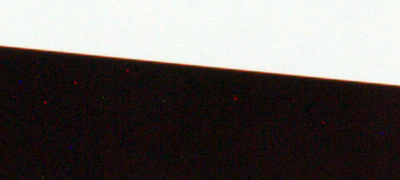
"The test had many other criticisms and discovered inconsistent quality issues. The very first K20D they purchased produced loud focusing noises, exposed badly, and was assembled badly -- it was replaced by a local distributor, and many issues were not present in the replacement... but some came back in the third K20D they tested."
Well, is there any report from real K20D end-users (not reviewers) for the hot pixel issue then? Yes, I've seen two new K20D reported about the hot pixels found in pictures produced by their K20D in a thread opened one month ago:-
http://www.dchome.net/viewthread.php?tid=491778&extra=page%3D1
(Post in Traditional Chinese, use BabelFish is required)
Direct link to a sample "hot" picture can be seen here.

The thread open person also reported that he had tried the K20D "pixel re-mapping" function, which is essentially a method to rule out known hot or dead pixel(s) by disabling particular pixel with problem and instructing the camera to use the neighbourhood pixel values to calculate (aka interpolate) a new value to insert into that dead pixel. However, he wrote that the problem could not be resolved even using this available function. So, finally, as the local Pentax service centre was unable to resolve the problem, they sent his unit back to Pentax Japan. The user has finally got back his K20D unit and he has made a quick post in telling us that the problem "has been resolved", with a small downsized sample picture posted too. But however, I am not sure if he has thoroughly tested his unit or not as he has not reported back further in details since then, despite he promised that there would be a more detailed "final" report ...
Afterall, it seems to me that it is just a hardware bug of the Samsung new CMOS sensor (for which Pentax was naive enough to hope that the firmware could eliminate the problem all). It might be that the pixel density are just too high as too many pixels are packed in a too small area with a too large photo site per pixel and with too little isolation/separation between pixels too such that the whole sensor/image may become just too hot for the inside temperature when it is working. As such, the accumulated thermal energy, which possibly could not be drained away properly physically, has caused electrical signal noise got out of control somehow at certain areas and finally those physically heated up pixels are recorded in the final image as hot pixels or even dead ones (if it constantly appeared red or green, usually).
Thursday, May 01, 2008
Pentax Starts to Drop Support for Body Driven AF
In the following specifications table of the new DA 17-70/F4 SDM found in the Pentax Norway website:-
http://www.pentax.no/accounts/433774/File/Datablader/Objektiver/18720.xls
It is stated that "Autofocus only functions if the mounted lens features a supersonic motor (the camera motor will not drive autofocus)."
Putting aside the logical mistake for the first part of the statement (how comes in the specs of a SDM lens to state about "if the mounted lens features a supersonic motor"?), I think what it really wants to tell is for the message in the brackets, that is, "the camera motor will not drive autofocus (with the DA 17-70 lens), which is simply meant that when the DA 17-70 is mounted on any older Pentax DSLR bodies prior to the K10D, it will have no AF function as none of those older bodies could support any SDM lenses. For AF to work, it must be used on one of the following four latest Pentax DSLR bodies: either a K10D, K100D Super, K20D or a K200D.
So, if Pentax starts to drop support for body driven AF in their latest lens, what does this imply? It simply hints that in the future it is possible to see new Pentax DSLR bodies which do not have body AF motor at all (like the Nikon D40/40X etc.) or more new Pentax AF lenses that are yet lens motor driven alone for the AF and it is also possible that eventually Pentax will completely discard their older body AF system.
No matter any or all of the above three possible cases happen later, it just means less backward and/or forward compatibility between different generations of lenses and bodies.
Nonetheless, without the burden of compatibility, that "pure" SDM design *may* have better AF performance (faster and/or more accurate, hopefully) and that another thing is for sure - it is simpler in design and is surely cheaper to make, no matter for the lens or even for the body - which only lens driven AF is included.
http://www.pentax.no/accounts/433774/File/Datablader/Objektiver/18720.xls
It is stated that "Autofocus only functions if the mounted lens features a supersonic motor (the camera motor will not drive autofocus)."
Putting aside the logical mistake for the first part of the statement (how comes in the specs of a SDM lens to state about "if the mounted lens features a supersonic motor"?), I think what it really wants to tell is for the message in the brackets, that is, "the camera motor will not drive autofocus (with the DA 17-70 lens), which is simply meant that when the DA 17-70 is mounted on any older Pentax DSLR bodies prior to the K10D, it will have no AF function as none of those older bodies could support any SDM lenses. For AF to work, it must be used on one of the following four latest Pentax DSLR bodies: either a K10D, K100D Super, K20D or a K200D.
So, if Pentax starts to drop support for body driven AF in their latest lens, what does this imply? It simply hints that in the future it is possible to see new Pentax DSLR bodies which do not have body AF motor at all (like the Nikon D40/40X etc.) or more new Pentax AF lenses that are yet lens motor driven alone for the AF and it is also possible that eventually Pentax will completely discard their older body AF system.
No matter any or all of the above three possible cases happen later, it just means less backward and/or forward compatibility between different generations of lenses and bodies.
Nonetheless, without the burden of compatibility, that "pure" SDM design *may* have better AF performance (faster and/or more accurate, hopefully) and that another thing is for sure - it is simpler in design and is surely cheaper to make, no matter for the lens or even for the body - which only lens driven AF is included.
標籤:
*ist Dx,
Issues,
K100D,
K100D Super,
K10D,
K200D,
K20D,
Lenses,
News,
Pentax,
SDM,
System Performance,
Technical Articles
Monday, April 14, 2008
K200D Battery Issue is Now Official!?
On Page 37 of the user's manual of the K200D (Page 39 of the pdf file), it is said that "the use of Ni-MH batteries is not recommended as the batteries' voltage characteristics may cause a malfunction", despite that in the same section about batteries for use in the K200D, it briefs about "AA lithium batteries", "NiMH AA rechargeable batteries" and "AA alkaline batteries" Only!(?) Where is CR-V3 lithium battery type? Can't they be used? And, don't Pentax know that CR-V3 Lithiums are having a different chemical formula than those (Energizer) AA Lithiums and generally have a slightly longer life?? Or, is it just that the K200D cannot use the CR-V3 Lithiums? (I don't think so, though).
The most funny thing is that whilst Pentax list out 3 types of batteries for their K200D in their manual, they immediately "do not recommend" 2 types already but left only the AA Lithiums to be the *only* "recommended" choice for use in their camera. So, does all the new K200D users can use "only" the (Energizer) AA Lithiums in their K200D? Hey, Pentax, don't you know that only Energizer make AA Lithiums but nobody else, unlike CR-V3 Lithiums?
In fact, I have always being disagreed with the over-conservative behaviour but actually irresponsible approach of Pentax for over-protecting themselves in their documentation (no matter in their manuals or in their websites) instead of trying to find a good solution to a *real problem*. Years ago, they simply banned all the Rechargeable CR-V3 batteries "one off", although many of those regulated RCR-V3 models should be working perfectly in their "AA DSLRs". Now, this time, they are even dare to say that Ni-MHs are "not recommended". Really funny, but super ridiculous! As I have been "blaming" them for years, why didn't they and don't they just compile a list of compatible battery models OR JUST to bundle an approved model/type of batteries along with a charger, no matter it is Eneloop NiMH (or something else alike that are usable, although NiMHs will surely make the camera slower, particularly for the AF) or even RCR-V3s, even they STILL have NOT found out a solution to improve their circuitry, for the camera's power supply part???
A disappointing finding afterall. This officially provided information does not only reflect the same old widely reported problem will probably be persistent forever, it also reflects the poor attitude, stubbornness and the lack of intention of Pentax in tackling some of the real and well-known problems (even this time it shows that they know very clearly about it) which is just a very stupid thing for them, really. Annoying and Sad!
Read Also:- When 1100 mAh Li-ion RCR-V3s Outperform 2500 mAh+ NiMH AAs
The most funny thing is that whilst Pentax list out 3 types of batteries for their K200D in their manual, they immediately "do not recommend" 2 types already but left only the AA Lithiums to be the *only* "recommended" choice for use in their camera. So, does all the new K200D users can use "only" the (Energizer) AA Lithiums in their K200D? Hey, Pentax, don't you know that only Energizer make AA Lithiums but nobody else, unlike CR-V3 Lithiums?
In fact, I have always being disagreed with the over-conservative behaviour but actually irresponsible approach of Pentax for over-protecting themselves in their documentation (no matter in their manuals or in their websites) instead of trying to find a good solution to a *real problem*. Years ago, they simply banned all the Rechargeable CR-V3 batteries "one off", although many of those regulated RCR-V3 models should be working perfectly in their "AA DSLRs". Now, this time, they are even dare to say that Ni-MHs are "not recommended". Really funny, but super ridiculous! As I have been "blaming" them for years, why didn't they and don't they just compile a list of compatible battery models OR JUST to bundle an approved model/type of batteries along with a charger, no matter it is Eneloop NiMH (or something else alike that are usable, although NiMHs will surely make the camera slower, particularly for the AF) or even RCR-V3s, even they STILL have NOT found out a solution to improve their circuitry, for the camera's power supply part???
A disappointing finding afterall. This officially provided information does not only reflect the same old widely reported problem will probably be persistent forever, it also reflects the poor attitude, stubbornness and the lack of intention of Pentax in tackling some of the real and well-known problems (even this time it shows that they know very clearly about it) which is just a very stupid thing for them, really. Annoying and Sad!
Read Also:- When 1100 mAh Li-ion RCR-V3s Outperform 2500 mAh+ NiMH AAs
Sunday, April 13, 2008
Samsung Hints at a Full Frame DSLR Sensor
Just seen this piece of news at the Amateur Photographer's website, for Samsung hints at a full-frame sensor for a professional DSLR camera in Pentax mount:-
http://www.amateurphotographer.co.uk/news/Samsung_hints_at_fullframe_sensor_for_professional_digital_SLR_camera_news_227234.html
I think the more exciting thing we can learn from the article should be the following quote:-
"Although there is no indication yet as to when it might arrive, it seems now that photographers can look forward to a professional full-frame DSLR with a Pentax lens mount at some point in the future."
Since it is said that the full-frame sensor project is still now at the early stage of the design phase, I think for all those existing Pentax users who are eager to see and dream for a Pentax FF DSLR soonest, they shall still have to wait for a longer time. There is *hope*, though, if this rumour is really true.
Read Also: The Current Pentax DSLR System as a System
http://www.amateurphotographer.co.uk/news/Samsung_hints_at_fullframe_sensor_for_professional_digital_SLR_camera_news_227234.html
I think the more exciting thing we can learn from the article should be the following quote:-
"Although there is no indication yet as to when it might arrive, it seems now that photographers can look forward to a professional full-frame DSLR with a Pentax lens mount at some point in the future."
Since it is said that the full-frame sensor project is still now at the early stage of the design phase, I think for all those existing Pentax users who are eager to see and dream for a Pentax FF DSLR soonest, they shall still have to wait for a longer time. There is *hope*, though, if this rumour is really true.
Read Also: The Current Pentax DSLR System as a System
Sunday, March 23, 2008
K200D First Impressions
Handled a K200D today and below are my observations:-
1. Body is larger and heavier than that I would like, at least noticeably more weight and bulkier than the K100D. The build quality is felt just a little bit better than the K100D, though, which is similar to the K10D and the K20D. Anyway, the plasticky outshell must not be something that I really like;
2. Viewfinder is the same as that of the K100D, for both the image magnification and the brightness, that is, medium image size and medium brightness for an APS-C DSLR - no particular excitement or disappointment here;
3. The AF point red illuminated marks are yet again misaligned, as usual. No real surprise here;
4. AF speed is the same, nothing considered speedy and it will become rather slow and hunt at just lower light conditions;
5. Mirror slap and shutter actions have been improved, smoother and quieter, very similar to the K20D, better than both K10D and K100D. Shutter lag and finder black out time are quite noticeable, close to the K20D for what I could see;
6. Auto ISO does work even when the Exposure Compensation is applied. The function and setting of the Auto ISO is just the same as that of the K10D and K20D. With the launch of the K200D and K20D and the dis-continuation of other older Pentax DSLR models, it has marked a full-stop for the annoying long lasting Pentax DSLR Auto ISO bug since the *ist D, which has been persistent for five year!(?) But yet, my question is: WHY Pentax do NOT release firmware updates for those other older Pentax DSLR models for all we old users so as to get rid of this annoying old problem completely??
7. The operations and settings of the camera are mostly identical to that of the K10D/K20D. Of course, the K200D has only one e-dial, though - but now there is a green reset button, also;
8. The LCD monitor looks the same as that of the K20D, larger than that of the K10D and the K100D but the pixels are now even more obvious as the resolution of the new monitor is yet the same;
9. It should be noted that set price of the K200D is the most expensive amongst the latest 10+ Mega Pixel DSLR offers from the brands C, N, O and S. Nevertheless, the K200D still costs less than half of the price of a K20D;
All in all, I can see a real dilemma here for the existing Pentax DSLR users who just wish to find a better upgrade path, especially for the old K users. The dilemma is that the K200D and the K20D are almost designed and built identically, feature wise and in many characteristics, even for those which are not published, e.g., the improved mirror damping and quieter shutter action (but along with some noticeably system time lag and finder black-out, which are very similar). The major (only) differences, which are obvious or published on paper, between the two latest DSLRs are just on the pixel count (and the new Samsung CMOS sensor) and the new Live View feature of the K20D which is weakest in the market in terms of features and functionality.
It seems that the K200D has a far better price-performance ratio than the K20D but it does not have the Live View (anyway, I think it is not a real concern as far as the K20D's LV is not further improved by Pentax with their upcoming firmwares which are to be issued, if any). But as far as price is concerned alone, the price of the K200D is not really competitive in any sense for a new purchaser whom has no "system concern". The AF of the K200D is indeed slow and the K20D's one is not really fast neither, despite that quite some users have already reported that the K20D has improved software algorithm for the AF-C mode now (it seems that the hardwares are the same) and has improved AF accuracy (which *should be* at the very *beginning*, frankly).
So, if the K200D is proved to have the same debugs as the K20D later on (e.g., so far I could see no more "soft in-camera jpegs" from the K200D and K20D so far), than I would say it is a no-brainer for anyone who want to buy or must buy a new Pentax DSLR now. If it is not, then I don't think it is valuable to get the K20D just for a few of those found debugs - I do believe many of the old Pentax DSLR users do wish for more for that premium price we would pay for the cost of a K20D!
To sum up, my final conclusion and comments are that the K200D is competitive for new users only if it is made smaller, sold cheaper (at least comparable to the D60, A200/300/350, 400D etc.) and should have some unique features, e.g. a better LiveView or tilting LCD or a better one and so on. On the other hand, if a current Pentax DSLR who really need an upgrade, I think the K200D should be the better choice, especially when the P/P ratio must be taken into account, but don't expect a *real* or significant upgrade for what we could get with the K200D, especially when we already have a later generation of Pentax DSLR, e.g., the K100D.
All in all, I do think Pentax should make a real entry level DSLR (which should be sold cheaper, and more importantly, smaller and lighter) and a real advanced level DSLR (like the D300, that has faster and stronger AF and quicker system responses), otherwise they again could seek no further market share at all, with their current somehow "weak" offers which are unable to compete in *any* market segments (Indeed, I really have big doubts about what are the actual *targeted* market segments which the K200D and K20D are positioned for by Pentax?? which is indeed very unclear, at least to me!)
1. Body is larger and heavier than that I would like, at least noticeably more weight and bulkier than the K100D. The build quality is felt just a little bit better than the K100D, though, which is similar to the K10D and the K20D. Anyway, the plasticky outshell must not be something that I really like;
2. Viewfinder is the same as that of the K100D, for both the image magnification and the brightness, that is, medium image size and medium brightness for an APS-C DSLR - no particular excitement or disappointment here;
3. The AF point red illuminated marks are yet again misaligned, as usual. No real surprise here;
4. AF speed is the same, nothing considered speedy and it will become rather slow and hunt at just lower light conditions;
5. Mirror slap and shutter actions have been improved, smoother and quieter, very similar to the K20D, better than both K10D and K100D. Shutter lag and finder black out time are quite noticeable, close to the K20D for what I could see;
6. Auto ISO does work even when the Exposure Compensation is applied. The function and setting of the Auto ISO is just the same as that of the K10D and K20D. With the launch of the K200D and K20D and the dis-continuation of other older Pentax DSLR models, it has marked a full-stop for the annoying long lasting Pentax DSLR Auto ISO bug since the *ist D, which has been persistent for five year!(?) But yet, my question is: WHY Pentax do NOT release firmware updates for those other older Pentax DSLR models for all we old users so as to get rid of this annoying old problem completely??
7. The operations and settings of the camera are mostly identical to that of the K10D/K20D. Of course, the K200D has only one e-dial, though - but now there is a green reset button, also;
8. The LCD monitor looks the same as that of the K20D, larger than that of the K10D and the K100D but the pixels are now even more obvious as the resolution of the new monitor is yet the same;
9. It should be noted that set price of the K200D is the most expensive amongst the latest 10+ Mega Pixel DSLR offers from the brands C, N, O and S. Nevertheless, the K200D still costs less than half of the price of a K20D;
All in all, I can see a real dilemma here for the existing Pentax DSLR users who just wish to find a better upgrade path, especially for the old K users. The dilemma is that the K200D and the K20D are almost designed and built identically, feature wise and in many characteristics, even for those which are not published, e.g., the improved mirror damping and quieter shutter action (but along with some noticeably system time lag and finder black-out, which are very similar). The major (only) differences, which are obvious or published on paper, between the two latest DSLRs are just on the pixel count (and the new Samsung CMOS sensor) and the new Live View feature of the K20D which is weakest in the market in terms of features and functionality.
It seems that the K200D has a far better price-performance ratio than the K20D but it does not have the Live View (anyway, I think it is not a real concern as far as the K20D's LV is not further improved by Pentax with their upcoming firmwares which are to be issued, if any). But as far as price is concerned alone, the price of the K200D is not really competitive in any sense for a new purchaser whom has no "system concern". The AF of the K200D is indeed slow and the K20D's one is not really fast neither, despite that quite some users have already reported that the K20D has improved software algorithm for the AF-C mode now (it seems that the hardwares are the same) and has improved AF accuracy (which *should be* at the very *beginning*, frankly).
So, if the K200D is proved to have the same debugs as the K20D later on (e.g., so far I could see no more "soft in-camera jpegs" from the K200D and K20D so far), than I would say it is a no-brainer for anyone who want to buy or must buy a new Pentax DSLR now. If it is not, then I don't think it is valuable to get the K20D just for a few of those found debugs - I do believe many of the old Pentax DSLR users do wish for more for that premium price we would pay for the cost of a K20D!
To sum up, my final conclusion and comments are that the K200D is competitive for new users only if it is made smaller, sold cheaper (at least comparable to the D60, A200/300/350, 400D etc.) and should have some unique features, e.g. a better LiveView or tilting LCD or a better one and so on. On the other hand, if a current Pentax DSLR who really need an upgrade, I think the K200D should be the better choice, especially when the P/P ratio must be taken into account, but don't expect a *real* or significant upgrade for what we could get with the K200D, especially when we already have a later generation of Pentax DSLR, e.g., the K100D.
All in all, I do think Pentax should make a real entry level DSLR (which should be sold cheaper, and more importantly, smaller and lighter) and a real advanced level DSLR (like the D300, that has faster and stronger AF and quicker system responses), otherwise they again could seek no further market share at all, with their current somehow "weak" offers which are unable to compete in *any* market segments (Indeed, I really have big doubts about what are the actual *targeted* market segments which the K200D and K20D are positioned for by Pentax?? which is indeed very unclear, at least to me!)
標籤:
K100D,
K100D Super,
K10D,
K200D,
K20D,
Pentax,
System Performance
Sunday, March 16, 2008
Improved Continuous AF Tracking of the K20D
A new K20D user has made an interesting and systematic comparison test in comparing the AF-C hit rate and performance with his new K20D against his old K10D :-
http://www.dchome.net/viewthread.php?tid=475739&extra=page%3D2
(Text in Traditional Chinese, use Babelfish if required)
What's the most interest test he did is the "Goldfish Test" (to be exact, the goldfish is called "Peacock"), he used a stop watch/time counter, set it to five minutes and then put his K10D or K20D in AF-C mode. There are 11 numbers of the goldfish in the tank. Each time he focused on one fish. After the focus confirmation is achieved, he focused on another nearest fish and repeated the test for five minutes. The number of taken shots was then counted and then the shots were then classified into "Good", "Fair" and "Bad" according to the sharpness in focusing or the amount of out-focusing. For example, "Bad" shots were those totally out-of-focus ones which are not usable and should go to the trash bin anyway, "Fair" means that there were slight out-focusing in the shots, but the amounts of errors were yet acceptable.
So, here are the raw results of his:-
K10D: 64 shots taken: 14 "Good", 23 "Fair", 27 "Bad";
K20D: 90 shots taken: 30 "Good", 44 "Fair", 16 "Bad".
Thus, it's obvious that the K20D has smarter continuous AF tracking ability than the K10D. The K20D had taken 40% more photos within the time limit! .. which simply means more photo opportunities which I have been emphasizing on from time to time.
I tabular the following on the successful, failure and in-between rates by simple calculations for our more easy reading:-
So, for ideal "Good" shots, K20D has a 52.47% improvement (by comparing the numbers of "Good" shots) over the K10D although the hit rate of 33.33% is still on the low side IMHO and there is pretty much room for improvement. As for the "Bad" share of shots of total failure, the difference between the two cameras are huge. That means that the "usable" rates for acceptable pictures, in counting both "Good" and "Fair" are 57.8% versus 82.22% for the K10D and K20D respectively. Oh well, for the K10D case, I can't think out a better quick phrase to describe that as what "hit and miss" could tell for a such a low hit rate on even "Acceptable" shots - nearly one picture out of two is trashable for the K10D!(?)
Do note also that the user had also tested the AF-C for *static* objects, which he found NO difference between the K10D and the K20D. But, who would use the AF-C mode for shooting *static* objects then?
Besides, the user has also done some quick checking on the image quality differences between two cameras. We can note the purple fringing difference and the noise level difference in the comparison shot he made and posted along the above same thread which shows that the K20D is just better.
So, now back to the AF issues, as stated in the user's above opening post. In fact, he has been much dissatisfied with the AF performance of his old K10D owing to the poor AF-S accuracy that decreased the resolution (and thus decreased the image quality of his good lenses) and the inferior AF-C performance as well. As such, he just took a gamble to go ahead to acquire the K20D without second thought as he just won't want to switch, he told. Well, just as one responded poster said, he was considered to be "very brave", as he had already found that the K10D to be performing so poorly in the AF department. I do second this viewpoint totally - just imagine IF the K20D's AF is actually identical to the K10D's one, then!?
In fact, I found that Pentax has once again to be 200% unwise (or simply *stupid*, I would say) to tell the world that the K20D uses the SAFOX VIII AF system, which is actually infamous for poor AF speed, low light performance and accuracy. In fact, since it has been verified that various new K20D users have found *improvements* of the AF for the K20D. WHY don't Pentax just tell us it is of an improved version, say, it can be named as SAFOX VIII E (Enhanced) or something, just to tell the difference.
Indeed, to explain such stupidity, it is just the typical and classic Pentax behaviour - they never admitted problems and tried to hide them as far as possible! BUT why not let the old bugs in the past over and be *positive* in promoting their new products? What wrong to tell the world that they have debugged (or maybe just using the word "improved" marketing-wise) the old system (although after so many years) and now they have been able to bring out a better version of the SAFOX VIII. I think it should still be a very positive thing afterall!
Read also: Improved AF accuracy of the K20D (Under White Lights Only)
http://www.dchome.net/viewthread.php?tid=475739&extra=page%3D2
(Text in Traditional Chinese, use Babelfish if required)
What's the most interest test he did is the "Goldfish Test" (to be exact, the goldfish is called "Peacock"), he used a stop watch/time counter, set it to five minutes and then put his K10D or K20D in AF-C mode. There are 11 numbers of the goldfish in the tank. Each time he focused on one fish. After the focus confirmation is achieved, he focused on another nearest fish and repeated the test for five minutes. The number of taken shots was then counted and then the shots were then classified into "Good", "Fair" and "Bad" according to the sharpness in focusing or the amount of out-focusing. For example, "Bad" shots were those totally out-of-focus ones which are not usable and should go to the trash bin anyway, "Fair" means that there were slight out-focusing in the shots, but the amounts of errors were yet acceptable.
So, here are the raw results of his:-
K10D: 64 shots taken: 14 "Good", 23 "Fair", 27 "Bad";
K20D: 90 shots taken: 30 "Good", 44 "Fair", 16 "Bad".
Thus, it's obvious that the K20D has smarter continuous AF tracking ability than the K10D. The K20D had taken 40% more photos within the time limit! .. which simply means more photo opportunities which I have been emphasizing on from time to time.
I tabular the following on the successful, failure and in-between rates by simple calculations for our more easy reading:-
| Camera | Good | Fair | Bad |
| K10D | 21.86% | 35.94% | 42.19% |
| K20D | 33.33% | 48.89% | 17.78% |
So, for ideal "Good" shots, K20D has a 52.47% improvement (by comparing the numbers of "Good" shots) over the K10D although the hit rate of 33.33% is still on the low side IMHO and there is pretty much room for improvement. As for the "Bad" share of shots of total failure, the difference between the two cameras are huge. That means that the "usable" rates for acceptable pictures, in counting both "Good" and "Fair" are 57.8% versus 82.22% for the K10D and K20D respectively. Oh well, for the K10D case, I can't think out a better quick phrase to describe that as what "hit and miss" could tell for a such a low hit rate on even "Acceptable" shots - nearly one picture out of two is trashable for the K10D!(?)
Do note also that the user had also tested the AF-C for *static* objects, which he found NO difference between the K10D and the K20D. But, who would use the AF-C mode for shooting *static* objects then?
Besides, the user has also done some quick checking on the image quality differences between two cameras. We can note the purple fringing difference and the noise level difference in the comparison shot he made and posted along the above same thread which shows that the K20D is just better.
So, now back to the AF issues, as stated in the user's above opening post. In fact, he has been much dissatisfied with the AF performance of his old K10D owing to the poor AF-S accuracy that decreased the resolution (and thus decreased the image quality of his good lenses) and the inferior AF-C performance as well. As such, he just took a gamble to go ahead to acquire the K20D without second thought as he just won't want to switch, he told. Well, just as one responded poster said, he was considered to be "very brave", as he had already found that the K10D to be performing so poorly in the AF department. I do second this viewpoint totally - just imagine IF the K20D's AF is actually identical to the K10D's one, then!?
In fact, I found that Pentax has once again to be 200% unwise (or simply *stupid*, I would say) to tell the world that the K20D uses the SAFOX VIII AF system, which is actually infamous for poor AF speed, low light performance and accuracy. In fact, since it has been verified that various new K20D users have found *improvements* of the AF for the K20D. WHY don't Pentax just tell us it is of an improved version, say, it can be named as SAFOX VIII E (Enhanced) or something, just to tell the difference.
Indeed, to explain such stupidity, it is just the typical and classic Pentax behaviour - they never admitted problems and tried to hide them as far as possible! BUT why not let the old bugs in the past over and be *positive* in promoting their new products? What wrong to tell the world that they have debugged (or maybe just using the word "improved" marketing-wise) the old system (although after so many years) and now they have been able to bring out a better version of the SAFOX VIII. I think it should still be a very positive thing afterall!
Read also: Improved AF accuracy of the K20D (Under White Lights Only)
Subscribe to:
Posts (Atom)