Owing to too many visits and "too much" traffic for downloading the recent images for measurbating purpose, the image server has been "down" and all the images hosted cannot be downloaded and viewed (thus they are not displayed on my Blog pages). :-(
I shall need some time to re-edit my recent articles, full 100% crops and comparisons will be made, so that faster and thus easier viewing will be facilitated, and bandwidth will be saved.
If you're interested in my those articles, please come back later. I apologise for the inconvenience for the time being!
Update 1-21: The Yahoo Web Hosting server continues refusing to work and block traffic whenever just some more readers attempt to download the small-sized jpeg crop pictures linked in my recent Blog posts.
I am checking the issue with Yahoo and hope that they can rectify the problem (my wishful thinking, I know). As I have NEVER experienced the same "bandwidth" problem with my old Geocities' "limited bandwidth" plan but is now opposite from day to day with Yahoo Web Hosting's ""Unlimited" bandwidth" plan (!?), I feel obliged to say only a few words to conclude: Yahoo Lies and Sucks!
With such poor performance and reliability of the web hosting service, I am afraid that my upcoming K-x review will be delayed, until I can find a solution for the picture hosting and sharing issue. Just to tell further, I have my K-x full review almost completed but how can I publish a review without pictures? :-)
Btw, my K-x review is written in a very comprehensive and special way, I am quite sure that you will not be disappointed! Just be patient. As long as I find the solution, I will put it online.
I just hope that the old Geocities hasn't been closed yet. But anyway it's true.. Now Yahoo just plays tricks with their customers as well as all the internet readers. They offer an "unlimited" bandwidth plan but just limit the traffic in a very mean way and cut down your site for prolonged time whenever such a ridiculously low transfer rate limit is exceeded! So? @_@ :-o
Update 1-22:-
I have cancelled that fucking Yahoo Web Hosting "service" - my site is consistently down and I have sent them three emails for two days but got No Reply at all!
I have already subscribed to a new image/video hosting service (but they promised much more bandwidth which is *just* "limited"!). I shall repair all the broken links within my Blog as soon as possible and as far as I can, with different priorities. And, in the future, I shall choose to re-publish some of my old but more useful/important technical articles / pages that were hosted at the Yahoo/Geocities, including the Blog Disclaimer, which will be the first one to be re-published.
When I have repaired all those things of mine which are jeopardized by the Yahoo!, I shall go on to re-edit (yes, I need to edit again all the links! >:-|) my K-x review and get it published as soon as I can, that will then yet come with more sample photos and videos!
Showing posts sorted by relevance for query re-published. Sort by date Show all posts
Showing posts sorted by relevance for query re-published. Sort by date Show all posts
Monday, January 18, 2010
Thursday, February 18, 2010
Re-published: My K100D Review
My K100D Review Re-published - Article of August 2006:-
http://ricehigh.atspace.com/K100D_Review/RiceHighs_Pentax_K100D_Full_Review.html
Read Also:-
My K-x Review is Here! (with Measurbations, Tips and Tricks)
My K-m Review, Tips and Tricks
http://ricehigh.atspace.com/K100D_Review/RiceHighs_Pentax_K100D_Full_Review.html
Read Also:-
My K-x Review is Here! (with Measurbations, Tips and Tricks)
My K-m Review, Tips and Tricks
Monday, August 23, 2010
Re-published: My Original DSLR Exposure Measurbation Page and Tests
Since I cut my Yahoo Web Hosting service (which sucked!) and my old pages were removed, I have managed to re-publish them one by one (at the AtSpace.com, which I think is so far so good for its service provided and its reliability and is truly Free)..
I think this would be my last old page for re-publication, which is also my first publicly published homepage with the very first serious articles of mine, mainly on the metering/exposure accuracy and measurbations on DSLRs (Pentax *ist D and DS mostly), here it is!
http://ricehigh.atspace.com/Exposure_Measurbation/home.html
And, I think the following article and page should also be read, which provides some basic concepts on exposure accurate and compensation for novices, by doing a simple experiment followed by some technical analyses:-
http://ricehigh.atspace.com/Exposure_Measurbation/FAStar_85_Delta_EF_RAW.html
Enjoy! I do hope that these are still useful nowadays although the DSLR models I tested are just so old and too outdated by now. :-)
I think this would be my last old page for re-publication, which is also my first publicly published homepage with the very first serious articles of mine, mainly on the metering/exposure accuracy and measurbations on DSLRs (Pentax *ist D and DS mostly), here it is!
http://ricehigh.atspace.com/Exposure_Measurbation/home.html
And, I think the following article and page should also be read, which provides some basic concepts on exposure accurate and compensation for novices, by doing a simple experiment followed by some technical analyses:-
http://ricehigh.atspace.com/Exposure_Measurbation/FAStar_85_Delta_EF_RAW.html
Enjoy! I do hope that these are still useful nowadays although the DSLR models I tested are just so old and too outdated by now. :-)
Thursday, March 10, 2011
Mysterious Firmware Revision Publication Changes for the K-r (and New K-5 Firmware Released)
Since the launch of K-r and K-5, it has been widely reported that this latest SAFOX IX/+ AF system of Pentax is really problematic in AF accuracy under indoor environments and particularly with tungsten lighting.
It is even found that the AF accuracy of the K-5 deteriorates sharply for a moderate lighting level at EV8 (which is not really quite dark actually) as measurbated by someone. As for the K-r, previously Pentax mysteriously withdrew the new 1.01 firmware from their Japanese global support page, which was not by accident, but intentionally.
Pentax Germany even admitted before that the K-r has the front focusing issue under lower/tungsten light and committed that a new K-r firmware would be released. However, a month has elapsed now and we only see today a new version of the K-5 firmware is released at the Pentax.jp English global support page:-
http://www.pentax.jp/english/support/digital/k-5_s.html
"Changes to V1.03
As for mysterious K-r disappearance case, after weeks, the K-r 1.01 firmware has been re-uploaded and re-published at the Pentax global support page again. I quickly downloaded it and re-installed the "latest" in my K-r to see if there is any hidden improvement. What I first did was to check about the actual and exact firmware version. Below is what I learnt with the PhotoME:-
Original shipped K-r firmware:
Last mysteriously withdrawn K-r firmware:
Latest re-uploaded K-r firmware:
So, Pentax guys at their HQs actually put a previous version of the firmware for the K-r but not a newer one, which is just very head scratching plus disappointing afterall! >:-( I have made a quick check about the indoor AF accuracy with the "latest" firmware 1.01.20.08, though. See the pair of test shots below:-

(AF Fine Adjustment Disabled)
Centre Crop:

(AF Fine Adjustment Enabled and at the Maximum Value of -10)
Centre Crop:
Lens used is a DA 16-45 at 45mm and f/4, focused at an object at about 1m away, the DoF is not that shallow actually. Central AF point was used, AF-Single mode; No re-composition of the frame.
Still, as you can see, the problem is the same and it is persistent. The camera Front Focused in indoor tungsten environment. An adjustment value of -10 will make it (as usually) and a sharp picture could be obtained.
Related:-
Two Yet Unresolved Major Issues of the K-5
Magnified AF Errors of the SAFOX IX than the SAFOX VIII !?
SAFOX IX Tungsten/Yellow Light Front Focus Issue Fully Investigated
Ten Reasons for Thinking Twice before Decided on a K-5..
K-r AF Point (Mode) Selection Firmware Bug
It is even found that the AF accuracy of the K-5 deteriorates sharply for a moderate lighting level at EV8 (which is not really quite dark actually) as measurbated by someone. As for the K-r, previously Pentax mysteriously withdrew the new 1.01 firmware from their Japanese global support page, which was not by accident, but intentionally.
Pentax Germany even admitted before that the K-r has the front focusing issue under lower/tungsten light and committed that a new K-r firmware would be released. However, a month has elapsed now and we only see today a new version of the K-5 firmware is released at the Pentax.jp English global support page:-
http://www.pentax.jp/english/support/digital/k-5_s.html
"Changes to V1.03
- Improved the accuracy of auto focus in low-intensity light condition.
- Improved stability for general performance."
As for mysterious K-r disappearance case, after weeks, the K-r 1.01 firmware has been re-uploaded and re-published at the Pentax global support page again. I quickly downloaded it and re-installed the "latest" in my K-r to see if there is any hidden improvement. What I first did was to check about the actual and exact firmware version. Below is what I learnt with the PhotoME:-
Original shipped K-r firmware:
Last mysteriously withdrawn K-r firmware:
Latest re-uploaded K-r firmware:
So, Pentax guys at their HQs actually put a previous version of the firmware for the K-r but not a newer one, which is just very head scratching plus disappointing afterall! >:-( I have made a quick check about the indoor AF accuracy with the "latest" firmware 1.01.20.08, though. See the pair of test shots below:-
(AF Fine Adjustment Disabled)
Centre Crop:
(AF Fine Adjustment Enabled and at the Maximum Value of -10)
Centre Crop:
Lens used is a DA 16-45 at 45mm and f/4, focused at an object at about 1m away, the DoF is not that shallow actually. Central AF point was used, AF-Single mode; No re-composition of the frame.
Still, as you can see, the problem is the same and it is persistent. The camera Front Focused in indoor tungsten environment. An adjustment value of -10 will make it (as usually) and a sharp picture could be obtained.
Related:-
Two Yet Unresolved Major Issues of the K-5
Magnified AF Errors of the SAFOX IX than the SAFOX VIII !?
SAFOX IX Tungsten/Yellow Light Front Focus Issue Fully Investigated
Ten Reasons for Thinking Twice before Decided on a K-5..
K-r AF Point (Mode) Selection Firmware Bug
Friday, February 12, 2010
Re-published: K Mount Metering and Exposure Bases
A Technical Brief:-
http://ricehigh.atspace.com/The_K_Mount/K_Mount_Metering_Exposure_Bases.html
(First Published: June 2005)
http://ricehigh.atspace.com/The_K_Mount/K_Mount_Metering_Exposure_Bases.html
(First Published: June 2005)
Wednesday, March 24, 2010
Re-published: How (Auto) Flashes and P-TTL Work?
http://ricehigh.atspace.com/P-TTL_Vs_TTL.html
(Article First Published: December 2005)
Read Also:-
Which Flash Units are Safe for Pentax DSLRs?
Live View & AF Methods Fully Dissected
(Article First Published: December 2005)
Read Also:-
Which Flash Units are Safe for Pentax DSLRs?
Live View & AF Methods Fully Dissected
Thursday, February 18, 2010
Wednesday, February 08, 2012
Pathetic TTL Flash System of the Pentax K-5! >:-(
Tested the AF360FGZ and a Metz 50 AF-1 quite thoroughly (at a shop) with 3 different original Pentax prime lenses of mine and compare the results against the built-in flash head-to-head, I saw the results are mostly pathetic!
So, this P of the P-TTL stands for Pathetic as regularly told by different Pentaxians is really true! I hate much for the fact that the on-board P-TTL flash of both my K-r and K-x used to be more accurate than my new flagship K-5! >:-o
So, what has happened actually? That is the infamous K-5 overexposure problem! Mind you that my K-5 has already had the latest firmware of version 1.12 programmed! And that overexposure error is in a great amount, so that many parts of the pictures are burnt! :-( And, that happened even with the flash fired on a white board (which should normally cause underexposure for typical flash exposure behaviour!)! Damn!!
The strangest thing is that the Metz overexposes even more, I guess it is typically in about 1EV for all those direct flash (not even to talk about bounce!), the 360 is by about a half stop more at +0.5EV in general. The on-board flash typically is correct for ISO 100 and 200 with DA lenses, but not at higher ISO 400 or above nor with Pentax original A/F/FA lenses of the previous generations, either any of which will cause more overexposure as a result! Again, my K-r and K-x does not exhibit these problems!!
So, what happens with Pentax and the K-5? Is the Pentax flash system is really so Pathetic nowadays, especially that one adopted in the still-the-current "flagship" K-5?! >:-{
Read Also:-
P-TTL Reliability
Re-published: How (Auto) Flashes and P-TTL Work?
My K-5 Impressions after the First 1,000+ Shots (Somewhat Detailed)
Who Said K-5 Cannot be Used as a JPEG Camera?
Ten Things that I Want Ricoh to Do for Pentax
So, this P of the P-TTL stands for Pathetic as regularly told by different Pentaxians is really true! I hate much for the fact that the on-board P-TTL flash of both my K-r and K-x used to be more accurate than my new flagship K-5! >:-o
So, what has happened actually? That is the infamous K-5 overexposure problem! Mind you that my K-5 has already had the latest firmware of version 1.12 programmed! And that overexposure error is in a great amount, so that many parts of the pictures are burnt! :-( And, that happened even with the flash fired on a white board (which should normally cause underexposure for typical flash exposure behaviour!)! Damn!!
The strangest thing is that the Metz overexposes even more, I guess it is typically in about 1EV for all those direct flash (not even to talk about bounce!), the 360 is by about a half stop more at +0.5EV in general. The on-board flash typically is correct for ISO 100 and 200 with DA lenses, but not at higher ISO 400 or above nor with Pentax original A/F/FA lenses of the previous generations, either any of which will cause more overexposure as a result! Again, my K-r and K-x does not exhibit these problems!!
So, what happens with Pentax and the K-5? Is the Pentax flash system is really so Pathetic nowadays, especially that one adopted in the still-the-current "flagship" K-5?! >:-{
Read Also:-
P-TTL Reliability
Re-published: How (Auto) Flashes and P-TTL Work?
My K-5 Impressions after the First 1,000+ Shots (Somewhat Detailed)
Who Said K-5 Cannot be Used as a JPEG Camera?
Ten Things that I Want Ricoh to Do for Pentax
Friday, January 22, 2010
Blog Disclaimer (Re-published)
RiceHigh's Pentax Blog - Disclaimer
All contents contained in this Blog, whether original, linked to or quoted, are for reference only and merely. The Author has no responsibility of any kind in the absolute accuracy, genuine generality or whatsoever for any of the contents provided in this Blog.
It should be further noted that despite that whilst quoted sources in Articles, if any, are selected as accurate as possible by the Author, they are not totally and completely verified, and that other original contents by the Author constitute the Blog represent the Author's own personal experiences, opinions and preferences only.
Anyone who accesses this Blog acknowledges hereby that he/she has fully understood all the above and completely agrees to this Disclaimer.
All contents contained in this Blog, whether original, linked to or quoted, are for reference only and merely. The Author has no responsibility of any kind in the absolute accuracy, genuine generality or whatsoever for any of the contents provided in this Blog.
It should be further noted that despite that whilst quoted sources in Articles, if any, are selected as accurate as possible by the Author, they are not totally and completely verified, and that other original contents by the Author constitute the Blog represent the Author's own personal experiences, opinions and preferences only.
Anyone who accesses this Blog acknowledges hereby that he/she has fully understood all the above and completely agrees to this Disclaimer.
Friday, February 11, 2011
(Useless) Pentax Interview at CP+

There has been not a single Pentax interview at the CP+ published so far. Today, I've seen one, finally:-
http://www.dslrmagazine.com/profesional/tecnicas-y-eventos-profesionales/entrevista-con-mr.-hiraku-kawauchi-de-pentax.html
(in Spanish, Google translation in English here)
But what has that Hoya senior official told us after all? I'm afraid there is None! >:-( Do you think that we could get any new and meaning information from all those lengthy sentences presented than what the world can simply see at the Pentax CP+ booth?
Is that just a case of "no news is good news" at the end of the day? :-o Nope, unfortunately! :-(
All in all, what Pentax has given us for this CP+? An Optio W90 replacement, a messy re-painted K-r, a re-painted K-5 c/w 3 re-painted DA Limiteds plus a new (US)$4,999 wide angle lens for the 645D?? So What then!? What have we typical Pentax users gained and will enjoy?! >:-[
Wednesday, May 20, 2009
More Leaks, Expected Prices, Etc.
A Czech site has published "another" specs of the K-7:-
http://www.fotoradce.cz/fotoaparaty/pentax-k-7-cislo1799
(Automatic Google Translation Here)
And, two more new K-7 photos are published:-


Well, the specs are more or less the same as what I have told and there are some more little details which I have not included and vice versa, e.g., the Guide Number of the built-in flash, which is 13m at ISO 100. The X-sync speed remains at 1/180th second! :-(
It is told that the suggested price of the K-7 Kit with the 18-55 WR is 1200 EUR with 19% VAT included, here.
And as for the latest expected street price of the K-7 (body?) at this moment, "tigrebleu" has reported here that the price as advised by his Canadian dealer is about (US)$1,400.
This is actually exactly the same as what I estimated with the basic information provided from another reader of mine on April 23.
Edit (5:00 p.m.): Official German Catalogue Leaked!
See: http://www.glanzbilder.org/2009/05/20/pentax-k-7-specs/


(The above linked directly to the original source.)
So, any new info? Yes, here they are:-
- LCD monitor is with Anti-Reflection (AR) coating;
- HD movie at maximum resolution (1536 x 1024 pixels / 30 frames) can be recorded up to 25 minutes or with a maximum file size of 4GB;
- External microphone-in for movie recording is stereo type;
- Shake Reduction up to 4EV protection;
- RAW is 12-bit;
- X-sync re-confirmed at 1/180 s;
- RTF: P-TTL, GN 13 (m @ ISO 100), angle of coverage: 28mm, 135 equivalent;
- Self-timer: 2 or 12 sec. delay; IR remote control: 0 or 3 sec.;
- 37 Custom Functions;
- In-camera image editing for aspect ratio (3:2, 4:3, 16:9 or 1:1 (square)) and fisheye effect, etc., in addition to the 16 digital filters for image processing.
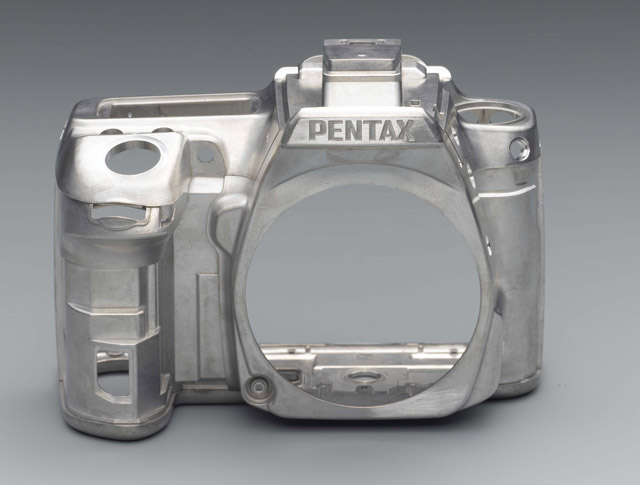
Edit 2 (6:30 p.m.): A Picture of the Magnesium Alloy Outer Shell!
Edit 3 (9:00 p.m.): B&H also has K-7 published with price and expected arrival date before any official announcement appears!
http://www.bhphotovideo.com/c/product/622079-REG/Pentax__K_7_SLR_Digital_Camera.html
Body Price: US$1,200; Arrival: July
(Edit 5-21: The Price has been changed to $1,300!)
Edit 4 (9:45 p.m.): Scanned copy of the K-7 Specifications page from an English official catalogue surfaced:-
http://www.priyantha.nl/tweakers/pentax/K7/K7_press_6.jpg
New Info: Video is Motion JPEG in AVI
Edit 5 (10:00 p.m.): K-7 Announced and Previewed at Dpreview!:-
http://www.dpreview.com/news/0905/09052003pentaxk7dslr.asp
(10:05 p.m.): The official teaser countdown timer has reached zero again at pentaximaging.com but the website has been down since then and is still unable to access up till now! (10:15 p.m.)
(10:30 p.m.): from DPR Preview:
"Custom Function 18: Slow Shutter Speed NR - 1: Auto, 2: Standard"
WHAT?? STILL *Forced* Dark Frame Subtraction for long exposure as there is NO "Off" *Option*!!!???
And, Custom Function 36 shows that AF adjustment and fine tuning is still available.
Edit 6 (11:00 p.m.): Imaging Resource K-7 Preview has been out:-
http://www.imaging-resource.com/PRODS/K7/K7A.HTM
http://www.fotoradce.cz/fotoaparaty/pentax-k-7-cislo1799
(Automatic Google Translation Here)
And, two more new K-7 photos are published:-
Well, the specs are more or less the same as what I have told and there are some more little details which I have not included and vice versa, e.g., the Guide Number of the built-in flash, which is 13m at ISO 100. The X-sync speed remains at 1/180th second! :-(
It is told that the suggested price of the K-7 Kit with the 18-55 WR is 1200 EUR with 19% VAT included, here.
And as for the latest expected street price of the K-7 (body?) at this moment, "tigrebleu" has reported here that the price as advised by his Canadian dealer is about (US)$1,400.
This is actually exactly the same as what I estimated with the basic information provided from another reader of mine on April 23.
Edit (5:00 p.m.): Official German Catalogue Leaked!
See: http://www.glanzbilder.org/2009/05/20/pentax-k-7-specs/


(The above linked directly to the original source.)
So, any new info? Yes, here they are:-
- LCD monitor is with Anti-Reflection (AR) coating;
- HD movie at maximum resolution (1536 x 1024 pixels / 30 frames) can be recorded up to 25 minutes or with a maximum file size of 4GB;
- External microphone-in for movie recording is stereo type;
- Shake Reduction up to 4EV protection;
- RAW is 12-bit;
- X-sync re-confirmed at 1/180 s;
- RTF: P-TTL, GN 13 (m @ ISO 100), angle of coverage: 28mm, 135 equivalent;
- Self-timer: 2 or 12 sec. delay; IR remote control: 0 or 3 sec.;
- 37 Custom Functions;
- In-camera image editing for aspect ratio (3:2, 4:3, 16:9 or 1:1 (square)) and fisheye effect, etc., in addition to the 16 digital filters for image processing.
Edit 2 (6:30 p.m.): A Picture of the Magnesium Alloy Outer Shell!
Edit 3 (9:00 p.m.): B&H also has K-7 published with price and expected arrival date before any official announcement appears!
http://www.bhphotovideo.com/c/product/622079-REG/Pentax__K_7_SLR_Digital_Camera.html
Body Price: US$1,200; Arrival: July
(Edit 5-21: The Price has been changed to $1,300!)
Edit 4 (9:45 p.m.): Scanned copy of the K-7 Specifications page from an English official catalogue surfaced:-
http://www.priyantha.nl/tweakers/pentax/K7/K7_press_6.jpg

New Info: Video is Motion JPEG in AVI
Edit 5 (10:00 p.m.): K-7 Announced and Previewed at Dpreview!:-
http://www.dpreview.com/news/0905/09052003pentaxk7dslr.asp
(10:05 p.m.): The official teaser countdown timer has reached zero again at pentaximaging.com but the website has been down since then and is still unable to access up till now! (10:15 p.m.)
(10:30 p.m.): from DPR Preview:
"Custom Function 18: Slow Shutter Speed NR - 1: Auto, 2: Standard"
WHAT?? STILL *Forced* Dark Frame Subtraction for long exposure as there is NO "Off" *Option*!!!???
And, Custom Function 36 shows that AF adjustment and fine tuning is still available.
Edit 6 (11:00 p.m.): Imaging Resource K-7 Preview has been out:-
http://www.imaging-resource.com/PRODS/K7/K7A.HTM
Friday, November 26, 2010
Over Hong Kong: Serious Problem of Air Pollution Caused by Industrial Over Production :-(
Had a helicopter flight over the Victoria Harbour of Hong Kong weeks ago and here are some photos to share:-
http://smg.photobucket.com/albums/v313/RiceHigh/5Ds/Over_Hong_Kong/?albumview=slideshow
Camera used was a Canon EF 17-40L on a Canon 5D. I have added captions for the photos to describe at which region over where I took a snapshot of.
Unfortunately, that hazy "weather" just let me re-think about the adverse consequence of the industrial over-production of we mankind. China, being the "World Factory" nowadays for the whole world, whilst has attained great economical gains and results, has to pay off hugely for environmental pollution of which possibly the destruction could never be recovered. Just see the NASA air pollution geographical plot below:-

(Source URL and Background: http://www.nasa.gov/topics/earth/features/health-sapping.html)
In fact, the mainland of China is where it suffers most. When we look up the sky, it is usually terrible, for most of the time! >:-(
On the other hand, Hong Kong, being located at the southest part of China, is not the worst place for air pollution in China indeed. The air pollution of HK does actually depends much on the wind direction of the weather. When we have South wind, the weather will be better. Here is an example shot, taken on a really clear day:-
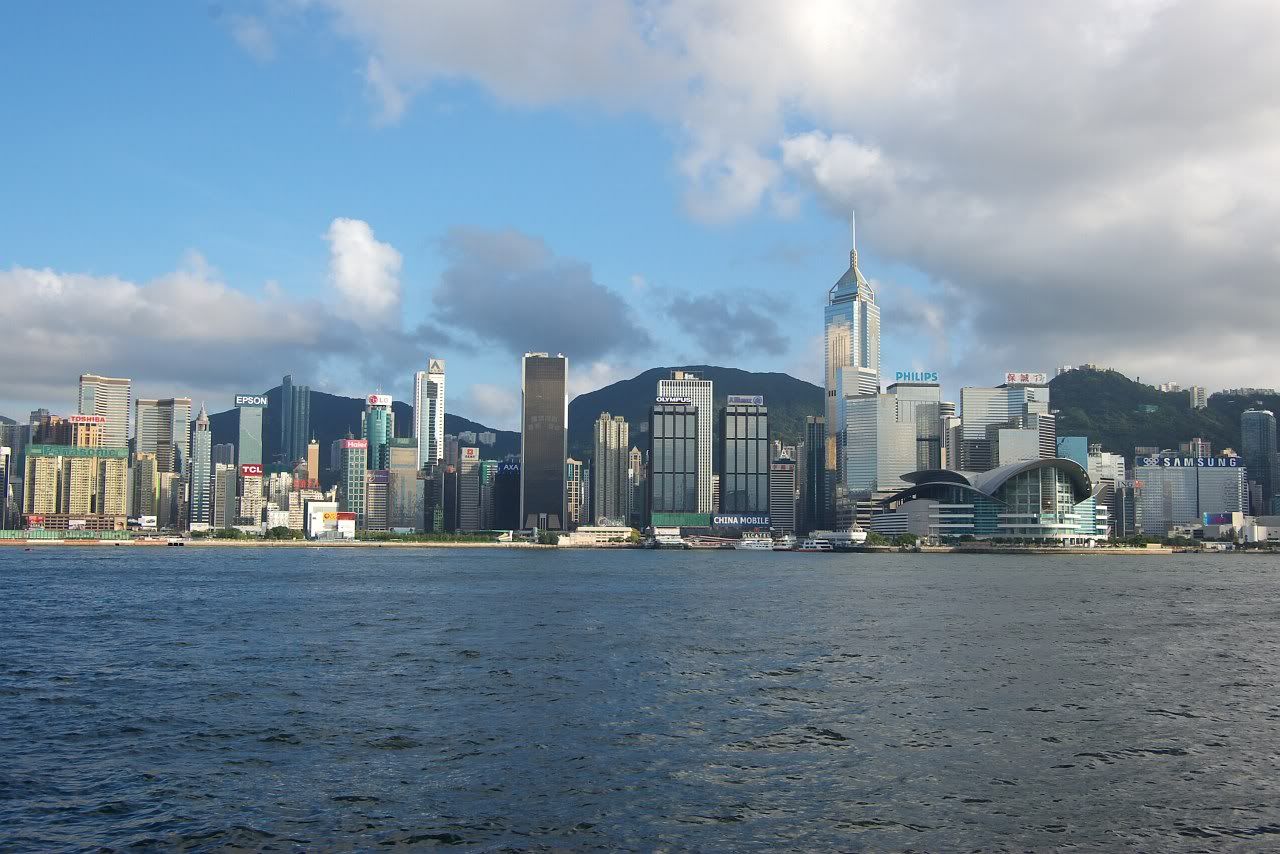
(Above: Taken with a Pentax DA 16-45/4 Lens on a Pentax K100D (My Full Review Here))
But when the weather is "not good". When I look out of the windows everywhere, we can only see a hazy scene. Below is a photo which I made last year for a large-scale local photo competition:-
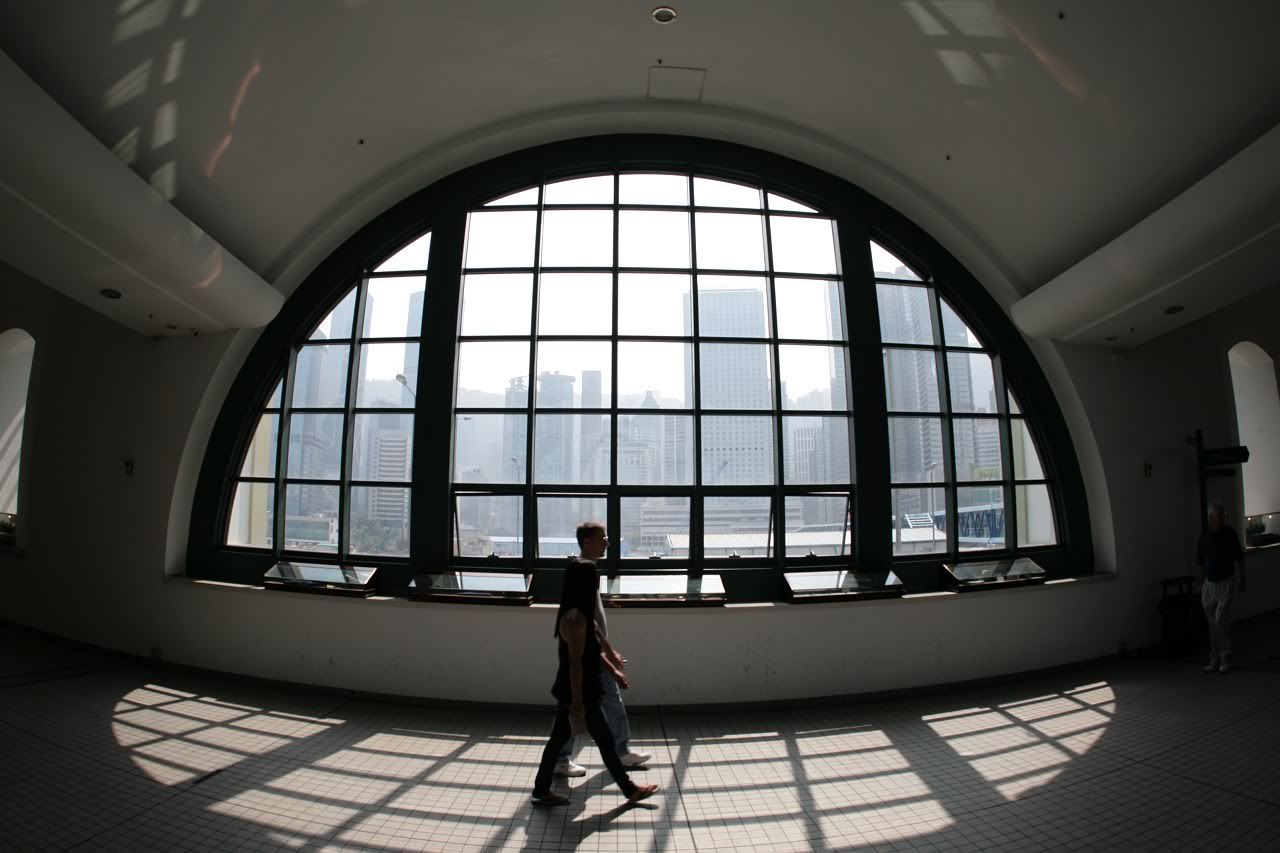
(Above: Taken with a Pentax SMC-F 17-28 Fisheye on a Canon 5D; Taken on a Sunny day in the early afternoon.)
After all, the Earth belongs to all of us, no matter you are living in China, South-East Asia or not. So, sometimes I just ask myself, if we really need to buy so many and too many unnecessary things daily and monthly ourselves. Even if we buy new stuff, we should find some good ways to re-use or re-cycle our "useless" items. And, should we do more to save the Earth but not driven too much by all those manufacturers in buying new stuff just for their own continuous survival. Otherwise, mankind will suffer and pay off very soon.
Act now, save the Earth! But if you still can't help in buying new gadgets (and also new fashions, bags, jewellery etc. for ladies), just think more before act and that will surely help! (Even if we can't help ourselves sometimes, as there are always temptations! :-))
P.S. There is a photo album book called "Over Hong Kong" published in Hong Kong since late 80s in which aero photos were taken over Hong Kong using the Pentax 67 gear on an airplane. The pictures look really great indeed but I am afraid it will be more and more difficult for them to take clear pictures these days in Hong Kong.
P.S.2. Now, the previous Pentax 67/645 film photographers could use the new 645D for doing landscape, but with a 1.36X crop factor and effective focal multiplier, the old wide angle lenses will not be wide as they were in their old glorious days. :-(
http://smg.photobucket.com/albums/v313/RiceHigh/5Ds/Over_Hong_Kong/?albumview=slideshow
Camera used was a Canon EF 17-40L on a Canon 5D. I have added captions for the photos to describe at which region over where I took a snapshot of.
Unfortunately, that hazy "weather" just let me re-think about the adverse consequence of the industrial over-production of we mankind. China, being the "World Factory" nowadays for the whole world, whilst has attained great economical gains and results, has to pay off hugely for environmental pollution of which possibly the destruction could never be recovered. Just see the NASA air pollution geographical plot below:-
(Source URL and Background: http://www.nasa.gov/topics/earth/features/health-sapping.html)
In fact, the mainland of China is where it suffers most. When we look up the sky, it is usually terrible, for most of the time! >:-(
On the other hand, Hong Kong, being located at the southest part of China, is not the worst place for air pollution in China indeed. The air pollution of HK does actually depends much on the wind direction of the weather. When we have South wind, the weather will be better. Here is an example shot, taken on a really clear day:-
(Above: Taken with a Pentax DA 16-45/4 Lens on a Pentax K100D (My Full Review Here))
But when the weather is "not good". When I look out of the windows everywhere, we can only see a hazy scene. Below is a photo which I made last year for a large-scale local photo competition:-
(Above: Taken with a Pentax SMC-F 17-28 Fisheye on a Canon 5D; Taken on a Sunny day in the early afternoon.)
After all, the Earth belongs to all of us, no matter you are living in China, South-East Asia or not. So, sometimes I just ask myself, if we really need to buy so many and too many unnecessary things daily and monthly ourselves. Even if we buy new stuff, we should find some good ways to re-use or re-cycle our "useless" items. And, should we do more to save the Earth but not driven too much by all those manufacturers in buying new stuff just for their own continuous survival. Otherwise, mankind will suffer and pay off very soon.
Act now, save the Earth! But if you still can't help in buying new gadgets (and also new fashions, bags, jewellery etc. for ladies), just think more before act and that will surely help! (Even if we can't help ourselves sometimes, as there are always temptations! :-))
P.S. There is a photo album book called "Over Hong Kong" published in Hong Kong since late 80s in which aero photos were taken over Hong Kong using the Pentax 67 gear on an airplane. The pictures look really great indeed but I am afraid it will be more and more difficult for them to take clear pictures these days in Hong Kong.
P.S.2. Now, the previous Pentax 67/645 film photographers could use the new 645D for doing landscape, but with a 1.36X crop factor and effective focal multiplier, the old wide angle lenses will not be wide as they were in their old glorious days. :-(
Sunday, October 28, 2007
The Current Pentax DSLR "System" As A *System*
There is always a good reason for people who need a DSLR, it is because the lenses of a DSLR system are interchangeable and that the lens lineup of a DSLR constitutes the most important part of such a system.
Now, we can have a look at the current lens lineup as offered by Pentax:-
http://www.pentaxslr.com/lenses
In fact, one will not be difficult to spot that Pentax's current lens lineup has no prime lens which is longer than 100mm and actually that "longest" prime is not a tele-lens neither and it is just a standard 100mm/2.8 macro lens. So, what're the remaining offerings at the tele-side? Well, there are two lenses which the Pentax user can still choose from, but both are just slow consumer zooms, namely, the DA 50-200/4-5.6 or the recent DA 18-250/3.5-6.3, which is widely believed to be a Tamron OEM variant anyway. So, if one don't mind to have such a slow and low-grade zoom (well, again, not even talking about primes), the longest focal one can get is just 250mm, but at f/6.3, with the inferior image quality which can be expected for a 13.9X "super zoom" used at the extreme end focals.
Of course, particular people (usually those brand defenders/blinded brand loyalists/brand fans, or whatever you could find a term to best describe them) would start arguing that *they* do not need to buy new or current lenses, they could just choose to use old lenses. But my opinions are simply that: 1. It is not an excuse for inadequate choice of lenses under the current lens lineup which are in production; 2. Old lenses are not fully supported by the current Pentax DSLR bodies as they were designed to work and function nor these lenses can enable all the latest features as contained in the current DSLR bodies, say, for the AF and AE or even Flash Exposure departments.
Actually, if one looks back Pentax's history and their offerings on those SLR system lens lineup, one would easily discover one sad fact: There has never been a while in Pentax's past history that they lack a complete lens lineup with such a limited focal range and the lack of useful primes (which *were* what Pentax truly excelled in themselves) than the present situation.
Just look at again the Pentax's great stuff for the past generations of the lens lineup, since the late 50s when they made their first SLR:- http://kmp.bdimitrov.de/lenses/index.html#data, then one will know immediately for how weak the current Pentax lens lineup really is.
The funny thing is that if you also look at my own Pentax AF lenses collection, then you will see that actually I have a more complete (or at least more balanced) lens lineup than what Pentax is offering now, especially at the tele-side and/or if those lenses are used with a Full Frame body. Nevertheless, most of the excellent FA film lenses in my own lineup have been discontinued by Pentax in recent years, since they launched their new DA lens production line in Vietnam.
Well, again, those particular people will start to mention about that Pentax has a lens roadmap and they will add new lenses in the future. Yes, I think we all know that. Below is the latest revised lens roadmap by Pentax:-
http://www.digital.pentax.co.jp/en/lens/roadmap.pdf
Now, there are new DA* tele primes to come. But if one have been reading the past lens roadmap updates with a more careful mind, one should have also discovered that now that the latest Pentax lens roadmap for those "future" lenses are now have no "tentative dates" for their targeted release times, if any.
Furthermore, there is yet one big problem with the planned Pentax's system if one bothers to compare it against what Canon, Nikon and Sony has been planning and are offering for their lens systems, that is, no one will make the telephoto side of their lens systems to be in APS-C format, at least not with the same nomenclature as what Pentax has planned for the "DA*" tele lenses. With a DA name, no one can guarantee that those new lenses, even if they are really to come (but when?), are actually Full Frame compatible, or not. BTW, has anyone ever been able to see an EF-S Canon tele lens or a DX formated Nikon tele?? (which doesn't make any sense at all IMHO..)
Well and well, people would ask why "Full Frame compatible" is so important? In fact, Canon, Nikon and Sony are surely having better foresight in planning a system to cope with future Full Frame bodies which they have been planning or simply have already implemented. In fact, the Full Frame trend (or the "Full Frame Train") seem to be the ultimate way to go in the foreseeable future. The C, N and S are at least mind corrected marketing wise, or even technically wise, unlike Pentax, who seems just know to insist on an APS-C development even though even those of their previously promised APS-C lenses are now just paperware which has nowhere to come.
Last but not least and in addition, what I feel indeed rather disappointed (again) for Pentax's lens lineup is that in the past I was always felt proud of being a Pentax user for having the choice or even owning quite some of the best valued and optically excellent and uniquely characterised lenses of Pentax which other systems lacked. But now if one with a more careful mind and without any stance who judges and compares different systems, he/she will not be difficult to learn that Pentax lenses, even DA* zooms, can be purchased as Tokina variants in C and N mounts at much cheaper prices but with similar optical performances and characteristics for all those "co-developed" (as verified in various published reviews and tests), and even the latest Pentax's offer can be found as a Tamron 18-250 super zoom in C or N mount, too. (But Tokina and Tamron just haven't offered those lens models in Pentax mount!)
So, after all and all in all, the big question is my mind is: Why Pentax NOW? And how could and should the Pentax DSLR system be chosen and be considered as a complete system?
You may think that I might be saying too many things that are considered "negative" about the *current* Pentax system in the above. But anyway whether you like the above or not, all these are *facts*. Nonetheless, I would still try to be contributive for my own insight and comment for how Pentax can be alive out of the current difficult situation. I can think out of a possible way or even maybe the only way for them to compete again with others *again* in the future: That is, to re-build/re-setup the old FA film Full Frame lens lineup for lens models as needed (especially for the primes and the tele-side lenses they are lacking, which I think they are theoretically capable of and the re-design works would be minimal, technically) *and* try ALL of their best efforts to make a Full Frame DSLR body - even though it shall not come eariler than the Sony, but should not be (much) later than them. Otherwise, when Canon, Nikon and Sony all have affordable FF DSLR models in the foreseeable future, Pentax would probably die in the end. Note again that C, N and S all have a complete lens lineup for *both* APS-C and FF but Pentax has actually not yet completed even their APS-C lineup (but they were however too "roughly" to decide to discontinue all those old film lenses, especially at the tele-side). My humble opinions and my two cents..
Now, we can have a look at the current lens lineup as offered by Pentax:-
http://www.pentaxslr.com/lenses
In fact, one will not be difficult to spot that Pentax's current lens lineup has no prime lens which is longer than 100mm and actually that "longest" prime is not a tele-lens neither and it is just a standard 100mm/2.8 macro lens. So, what're the remaining offerings at the tele-side? Well, there are two lenses which the Pentax user can still choose from, but both are just slow consumer zooms, namely, the DA 50-200/4-5.6 or the recent DA 18-250/3.5-6.3, which is widely believed to be a Tamron OEM variant anyway. So, if one don't mind to have such a slow and low-grade zoom (well, again, not even talking about primes), the longest focal one can get is just 250mm, but at f/6.3, with the inferior image quality which can be expected for a 13.9X "super zoom" used at the extreme end focals.
Of course, particular people (usually those brand defenders/blinded brand loyalists/brand fans, or whatever you could find a term to best describe them) would start arguing that *they* do not need to buy new or current lenses, they could just choose to use old lenses. But my opinions are simply that: 1. It is not an excuse for inadequate choice of lenses under the current lens lineup which are in production; 2. Old lenses are not fully supported by the current Pentax DSLR bodies as they were designed to work and function nor these lenses can enable all the latest features as contained in the current DSLR bodies, say, for the AF and AE or even Flash Exposure departments.
Actually, if one looks back Pentax's history and their offerings on those SLR system lens lineup, one would easily discover one sad fact: There has never been a while in Pentax's past history that they lack a complete lens lineup with such a limited focal range and the lack of useful primes (which *were* what Pentax truly excelled in themselves) than the present situation.
Just look at again the Pentax's great stuff for the past generations of the lens lineup, since the late 50s when they made their first SLR:- http://kmp.bdimitrov.de/lenses/index.html#data, then one will know immediately for how weak the current Pentax lens lineup really is.
The funny thing is that if you also look at my own Pentax AF lenses collection, then you will see that actually I have a more complete (or at least more balanced) lens lineup than what Pentax is offering now, especially at the tele-side and/or if those lenses are used with a Full Frame body. Nevertheless, most of the excellent FA film lenses in my own lineup have been discontinued by Pentax in recent years, since they launched their new DA lens production line in Vietnam.
Well, again, those particular people will start to mention about that Pentax has a lens roadmap and they will add new lenses in the future. Yes, I think we all know that. Below is the latest revised lens roadmap by Pentax:-
http://www.digital.pentax.co.jp/en/lens/roadmap.pdf
Now, there are new DA* tele primes to come. But if one have been reading the past lens roadmap updates with a more careful mind, one should have also discovered that now that the latest Pentax lens roadmap for those "future" lenses are now have no "tentative dates" for their targeted release times, if any.
Furthermore, there is yet one big problem with the planned Pentax's system if one bothers to compare it against what Canon, Nikon and Sony has been planning and are offering for their lens systems, that is, no one will make the telephoto side of their lens systems to be in APS-C format, at least not with the same nomenclature as what Pentax has planned for the "DA*" tele lenses. With a DA name, no one can guarantee that those new lenses, even if they are really to come (but when?), are actually Full Frame compatible, or not. BTW, has anyone ever been able to see an EF-S Canon tele lens or a DX formated Nikon tele?? (which doesn't make any sense at all IMHO..)
Well and well, people would ask why "Full Frame compatible" is so important? In fact, Canon, Nikon and Sony are surely having better foresight in planning a system to cope with future Full Frame bodies which they have been planning or simply have already implemented. In fact, the Full Frame trend (or the "Full Frame Train") seem to be the ultimate way to go in the foreseeable future. The C, N and S are at least mind corrected marketing wise, or even technically wise, unlike Pentax, who seems just know to insist on an APS-C development even though even those of their previously promised APS-C lenses are now just paperware which has nowhere to come.
Last but not least and in addition, what I feel indeed rather disappointed (again) for Pentax's lens lineup is that in the past I was always felt proud of being a Pentax user for having the choice or even owning quite some of the best valued and optically excellent and uniquely characterised lenses of Pentax which other systems lacked. But now if one with a more careful mind and without any stance who judges and compares different systems, he/she will not be difficult to learn that Pentax lenses, even DA* zooms, can be purchased as Tokina variants in C and N mounts at much cheaper prices but with similar optical performances and characteristics for all those "co-developed" (as verified in various published reviews and tests), and even the latest Pentax's offer can be found as a Tamron 18-250 super zoom in C or N mount, too. (But Tokina and Tamron just haven't offered those lens models in Pentax mount!)
So, after all and all in all, the big question is my mind is: Why Pentax NOW? And how could and should the Pentax DSLR system be chosen and be considered as a complete system?
You may think that I might be saying too many things that are considered "negative" about the *current* Pentax system in the above. But anyway whether you like the above or not, all these are *facts*. Nonetheless, I would still try to be contributive for my own insight and comment for how Pentax can be alive out of the current difficult situation. I can think out of a possible way or even maybe the only way for them to compete again with others *again* in the future: That is, to re-build/re-setup the old FA film Full Frame lens lineup for lens models as needed (especially for the primes and the tele-side lenses they are lacking, which I think they are theoretically capable of and the re-design works would be minimal, technically) *and* try ALL of their best efforts to make a Full Frame DSLR body - even though it shall not come eariler than the Sony, but should not be (much) later than them. Otherwise, when Canon, Nikon and Sony all have affordable FF DSLR models in the foreseeable future, Pentax would probably die in the end. Note again that C, N and S all have a complete lens lineup for *both* APS-C and FF but Pentax has actually not yet completed even their APS-C lineup (but they were however too "roughly" to decide to discontinue all those old film lenses, especially at the tele-side). My humble opinions and my two cents..
Monday, December 11, 2006
Does the Number of Bits (in Digitization) Matter?
When Pentax always talk about the Analog to Digital Convertor of K10D has 1024 times more tonal levels recorded when compared against conventional/typical DSLRs, what does this actually mean? And, what're the benefits? Practically, how significant this would be and does this really useful, or not?
First of all, as I have included in the Introduction part of my Homepage the following links, these two (great, clear and useful) articles are something that must be read for anyone who are interested in the topic of digital tonality (and anything related to this topic):-
http://www.normankoren.com/digital_tonality.html
http://www.luminous-landscape.com/tutorials/expose-right.shtml
With a few of the basic concepts in mind, assuming the CCD and ADC combo is calibrated for a full (dynamic) range of 4 EVs for all the digitized tonal levels, i.e., from Zone III to Zone VII (-2EV to +2EV respectively, with 0EV at Zone V, which is the middle of the range), I summarize the relationship between the Number of Bits in Digitization and the Distribution of Recordable Tonal Levels along the Brightness Histogram, as follows (linear response curve within the ADC is also assumed):-
http://www.geocities.com/ricehigh/blogger/Distribution_of_Tonal_Levels.html
Now that just like what Mr. Norman Koren and Mr. Michael Reichmann have illustrated in their respective articles, it should be noted again most of the recorded/recordable tonal levels are "condensed" at the brighter side or the "right" side (of a histogram). It can be noted also when the brightness levels is doubled, the (sub-)total number of tonal levels within the brightness range is doubled and ditto when halved.
Do note that if the ADC with the CCD is to be calibrated for more Zones, then the distribution of recorded tonal levels will be even drifted more to the right side of the histogram (while the total number remains the same). Nonetheless, the assumption of -2EV to +2EV is fair and practical enough for a traditional light recording media like slide film which has more or less the same (narrow) latitude in exposure as digital imagers.
So, with reference to the figures in my above table, the total number of tonal levels is calculated by 2 to the power of (the number of bits). It can be seen that the total number of tonal levels for a 22-bit digitization device is a tremendous figure. By dividing the 4,194,304 (which is the theoretical figure for a 22-bit device) with 4,096 (which is the figure for a 12-bit device), the difference is 1024 times. This is what Pentax emphasize on and here is how it comes.
However, as explained in my last article about the ADC of the K10D, the highly oversampled bit rate (which I would say it is overkilled) will be downsampled to 12-bit *shortly* after the digital data are passing out of the DBE (Digital Back End) of the ADC. This number of bit is what a RAW file of the K10D can give. And again, as what Pentax have also told, at the same time, but not explicitly, it is only 1/1024th of the original data of the 22-bit ADC! (just because the K10D RAW files are *also* in 12-bit, as against 22-bit).
The good thing here (about the K10D) is that a linear curve is not mandatory for the ADC of the K10D (again, see my last article, remember the "knee" points function?) so oversampling can provide more data for adjustment and correction. For the bad thing(s), I shall talk in the following paragraphs.
So, how important is this "number of bits" figure on the image quality and the tonal response (smoothness in transition, etc.)? It is very trivial that the more levels it records, the smoother the tonal quality and response it would be. However, it is the main weakness of *any* digital camera that the number of tonal levels at the shadow areas are much less than those counted at the brighter parts, i.e. the highlights, owing to the primitive nature of CCD/CMOS imager, which is a linear square law detector.
As such, assuming *perfectly* ideal exposure which means that an evenly spread histogram is obtained, *at* the time of picture taking, then most of the tonal levels are recorded as *useful image data*. In contrast, if underexposure happened or just that the highlights part of the picture are out of interest by the photographer, then the limited number of tonal levels at the shadow, say, only 273 nos. for a 12-bit RAW, at the darkest quarter of 0-63, then this limited number of tonal level steps, as recorded in the RAW file, will be "stretched" to re-build the whole picture, resulting in visible noise and lack of smoothness of tone transition.
So, in short, the number of bits from the DBE (actually it is also what the RAW file could contain) is very crucial for what later on the user can tweak a picture or how the IPU (Image Processing Unit) of the DSLR can process the image, for a better looking one.
Well, at this point, what I must emphasize (again, as always) is that an accurate metering and exposure system of the DSLR is of prime importance than anything else, given that the number of bits of the RAW file is the identical. In contrast, if the RAW file has more bits, then this will open up significant more room for post processing of the RAW, just see the 14-bit example of the Fuji S3 Pro in the above summary table. It has four times more tonal levels even at the darkest quad of the histogram.
Nonetheless, for a properly exposed digital image which requires little adjustment of the levels, the number of bits will then become insignificant. The fact is that most output format and devices have only 8-bit per channel (24 bits for all colors), these include JPEG files (which Fuji Frontier Laser Photo Printing Machines accept as standard format for printing) as well as the latest PC DVI interface (which is 24-bit only for its TMDS transmission protocol):-
http://www.answers.com/topic/digital-visual-interface
In fact, most cheaper LCD panels/monitors are of 6-bit per pixel only and by dithering tricks of four pixels to form one, they can yield a maximum of 16.2M colors in the published specifications (instead of 16.77 million colors for true 8-bit panels). My current LCD monitor used at my home is an EIZO / FlexScan S1961 which has a true 8-bit per pixel panel and an internal 10-bit signal processor which is already very good in tonal and color reproduction.
Indeed, I always find that EIZO products are designed and built *very* accurately, for my experience with their various models over years. To compare, previously I also bought a Samsung 770P top-of-the-line (also) true 8-bit LCD monitor but which IMHO by no means can match with the EIZO, in terms of color and tonal accuracy, despite the published specs are quite similar. This story strongly reminds me again that sometimes specifications don't tell much but only the actual performance as well as the level of accuracy of a product are the true important things that really count.
So, in the end, you need a high bit *output* device to output your high bit pictures, if any. Actually, DVI cannot give more than 8-bit (the transmitted data are in 10-bit, but the remaining two bits is for the transmission protocol, but not contain any picture data). HDMI can have more bits in 12 numbers, but currently very few PC display cards as well as monitors support this. Of course, one would argue that why not use CRT displays which has more colors? My humble opinion is simply that to set up an accurate analog color output system is not for non-professionals nor most home users! Even more, to maintain and calibrate such a carefully set up system is again not an trivial job!
Last but not least, if you still have some unresolved puzzles about the basic concept(s) in your mind after reading all these here and even after reading the above two provided (important) articles written by Norman Koren and Michael Reichmann, you may wish to read also my article, "How Lights are Mapped into Levels" (contained also in the "Links" section of this Blog), which I hope I have written in an "easier" way.
First of all, as I have included in the Introduction part of my Homepage the following links, these two (great, clear and useful) articles are something that must be read for anyone who are interested in the topic of digital tonality (and anything related to this topic):-
http://www.normankoren.com/digital_tonality.html
http://www.luminous-landscape.com/tutorials/expose-right.shtml
With a few of the basic concepts in mind, assuming the CCD and ADC combo is calibrated for a full (dynamic) range of 4 EVs for all the digitized tonal levels, i.e., from Zone III to Zone VII (-2EV to +2EV respectively, with 0EV at Zone V, which is the middle of the range), I summarize the relationship between the Number of Bits in Digitization and the Distribution of Recordable Tonal Levels along the Brightness Histogram, as follows (linear response curve within the ADC is also assumed):-
http://www.geocities.com/ricehigh/blogger/Distribution_of_Tonal_Levels.html
Now that just like what Mr. Norman Koren and Mr. Michael Reichmann have illustrated in their respective articles, it should be noted again most of the recorded/recordable tonal levels are "condensed" at the brighter side or the "right" side (of a histogram). It can be noted also when the brightness levels is doubled, the (sub-)total number of tonal levels within the brightness range is doubled and ditto when halved.
Do note that if the ADC with the CCD is to be calibrated for more Zones, then the distribution of recorded tonal levels will be even drifted more to the right side of the histogram (while the total number remains the same). Nonetheless, the assumption of -2EV to +2EV is fair and practical enough for a traditional light recording media like slide film which has more or less the same (narrow) latitude in exposure as digital imagers.
So, with reference to the figures in my above table, the total number of tonal levels is calculated by 2 to the power of (the number of bits). It can be seen that the total number of tonal levels for a 22-bit digitization device is a tremendous figure. By dividing the 4,194,304 (which is the theoretical figure for a 22-bit device) with 4,096 (which is the figure for a 12-bit device), the difference is 1024 times. This is what Pentax emphasize on and here is how it comes.
However, as explained in my last article about the ADC of the K10D, the highly oversampled bit rate (which I would say it is overkilled) will be downsampled to 12-bit *shortly* after the digital data are passing out of the DBE (Digital Back End) of the ADC. This number of bit is what a RAW file of the K10D can give. And again, as what Pentax have also told, at the same time, but not explicitly, it is only 1/1024th of the original data of the 22-bit ADC! (just because the K10D RAW files are *also* in 12-bit, as against 22-bit).
The good thing here (about the K10D) is that a linear curve is not mandatory for the ADC of the K10D (again, see my last article, remember the "knee" points function?) so oversampling can provide more data for adjustment and correction. For the bad thing(s), I shall talk in the following paragraphs.
So, how important is this "number of bits" figure on the image quality and the tonal response (smoothness in transition, etc.)? It is very trivial that the more levels it records, the smoother the tonal quality and response it would be. However, it is the main weakness of *any* digital camera that the number of tonal levels at the shadow areas are much less than those counted at the brighter parts, i.e. the highlights, owing to the primitive nature of CCD/CMOS imager, which is a linear square law detector.
As such, assuming *perfectly* ideal exposure which means that an evenly spread histogram is obtained, *at* the time of picture taking, then most of the tonal levels are recorded as *useful image data*. In contrast, if underexposure happened or just that the highlights part of the picture are out of interest by the photographer, then the limited number of tonal levels at the shadow, say, only 273 nos. for a 12-bit RAW, at the darkest quarter of 0-63, then this limited number of tonal level steps, as recorded in the RAW file, will be "stretched" to re-build the whole picture, resulting in visible noise and lack of smoothness of tone transition.
So, in short, the number of bits from the DBE (actually it is also what the RAW file could contain) is very crucial for what later on the user can tweak a picture or how the IPU (Image Processing Unit) of the DSLR can process the image, for a better looking one.
Well, at this point, what I must emphasize (again, as always) is that an accurate metering and exposure system of the DSLR is of prime importance than anything else, given that the number of bits of the RAW file is the identical. In contrast, if the RAW file has more bits, then this will open up significant more room for post processing of the RAW, just see the 14-bit example of the Fuji S3 Pro in the above summary table. It has four times more tonal levels even at the darkest quad of the histogram.
Nonetheless, for a properly exposed digital image which requires little adjustment of the levels, the number of bits will then become insignificant. The fact is that most output format and devices have only 8-bit per channel (24 bits for all colors), these include JPEG files (which Fuji Frontier Laser Photo Printing Machines accept as standard format for printing) as well as the latest PC DVI interface (which is 24-bit only for its TMDS transmission protocol):-
http://www.answers.com/topic/digital-visual-interface
In fact, most cheaper LCD panels/monitors are of 6-bit per pixel only and by dithering tricks of four pixels to form one, they can yield a maximum of 16.2M colors in the published specifications (instead of 16.77 million colors for true 8-bit panels). My current LCD monitor used at my home is an EIZO / FlexScan S1961 which has a true 8-bit per pixel panel and an internal 10-bit signal processor which is already very good in tonal and color reproduction.
Indeed, I always find that EIZO products are designed and built *very* accurately, for my experience with their various models over years. To compare, previously I also bought a Samsung 770P top-of-the-line (also) true 8-bit LCD monitor but which IMHO by no means can match with the EIZO, in terms of color and tonal accuracy, despite the published specs are quite similar. This story strongly reminds me again that sometimes specifications don't tell much but only the actual performance as well as the level of accuracy of a product are the true important things that really count.
So, in the end, you need a high bit *output* device to output your high bit pictures, if any. Actually, DVI cannot give more than 8-bit (the transmitted data are in 10-bit, but the remaining two bits is for the transmission protocol, but not contain any picture data). HDMI can have more bits in 12 numbers, but currently very few PC display cards as well as monitors support this. Of course, one would argue that why not use CRT displays which has more colors? My humble opinion is simply that to set up an accurate analog color output system is not for non-professionals nor most home users! Even more, to maintain and calibrate such a carefully set up system is again not an trivial job!
Last but not least, if you still have some unresolved puzzles about the basic concept(s) in your mind after reading all these here and even after reading the above two provided (important) articles written by Norman Koren and Michael Reichmann, you may wish to read also my article, "How Lights are Mapped into Levels" (contained also in the "Links" section of this Blog), which I hope I have written in an "easier" way.
Wednesday, January 26, 2011
First Official Statement by Pentax about K-5 "Sensor Stains" Issue
They have just published their official statement directly from themselves about the issue for the first time, ever:-
http://www.pentax.jp/english/news/announce/20110126.html
Quoted:-
But would this be the end of the story? I am afraid NOT.. Just see a few of all those recent reports by various different K-5 users about the re-occurrence of the same issue after repair/replacement/cleaning of their original K-5 units, as below! :-o It seems that the *root* cause of the issue has not yet been completely located and totally eliminated. >:-(
K-5 Sensor "Stains" Developing Over Time!?
Report of Re-appeared UFOs with Repaired/Replaced K-5 Unit! :-o
LiveView of the K-5 Creates UFOs / Pearls on Sensor?
K-5 Serial Numbers and Issues Summary
http://www.pentax.jp/english/news/announce/20110126.html
Quoted:-
"To PENTAX K-5 Digital SLR Camera Users
We would like to express our heartfelt appreciation for your patronage of PENTAX products.
We deeply regret that the first shipment of our PENTAX K-5 digital SLR camera included some products with a stained image sensor — a problem which we believe was caused during manufacturing — causing them to occasionally produce images with spots which look something like water drops, and which users cannot remove with ordinary cleaning methods.
All users of these defective products will receive free repair at our service center.
We sincerely apologize for any trouble and inconvenience this problem may have caused. We also promise to do all we can to achieve the highest level of quality control in the future, and eliminate any worries our customers might have about our products. We sincerely appreciate your kind understanding and cooperation regarding this issue.
Detail of problem:
Spots looking something like water drops may appear on recorded images under certain conditions.
 |  | |
| Entire image | Enlarged image of spots |
*The following information is for customer who lives in Japan. If you are an international customer, please contact nearest service center."
But would this be the end of the story? I am afraid NOT.. Just see a few of all those recent reports by various different K-5 users about the re-occurrence of the same issue after repair/replacement/cleaning of their original K-5 units, as below! :-o It seems that the *root* cause of the issue has not yet been completely located and totally eliminated. >:-(
K-5 Sensor "Stains" Developing Over Time!?
Report of Re-appeared UFOs with Repaired/Replaced K-5 Unit! :-o
LiveView of the K-5 Creates UFOs / Pearls on Sensor?
K-5 Serial Numbers and Issues Summary
Wednesday, December 08, 2010
Endless Stains on the K-5 Sensors! (and the Possible Root Cause?)
These days, the "Stains" reports of the K-5 now appear endlessly, see what this frustrated K-5 user in the Middle East complains, who is really pissed off:-
http://forums.dpreview.com/forums/read.asp?forum=1036&message=37111740
I do really feel for him, very very much indeed. Someone in the thread who've replied emphasizes that as long as Pentax honours a replacement under the warranty, it is "just a non-issue". The victim replies in the thread that it is not easy for him to get another replacement, as the stock is rather limited at his country, and also that the dealer may not honour the replacement at the end. But then other stupid Pentax fanboys immediately jumped on him for saying that it's all his fault for not checking the return policy before he bought, that IMHO is rather plain stupid and the real utmost stupid saying afterall! >:-(
So, do you think and do you know, even Pentax or her agents/dealers over the world do all honour the warranty and offer for the free replacement eventually, could the problem be resolved? It is not even mentioned about all the troubles and time or even money loss, including that for fighting for a replacement and the subsequent shipping and arrangement etc. as well as the time wasted for those troubles as well as the time lost for not having a new DSLR body for use and taking photos - which is what all the new K-5 users and Pentax supporters bought this new model at the first time at a premium price original intended for!!
Okay, to answer back the question. Here is the showcase of the first K-5 user whom I first seen for reporting the issue, back to early November. After prolonged "fighting" and struggling with the local Pentax sole Agent and his shop, he finally got his another brand new replacement unit for after almost a month. Previously, he reported that his new unit was fine (as it seemed to be) when he first got his replacement unit, but now he has just reported today that his new unit has started to have the *same* problem appeared! :-o As previously, he also posts a photo taken with yet his another replaced K-5 for showing the issue.
So, at the end of the day, this issue seems to be a real issue which affects many K-5 units as reported widely, even if not all. Do note that some users may not notice the problem unless they shoot with small apertures and check more carefully. All in all, I think Pentax/Hoya should issue a product re-call, which they have never done that before anyway, but Canon and Nikon did for other major issues of their products happened and confirmed before, in the big contrast.
As for the very possible cause of the issue, this Canon published service notice tells it all! (My special thanks to OGL for providing the information of this! :-))
http://canoncanada.custhelp.com/app/answers/detail/a_id/12944/~/service-notice%3A-eos-1d-mark-iii%2Feos-1ds-mark-iii%3A-oil-spots-on-lpf-surface
Okay, Pentax, or, you should be called Hoya, it's your take now! Still waiting? Want to hide around? Do not want to respond and just know to fix the issue secretly at your side as far as you can? Really? Yet once again??
If this most unfortunate behaviour of Hoya does happen again for this case, Hoya, I dare to tell you, you are the one who hurts yourself most for doing your business better! Originally, you could have been able to sell more of your products but since there is and will be no reaction, the sales hurt deeply - but by your ownself! >:-[ As time goes by, the reputation of your *brand* is trashed and Pentax dies. If it really happens, Hoya, you're the real culprit! History will record that! >>:-\
Update (12-9):-
1. The stain reports have never ended, an Australian user posted his photo that clearly showing the problem:-
http://forums.dpreview.com/forums/read.asp?forum=1036&message=37130900
Yet, here is another posted real world photo posted by a Hong Kong user:-
http://www.dchome.net/viewthread.php?tid=949406&page=37#pid11334257
By looking at all those affected photos, it seems that there is a chain of circular spots in a line across the sensor. And, most of them are near the centre. So, the cause of these may not be the oil splitting as in the case of Canon 1D3, but possibly other manufacturing issues.
2. The first K-5 user who found and reported the problem has posted the serial numbers of his original K-5 and newly replaced unit, which is yet still defective. The s/n begins with 3827 for the old one and the new one is 3877.
3. Yet another victim who has lately reported about his case writes that he has checked four different K-5 units so far, two s/n begin with 38XX and another two begin with 39XX. But he got no luck! So, as we can see, the problem persists and the latest batch of the production K-5 units are still affected! :-[
4. Now, the HK K-5 users and Pentaxians have created a name of this issue: "The K-5 UFO Incident and Phenomenon". They have started a Petition to Hoya at the DCHome.net Pentax forum. Let's see if Hoya will respond, but my bet is Possibly Not, as we learnt from the SDM failure case, the 1,000+ Pentaxians in a Petition are just got completely ignored!
Last Report About the Issue:-
"Stains" on K-5 Sensors, the Story Continues..
http://forums.dpreview.com/forums/read.asp?forum=1036&message=37111740
I do really feel for him, very very much indeed. Someone in the thread who've replied emphasizes that as long as Pentax honours a replacement under the warranty, it is "just a non-issue". The victim replies in the thread that it is not easy for him to get another replacement, as the stock is rather limited at his country, and also that the dealer may not honour the replacement at the end. But then other stupid Pentax fanboys immediately jumped on him for saying that it's all his fault for not checking the return policy before he bought, that IMHO is rather plain stupid and the real utmost stupid saying afterall! >:-(
So, do you think and do you know, even Pentax or her agents/dealers over the world do all honour the warranty and offer for the free replacement eventually, could the problem be resolved? It is not even mentioned about all the troubles and time or even money loss, including that for fighting for a replacement and the subsequent shipping and arrangement etc. as well as the time wasted for those troubles as well as the time lost for not having a new DSLR body for use and taking photos - which is what all the new K-5 users and Pentax supporters bought this new model at the first time at a premium price original intended for!!
Okay, to answer back the question. Here is the showcase of the first K-5 user whom I first seen for reporting the issue, back to early November. After prolonged "fighting" and struggling with the local Pentax sole Agent and his shop, he finally got his another brand new replacement unit for after almost a month. Previously, he reported that his new unit was fine (as it seemed to be) when he first got his replacement unit, but now he has just reported today that his new unit has started to have the *same* problem appeared! :-o As previously, he also posts a photo taken with yet his another replaced K-5 for showing the issue.
So, at the end of the day, this issue seems to be a real issue which affects many K-5 units as reported widely, even if not all. Do note that some users may not notice the problem unless they shoot with small apertures and check more carefully. All in all, I think Pentax/Hoya should issue a product re-call, which they have never done that before anyway, but Canon and Nikon did for other major issues of their products happened and confirmed before, in the big contrast.
As for the very possible cause of the issue, this Canon published service notice tells it all! (My special thanks to OGL for providing the information of this! :-))
http://canoncanada.custhelp.com/app/answers/detail/a_id/12944/~/service-notice%3A-eos-1d-mark-iii%2Feos-1ds-mark-iii%3A-oil-spots-on-lpf-surface
Okay, Pentax, or, you should be called Hoya, it's your take now! Still waiting? Want to hide around? Do not want to respond and just know to fix the issue secretly at your side as far as you can? Really? Yet once again??
If this most unfortunate behaviour of Hoya does happen again for this case, Hoya, I dare to tell you, you are the one who hurts yourself most for doing your business better! Originally, you could have been able to sell more of your products but since there is and will be no reaction, the sales hurt deeply - but by your ownself! >:-[ As time goes by, the reputation of your *brand* is trashed and Pentax dies. If it really happens, Hoya, you're the real culprit! History will record that! >>:-\
Update (12-9):-
1. The stain reports have never ended, an Australian user posted his photo that clearly showing the problem:-
http://forums.dpreview.com/forums/read.asp?forum=1036&message=37130900
Yet, here is another posted real world photo posted by a Hong Kong user:-
http://www.dchome.net/viewthread.php?tid=949406&page=37#pid11334257
By looking at all those affected photos, it seems that there is a chain of circular spots in a line across the sensor. And, most of them are near the centre. So, the cause of these may not be the oil splitting as in the case of Canon 1D3, but possibly other manufacturing issues.
2. The first K-5 user who found and reported the problem has posted the serial numbers of his original K-5 and newly replaced unit, which is yet still defective. The s/n begins with 3827 for the old one and the new one is 3877.
3. Yet another victim who has lately reported about his case writes that he has checked four different K-5 units so far, two s/n begin with 38XX and another two begin with 39XX. But he got no luck! So, as we can see, the problem persists and the latest batch of the production K-5 units are still affected! :-[
4. Now, the HK K-5 users and Pentaxians have created a name of this issue: "The K-5 UFO Incident and Phenomenon". They have started a Petition to Hoya at the DCHome.net Pentax forum. Let's see if Hoya will respond, but my bet is Possibly Not, as we learnt from the SDM failure case, the 1,000+ Pentaxians in a Petition are just got completely ignored!
Last Report About the Issue:-
"Stains" on K-5 Sensors, the Story Continues..
Monday, June 15, 2009
Development Stories of the K-7
It's official but interesting. Look!
http://www.camera-pentax.jp/story/


Some key points as mentioned:-
1. The K-7 is the result of all the latest R&D efforts of Pentax and Genes.
2. The K-7 is designed to be operational under cold temperature of -10 deg. C. (Well, we all know..)
3. The interviewee is Mr. 濱村壽宏, the Designer of the Development Team of the Pentax Imaging Division of the Hoya Corporation.
4. One of the main target was to make a body to match well with the Limited lenses.
5. The K20D is just too large, we wanted to make back an *ist D sized camera.
6. To not make a curved camera body further, but a classical look one with more straight line.
7. A lot of CAD (Computer Aided Design) resources have been utilised during the development.
8. They spent quite some efforts to make the built-in flash far less protruding and can be raised higher.
9. In order to test the weight balance and feel of the new body, various mock-up units were produced.
10. They invited also novices to try and test the mock-ups! Just because novices have no prejudges! (Well, brilliant!)
11. They created the K-7 with the pride of the most famous and successful Pentax bodies in mind, like the LX and MZ-S. A new brand/product image is intended to be re-established with the K-7.
12. The minimization of the K-7 body is done to an extreme and it is achieved to be very small actually.
13. The lines/shape of the Pentaprism part of the K-7 is intentionally made in a way to preamp the Pentaxprism, which is 100% field of view.
14. The body fittness / ergonomics and comfortability of the K-7 was further fine tuned with various clay mock-up models and the gripped hand positions were recorded for reference.
15. So did the position, shape and size of buttons, dials and levels, which were all very carefully designed.
16. Dials are now covered with sturdy rubber so as to further improve comfortability and reliability for operation.
My translations may not be exact and please excuse for the poor translation and I hope you can get the meanings contained! :-)
Update (6-17): I've found a full translation (almost) by a Swedish poster who stays at Japan.
Here it is:-
http://forums.dpreview.com/forums/read.asp?forum=1036&message=32149442
I hope this would be more complete in sense for the whole story.
Update (9-24): The above Japanese page has been updated and is now split into three stories and subpages:-
http://www.camera-pentax.jp/k-7/story/index1.html
http://www.camera-pentax.jp/k-7/story/index2.html
http://www.camera-pentax.jp/k-7/story/index3.html
Remarks: Note that the original story and link above should now be the first story ("index1"), although it automatically (wrongly) links to the third story ("index3"). And, the links of the original pictures linked above are now invalid and thus I have updated the picture links accordingly. The headline of my this blog entry is also updated, from "story" to "stories".
And, the OK1000 Pentax Blog (which is now getting almost semi-official) has got the official translations from Pentax (Imaging, USA?) and has published also the first two stories up till now:-
http://www.ok1000pentax.com/2009/09/pentax-k-7-designers-notes-toshihiro.html
http://www.ok1000pentax.com/2009/09/pentax-k-7-designers-notes-takeharu.html
I expect the translation for the third article to come at the OK1000 very soon and you may wish to re-visit the site later on if you are interested.
Btw, I don't feel good for yet another used-to-be (long time ago) totally non-Pentax affiliated (as it is claimed) site going semi-official and now has very close relationship with Pentax (Imaging) again, which I think may not be a good thing (when most of the larger Pentax blogs are now semi-official). Indeed, when you read information from a website which has close to very close relationship with a commercial sector, I think you should note about that fact and think more about their stance, my humble opinion.
http://www.camera-pentax.jp/story/
Some key points as mentioned:-
1. The K-7 is the result of all the latest R&D efforts of Pentax and Genes.
2. The K-7 is designed to be operational under cold temperature of -10 deg. C. (Well, we all know..)
3. The interviewee is Mr. 濱村壽宏, the Designer of the Development Team of the Pentax Imaging Division of the Hoya Corporation.
4. One of the main target was to make a body to match well with the Limited lenses.
5. The K20D is just too large, we wanted to make back an *ist D sized camera.
6. To not make a curved camera body further, but a classical look one with more straight line.
7. A lot of CAD (Computer Aided Design) resources have been utilised during the development.
8. They spent quite some efforts to make the built-in flash far less protruding and can be raised higher.
9. In order to test the weight balance and feel of the new body, various mock-up units were produced.
10. They invited also novices to try and test the mock-ups! Just because novices have no prejudges! (Well, brilliant!)
11. They created the K-7 with the pride of the most famous and successful Pentax bodies in mind, like the LX and MZ-S. A new brand/product image is intended to be re-established with the K-7.
12. The minimization of the K-7 body is done to an extreme and it is achieved to be very small actually.
13. The lines/shape of the Pentaprism part of the K-7 is intentionally made in a way to preamp the Pentaxprism, which is 100% field of view.
14. The body fittness / ergonomics and comfortability of the K-7 was further fine tuned with various clay mock-up models and the gripped hand positions were recorded for reference.
15. So did the position, shape and size of buttons, dials and levels, which were all very carefully designed.
16. Dials are now covered with sturdy rubber so as to further improve comfortability and reliability for operation.
My translations may not be exact and please excuse for the poor translation and I hope you can get the meanings contained! :-)
Update (6-17): I've found a full translation (almost) by a Swedish poster who stays at Japan.
Here it is:-
http://forums.dpreview.com/forums/read.asp?forum=1036&message=32149442
I hope this would be more complete in sense for the whole story.
Update (9-24): The above Japanese page has been updated and is now split into three stories and subpages:-
http://www.camera-pentax.jp/k-7/story/index1.html
http://www.camera-pentax.jp/k-7/story/index2.html
http://www.camera-pentax.jp/k-7/story/index3.html
Remarks: Note that the original story and link above should now be the first story ("index1"), although it automatically (wrongly) links to the third story ("index3"). And, the links of the original pictures linked above are now invalid and thus I have updated the picture links accordingly. The headline of my this blog entry is also updated, from "story" to "stories".
And, the OK1000 Pentax Blog (which is now getting almost semi-official) has got the official translations from Pentax (Imaging, USA?) and has published also the first two stories up till now:-
http://www.ok1000pentax.com/2009/09/pentax-k-7-designers-notes-toshihiro.html
http://www.ok1000pentax.com/2009/09/pentax-k-7-designers-notes-takeharu.html
I expect the translation for the third article to come at the OK1000 very soon and you may wish to re-visit the site later on if you are interested.
Btw, I don't feel good for yet another used-to-be (long time ago) totally non-Pentax affiliated (as it is claimed) site going semi-official and now has very close relationship with Pentax (Imaging) again, which I think may not be a good thing (when most of the larger Pentax blogs are now semi-official). Indeed, when you read information from a website which has close to very close relationship with a commercial sector, I think you should note about that fact and think more about their stance, my humble opinion.
Saturday, December 18, 2010
Pentax Flagship Reviews
As we all know, DPR's K-5 review has been out:-
http://www.dpreview.com/reviews/pentaxk5
Congratz to Pentax for getting a "Gold Award" for this camera. I think DPR's comments and remarks throughout the whole review are in general accurate and fair enough this time. In particular, the video feature of the K-5 is dated and full of limitations. Namely, as I have been saying those for long here, its Motion JPEG codec is rather inefficient and the lack of AF (neither re-focusing) during video recording are too outdated against the current competition. Furthermore, no K-5 user could take a full-resolution photo at the time of video recording, unlike what Canon, Nikon and Sony DSLR users can now do with their current models.
As we can also see from the resolution chart tests, K-5's JPEG engine is obviously still quite weak when it is compared to what RAW could deliver. So, it would be better to shoot RAW to get the highest possible resolution and image details. This holds true for the Nikon D7000. But I do find that the difference between RAW and JPEG is less subtle as for the case of K-x, which should be a more ideal JPEG machine. Maybe it's time for a PRIME III or EXPEED 3 or whatsoever. But anyway, I think the camera makers know well how to make a "proper" image engine according to the targeted market segments and selling prices of their products.
Finally, despite what measurbations and comments as laid down in the review and put up by the reviewers, we still need to view and inspect all those selected samples and judge by ourselves further, but yet I think I am not impressed by many of those, nevertheless.
Finally, I think this "early arrived" (when compared to previous Pentax DSLR models) and favourable DPR K-5 review should have helped Pentax a lot in promoting their K-5 and products and more importantly, to help those potential or existing K-5 users for more "re-assurance" for themselves, which many of the gadget consumers nowadays always want! :-D But then I am afraid that the K-5 Sensor Stains Issue and Evil would still hurt them much, that is, the potential users will hold on their purchasing plan, until and unless Pentax/Hoya would really tell us something about this quality issue and the root cause, and more importantly, the corrective and preventive remedials.
Next, let's talk about the true Pentax DSLR flagship but which is not of K-mount anyway, i.e., the 645D. Here is a new review with (small sized) samples, view the links below:-
http://diglloyd.com/diglloyd/2010-12-blog.html#blog20101216Pentax645Dexamples
http://diglloyd.com/dap/index.html#Pentax645D
Update (12-21):-
Since DPR's K-5 review has been out, people have been wondering and discussing about why a different "standard" lens has been used for the final review, and in particularly, it is the first time for DPR to have such a move. See what Peter Zheng reports and comments:-
http://forum.xitek.com/showthread.php?threadid=818466
(in Chinese, Google translated English Page Here)
He has got the previous K-5 measurbation test shots and crops with the FA50/1.4 lens on K-5 (originally, when the DPR 60D review was published just earlier) and then compared to those with the DFA 50/2.8 Macro now, for the final K-5 review.. I wonder comment further for what Peter has found and writes. You'd better read and judge yourself. I blog, you decide! :-)
Previous Related:-
Ten Reasons for Thinking Twice before Decided on a K-5..
http://www.dpreview.com/reviews/pentaxk5
Congratz to Pentax for getting a "Gold Award" for this camera. I think DPR's comments and remarks throughout the whole review are in general accurate and fair enough this time. In particular, the video feature of the K-5 is dated and full of limitations. Namely, as I have been saying those for long here, its Motion JPEG codec is rather inefficient and the lack of AF (neither re-focusing) during video recording are too outdated against the current competition. Furthermore, no K-5 user could take a full-resolution photo at the time of video recording, unlike what Canon, Nikon and Sony DSLR users can now do with their current models.
As we can also see from the resolution chart tests, K-5's JPEG engine is obviously still quite weak when it is compared to what RAW could deliver. So, it would be better to shoot RAW to get the highest possible resolution and image details. This holds true for the Nikon D7000. But I do find that the difference between RAW and JPEG is less subtle as for the case of K-x, which should be a more ideal JPEG machine. Maybe it's time for a PRIME III or EXPEED 3 or whatsoever. But anyway, I think the camera makers know well how to make a "proper" image engine according to the targeted market segments and selling prices of their products.
Finally, despite what measurbations and comments as laid down in the review and put up by the reviewers, we still need to view and inspect all those selected samples and judge by ourselves further, but yet I think I am not impressed by many of those, nevertheless.
Finally, I think this "early arrived" (when compared to previous Pentax DSLR models) and favourable DPR K-5 review should have helped Pentax a lot in promoting their K-5 and products and more importantly, to help those potential or existing K-5 users for more "re-assurance" for themselves, which many of the gadget consumers nowadays always want! :-D But then I am afraid that the K-5 Sensor Stains Issue and Evil would still hurt them much, that is, the potential users will hold on their purchasing plan, until and unless Pentax/Hoya would really tell us something about this quality issue and the root cause, and more importantly, the corrective and preventive remedials.
Next, let's talk about the true Pentax DSLR flagship but which is not of K-mount anyway, i.e., the 645D. Here is a new review with (small sized) samples, view the links below:-
http://diglloyd.com/diglloyd/2010-12-blog.html#blog20101216Pentax645Dexamples
http://diglloyd.com/dap/index.html#Pentax645D
Update (12-21):-
Since DPR's K-5 review has been out, people have been wondering and discussing about why a different "standard" lens has been used for the final review, and in particularly, it is the first time for DPR to have such a move. See what Peter Zheng reports and comments:-
http://forum.xitek.com/showthread.php?threadid=818466
(in Chinese, Google translated English Page Here)
He has got the previous K-5 measurbation test shots and crops with the FA50/1.4 lens on K-5 (originally, when the DPR 60D review was published just earlier) and then compared to those with the DFA 50/2.8 Macro now, for the final K-5 review.. I wonder comment further for what Peter has found and writes. You'd better read and judge yourself. I blog, you decide! :-)
Previous Related:-
Ten Reasons for Thinking Twice before Decided on a K-5..
Friday, December 01, 2006
The Secrets of the K10D (Part 1 of 3) - The Heart: CCD Imager
In my this new series of technical articles, I am going to write some of the inside "secrets" of the K10D. Well, I would call those inside things the "heart", the "brain", and also the "bridge" connecting the two, i.e., from the CCD, to the Analog to Digital Convert (ADC), and then to the Image Processor Unit (IPU).
As the first Part of this series of articles, I shall brief about the CCD used in the K10D. As you may know, it is a Sony CCD imager/sensor. First of all, here is the simple (marketing) datasheet, in Japanese:-
http://www.sony.co.jp/Products/SC-HP/cx_pal/vol69/pdf/icx493aqa.pdf
Well, the model name of the CCD used is called "ICX493AQA". The ICX493AQA is a newer generation of the 10 MegaPixel APS-C sized CCD imager from Sony, which its predecessor is the Sony ICX483AQA that used in the Nikon D200. Do note that the K10D is not the only nor the first DSLR model that uses the ICX493AQA, actually the Sony A100 is the first one used this new model, for Sony themselves.
Okay, let's go through a bit about the information provided in the above factual datasheet. Firstly, the new ICX493 has 2-channels in two pipelines which allow *analogue* pixel data to be "clocked out" by shifting the signal (voltage) levels in each recorded pixel and then propagated in the two analogue chains of electrical waveform, at a clock frequency of 25MHz.
For the (analogue) addressing and sequencing of the waveform chain, diagram 1 on the page two of the datasheet is referred (note the numbered pixels of R1, R2, R3 ... to R8, ditto for B and G). In short, Red and Blue pixels are "queued" and put together in the same channel (which is actually the same "chain", I will have it explained in more details later in the next paragraph) for output and then the Green pixels, denoted Gr (along the Red pixel lines, horizontally), and the Green pixels, denoted Gb (along the Blue pixel lines, horizontally) are grouped together and output at the other second channel.
In more details, The Red pixels are clocked horizontally in the sequence and pattern as shown in the diagram 1, for two adjacent horizontal lines of pixels, from left to right. The first cycle is for the Red lines of two and then the second cycle is repeated similarly to the first cycle, but for the Blue pixels this time (again of two adjacent horizontal lines). The same applies for the green channels for the two type of green pixels. Recursively, the whole frame is hence "clocked" out of the whole CCD arrays from bottom to top with repeating processes, then the data from the two channels is re-composed again, to form a complete composite picture data of the whole frame.
To compare against the older ICX483AQA, which has 4 individual channels of R, B, Gr and Gb respectively, the ICX493 undoubtedly will have a lower output data rate and hence a lower frame per second rate (3.3 frame/s Vs 5.57 frame/s) just because the ICX483 has double the channels but both models run at the same clock frequency of 25MHz. In this connection, it is interesting to note that the maximum number of continuous shooting frame rate of the K10D is by itself limited by the specifications of the Sony CCD sensor, but not the peripheral components within the K10D. But there is a small mystery on the K10D specifications: I actually had got a copy of the Pentax Press Release file well before the embargo released date of 14 September, the K10D specifications contained in it stated that the continous frame rate is 3.3 fps but now that all the published specifications have been updated to 3 fps only. Interestingly, the Sony A100 has also a 3 fps rating but not 3.3 fps, which is again lower than the theoretical maximum allowed rate for the Sony sensor.
Although more channels will lead to a faster frame rate, for the same clock speed, the more channels a CCD has, the more vulnerable the CCD would be for producing artifacts by itself, for the composite picture frame. Just say if the ICX493 which has two channels for the picture data, the whole picture will be re-built by using the two channel data streams. Similarly but in contrast, the ICX483 will require four data streams to build up the whole picture frame. Just in case one or any of the data streams does have some inconsistency than the others, owing to the fact that no two circuitries or (micro-)electronic components like amplifiers, etc. are built and could be built *totally* identical practically, some inconsistency within the frame might be seen for the final composite picture. A good example for this problem/technical limitation is the famous banding issue of the D200. As a remedy, the subsequent ADC and/or the IPU can take up the adjustment and preset calibration (at the factory) jobs, so as to eliminate the undesirable effect(s).
Regarding the "banding" issue, there are actually many causes for the generally called "banding" phenomemons (which are more than one type). I opt to write more about "banding" in a coming article, after I finish this series of the 3 "K10D inside" articles.
Afterall, a two-channel versus four-channel design is just a case of give and take. Whilst the continuous frame rate has been decreased (almost by half), a more consistent the picture quality would be better guaranteed, comparatively. Well, I would prefer the former as still picture quality should be of no doubt more important than continuous shooting, at least for me. Also, 3 fps is not a very slow frame rate already, it should be adequate for typical use.
Secondly, another major advantage/improvement of the ICX493 over the ICX483 is about the power consumption. Now that the 493 requires only 6 Volts to drive and the previous 483 requires 7V. As a result of a lower voltage and an overall simplified circuit(ry), the power consumption has been dramatically reduced by 37%, as claimed by Sony. So, what's the implication of this? Beside it consumes less power which means a longer battery life, more importantly is that there is less heat generated which simply means less electrical noise (and hence picture noise in the final image) will be introduced as a result of a higher temperature within the CCD during operation. As a final result, the Signal-to-Noise ratio of the 493 CCD could be improved.
Thirdly, another advantage of a simplified circuit design is the package size of the CCD component is minimised. The new QIP (Quad In-line Package) has only 64 pins, versus the 80 pins QIP of the 483, which means fewer connection points to save manufacturing cost and increase the reliability (very marginally), too. Thus, the outer flat area size of the 493 package boundary is only 81.8% of the 483 (there is a typo in the page 2 of the datasheet which mentions "91%", as I calculate it to be only 81.8%, according to the actual dimensions provided in the datasheet) and that the weight of the new CCD is only 75% of the old model.
But do note that the gross total light sensitive image area of the 493 is actually smaller for the vertical height (18.42mm Vs 20.3mm) whilst the horizontal length is the same (26.1mm). However, since not all the area of the CCD light sensitive area is used for imaging, as some areas must be masked out for calculating the dark current (to rule out the background noise for the true image signal), the actually "sensible" area and number of pixels remain the same (3872h x 2592v for K10D, ditto D200), which results in a recommended diagonal length of 28.328mm by Sony and thus the multiplying factor is 43.2666mm / 28.328 mm = 1.5273. Just for your further information, the 43.2666mm is the diagional length of 135 film frame which is in 36 x 24mm.
Okay, in the next Part of this series of articles, I shall talk in-depth about the "Bridge", that is, the AD Converter used in the K10D! Please come back later! (Of course, I have done my research already for something to be shared with you folks! :-))
>> Go to Part 2
As the first Part of this series of articles, I shall brief about the CCD used in the K10D. As you may know, it is a Sony CCD imager/sensor. First of all, here is the simple (marketing) datasheet, in Japanese:-
http://www.sony.co.jp/Products/SC-HP/cx_pal/vol69/pdf/icx493aqa.pdf
Well, the model name of the CCD used is called "ICX493AQA". The ICX493AQA is a newer generation of the 10 MegaPixel APS-C sized CCD imager from Sony, which its predecessor is the Sony ICX483AQA that used in the Nikon D200. Do note that the K10D is not the only nor the first DSLR model that uses the ICX493AQA, actually the Sony A100 is the first one used this new model, for Sony themselves.
Okay, let's go through a bit about the information provided in the above factual datasheet. Firstly, the new ICX493 has 2-channels in two pipelines which allow *analogue* pixel data to be "clocked out" by shifting the signal (voltage) levels in each recorded pixel and then propagated in the two analogue chains of electrical waveform, at a clock frequency of 25MHz.
For the (analogue) addressing and sequencing of the waveform chain, diagram 1 on the page two of the datasheet is referred (note the numbered pixels of R1, R2, R3 ... to R8, ditto for B and G). In short, Red and Blue pixels are "queued" and put together in the same channel (which is actually the same "chain", I will have it explained in more details later in the next paragraph) for output and then the Green pixels, denoted Gr (along the Red pixel lines, horizontally), and the Green pixels, denoted Gb (along the Blue pixel lines, horizontally) are grouped together and output at the other second channel.
In more details, The Red pixels are clocked horizontally in the sequence and pattern as shown in the diagram 1, for two adjacent horizontal lines of pixels, from left to right. The first cycle is for the Red lines of two and then the second cycle is repeated similarly to the first cycle, but for the Blue pixels this time (again of two adjacent horizontal lines). The same applies for the green channels for the two type of green pixels. Recursively, the whole frame is hence "clocked" out of the whole CCD arrays from bottom to top with repeating processes, then the data from the two channels is re-composed again, to form a complete composite picture data of the whole frame.
To compare against the older ICX483AQA, which has 4 individual channels of R, B, Gr and Gb respectively, the ICX493 undoubtedly will have a lower output data rate and hence a lower frame per second rate (3.3 frame/s Vs 5.57 frame/s) just because the ICX483 has double the channels but both models run at the same clock frequency of 25MHz. In this connection, it is interesting to note that the maximum number of continuous shooting frame rate of the K10D is by itself limited by the specifications of the Sony CCD sensor, but not the peripheral components within the K10D. But there is a small mystery on the K10D specifications: I actually had got a copy of the Pentax Press Release file well before the embargo released date of 14 September, the K10D specifications contained in it stated that the continous frame rate is 3.3 fps but now that all the published specifications have been updated to 3 fps only. Interestingly, the Sony A100 has also a 3 fps rating but not 3.3 fps, which is again lower than the theoretical maximum allowed rate for the Sony sensor.
Although more channels will lead to a faster frame rate, for the same clock speed, the more channels a CCD has, the more vulnerable the CCD would be for producing artifacts by itself, for the composite picture frame. Just say if the ICX493 which has two channels for the picture data, the whole picture will be re-built by using the two channel data streams. Similarly but in contrast, the ICX483 will require four data streams to build up the whole picture frame. Just in case one or any of the data streams does have some inconsistency than the others, owing to the fact that no two circuitries or (micro-)electronic components like amplifiers, etc. are built and could be built *totally* identical practically, some inconsistency within the frame might be seen for the final composite picture. A good example for this problem/technical limitation is the famous banding issue of the D200. As a remedy, the subsequent ADC and/or the IPU can take up the adjustment and preset calibration (at the factory) jobs, so as to eliminate the undesirable effect(s).
Regarding the "banding" issue, there are actually many causes for the generally called "banding" phenomemons (which are more than one type). I opt to write more about "banding" in a coming article, after I finish this series of the 3 "K10D inside" articles.
Afterall, a two-channel versus four-channel design is just a case of give and take. Whilst the continuous frame rate has been decreased (almost by half), a more consistent the picture quality would be better guaranteed, comparatively. Well, I would prefer the former as still picture quality should be of no doubt more important than continuous shooting, at least for me. Also, 3 fps is not a very slow frame rate already, it should be adequate for typical use.
Secondly, another major advantage/improvement of the ICX493 over the ICX483 is about the power consumption. Now that the 493 requires only 6 Volts to drive and the previous 483 requires 7V. As a result of a lower voltage and an overall simplified circuit(ry), the power consumption has been dramatically reduced by 37%, as claimed by Sony. So, what's the implication of this? Beside it consumes less power which means a longer battery life, more importantly is that there is less heat generated which simply means less electrical noise (and hence picture noise in the final image) will be introduced as a result of a higher temperature within the CCD during operation. As a final result, the Signal-to-Noise ratio of the 493 CCD could be improved.
Thirdly, another advantage of a simplified circuit design is the package size of the CCD component is minimised. The new QIP (Quad In-line Package) has only 64 pins, versus the 80 pins QIP of the 483, which means fewer connection points to save manufacturing cost and increase the reliability (very marginally), too. Thus, the outer flat area size of the 493 package boundary is only 81.8% of the 483 (there is a typo in the page 2 of the datasheet which mentions "91%", as I calculate it to be only 81.8%, according to the actual dimensions provided in the datasheet) and that the weight of the new CCD is only 75% of the old model.
But do note that the gross total light sensitive image area of the 493 is actually smaller for the vertical height (18.42mm Vs 20.3mm) whilst the horizontal length is the same (26.1mm). However, since not all the area of the CCD light sensitive area is used for imaging, as some areas must be masked out for calculating the dark current (to rule out the background noise for the true image signal), the actually "sensible" area and number of pixels remain the same (3872h x 2592v for K10D, ditto D200), which results in a recommended diagonal length of 28.328mm by Sony and thus the multiplying factor is 43.2666mm / 28.328 mm = 1.5273. Just for your further information, the 43.2666mm is the diagional length of 135 film frame which is in 36 x 24mm.
Okay, in the next Part of this series of articles, I shall talk in-depth about the "Bridge", that is, the AD Converter used in the K10D! Please come back later! (Of course, I have done my research already for something to be shared with you folks! :-))
>> Go to Part 2
Wednesday, October 15, 2008
Yet Another New K-m Preview
A new K-m Preview is out today at the DC page of the Japanese Impress Watch, here it is:-
http://dc.watch.impress.co.jp/cda/review/2008/10/15/9420.html
The article shows us something new and interesting, say:-
1. The bright green power LED indicator does actually indicate also the power level, namely, strong, weak and empty. With the deletion of the top monochrome LCD status indication panel, I think this design is just clever and brilliant as it is simple but yet provides very clear and easy-to-see indication to the user/operator;
2. Battery type can now be entered into the camera or the user can still let the camera to "Auto Detect" the battery type in use. The supported battery types (of the 4 AA batteries) are namely: NiMH, Alkaline or Lithium. It seems that Pentax have finally done something to improve the power stability when they had to insist on the AA battery solution in their lower level DSLRs but which has been proven to be ultra problematic for almost half a decade. Well, my MZ-S battery grip did use to have a battery type selector as it is told in the user manual that it must be selected for the proper operation of the camera. Now, Pentax could only re-think and re-introduce such an essential feature after 7.5 years. Huh? But Late is better than None, anyway! And also let's wait and see if the problem is really completely resolved!
3. A few more screen shots for camera's recording functions, playback options and digital filter / color setting options etc.
Furthermore, there is a shutter sound wave (.wav) file which is available for download in the page. The first time I downloaded it and heard its sound did make me feel really excited for its light touch and smoothness, which just doesn't look like any previous Pentax DSLRs and it would be an improvement over its predecessors. But however, I noticed very shortly about the file name of "5D2_01" for the wav file which is just highly suspected that it is the sound of the 5D MkII instead and the editor has very probably been mistaken.
So, I just browsed through the front page and then go to their 5D MkII Preview page and it is confirmed that my suspection is correct, i.e., the "K-m sound file" is just the 5DMkII one! :-( Now, I just hope that the editor can make the correction and put a true K-m sound file for my measurbation, like I did myself for those, very soon! Anyway, I have already measured the overall system lag time of the 5D MkII to be 105 ms which is indeed 27 ms longer than the original 5D but nonetheless is still faster/shorter than that of any of Pentax DSLRs ever tested and published for the timings. My 5D MkI produces clunky large shutter/mirror sound, though, although it is yet faster.
Update (Oct. 16):
The editor has noticed the error and made the correction already. There are now two sound file links in which the wave files should be the K-m's ones this time: One for the Single frame mode and the other for Continuous shooting mode, the direct links are as follows:-
http://dc.watch.impress.co.jp/static/2008/10/14/tansha.wav
(Single frame mode: ~2.1MB)
http://dc.watch.impress.co.jp/static/2008/10/14/rensha.wav
(Continuous shooting mode: ~3.3MB)
From the two sound files, I have measurebated the following actual performance figures of the K-m:-
1. Actual shooting rate/frequency is only at 2.87 frames per second (well below and much worse than the claimed Spec. of 3.5 fps);
2. A maximum of 10 frames can be shot up to in a chain (doubled and better than the official Spec., which is 5 only);
3. The system time lag (shutter lag) is measured to be 114 ms or 0.114 second (the best figure I have ever seen for an entry level Pentax DSLR - not bad for an entry level DSLR indeed).
I would comment that it just sounds to be smoother for both mirror up and down actions which are now having a lighter touch or simply gentler (for what it was recorded and as it seems to be - the actual noise level cannot be judged exactly, though). Well, well done, Pentax! (I still would say for that part, but the lower fps is yet something which I do not wish to see..)
http://dc.watch.impress.co.jp/cda/review/2008/10/15/9420.html
The article shows us something new and interesting, say:-
1. The bright green power LED indicator does actually indicate also the power level, namely, strong, weak and empty. With the deletion of the top monochrome LCD status indication panel, I think this design is just clever and brilliant as it is simple but yet provides very clear and easy-to-see indication to the user/operator;
2. Battery type can now be entered into the camera or the user can still let the camera to "Auto Detect" the battery type in use. The supported battery types (of the 4 AA batteries) are namely: NiMH, Alkaline or Lithium. It seems that Pentax have finally done something to improve the power stability when they had to insist on the AA battery solution in their lower level DSLRs but which has been proven to be ultra problematic for almost half a decade. Well, my MZ-S battery grip did use to have a battery type selector as it is told in the user manual that it must be selected for the proper operation of the camera. Now, Pentax could only re-think and re-introduce such an essential feature after 7.5 years. Huh? But Late is better than None, anyway! And also let's wait and see if the problem is really completely resolved!

3. A few more screen shots for camera's recording functions, playback options and digital filter / color setting options etc.
Furthermore, there is a shutter sound wave (.wav) file which is available for download in the page. The first time I downloaded it and heard its sound did make me feel really excited for its light touch and smoothness, which just doesn't look like any previous Pentax DSLRs and it would be an improvement over its predecessors. But however, I noticed very shortly about the file name of "5D2_01" for the wav file which is just highly suspected that it is the sound of the 5D MkII instead and the editor has very probably been mistaken.
So, I just browsed through the front page and then go to their 5D MkII Preview page and it is confirmed that my suspection is correct, i.e., the "K-m sound file" is just the 5DMkII one! :-( Now, I just hope that the editor can make the correction and put a true K-m sound file for my measurbation, like I did myself for those, very soon! Anyway, I have already measured the overall system lag time of the 5D MkII to be 105 ms which is indeed 27 ms longer than the original 5D but nonetheless is still faster/shorter than that of any of Pentax DSLRs ever tested and published for the timings. My 5D MkI produces clunky large shutter/mirror sound, though, although it is yet faster.
Update (Oct. 16):
The editor has noticed the error and made the correction already. There are now two sound file links in which the wave files should be the K-m's ones this time: One for the Single frame mode and the other for Continuous shooting mode, the direct links are as follows:-
http://dc.watch.impress.co.jp/static/2008/10/14/tansha.wav
(Single frame mode: ~2.1MB)
http://dc.watch.impress.co.jp/static/2008/10/14/rensha.wav
(Continuous shooting mode: ~3.3MB)
From the two sound files, I have measurebated the following actual performance figures of the K-m:-
1. Actual shooting rate/frequency is only at 2.87 frames per second (well below and much worse than the claimed Spec. of 3.5 fps);
2. A maximum of 10 frames can be shot up to in a chain (doubled and better than the official Spec., which is 5 only);
3. The system time lag (shutter lag) is measured to be 114 ms or 0.114 second (the best figure I have ever seen for an entry level Pentax DSLR - not bad for an entry level DSLR indeed).
I would comment that it just sounds to be smoother for both mirror up and down actions which are now having a lighter touch or simply gentler (for what it was recorded and as it seems to be - the actual noise level cannot be judged exactly, though). Well, well done, Pentax! (I still would say for that part, but the lower fps is yet something which I do not wish to see..)
Subscribe to:
Posts (Atom)